
Many business owners search for “how to get a Google review removed” after receiving a negative, misleading, or damaging comment. Online reviews directly affect credibility, local rankings, and customer decisions, so the concern is valid.
However, Google’s review system is intentionally strict. In most cases, businesses cannot remove reviews simply because they are negative. Understanding Google’s rules is the first step toward managing reviews effectively and avoiding wasted effort.
This guide explains when a Google review can be removed, why most cannot, and how businesses can protect their reputation in ways that fully comply with Google policies.
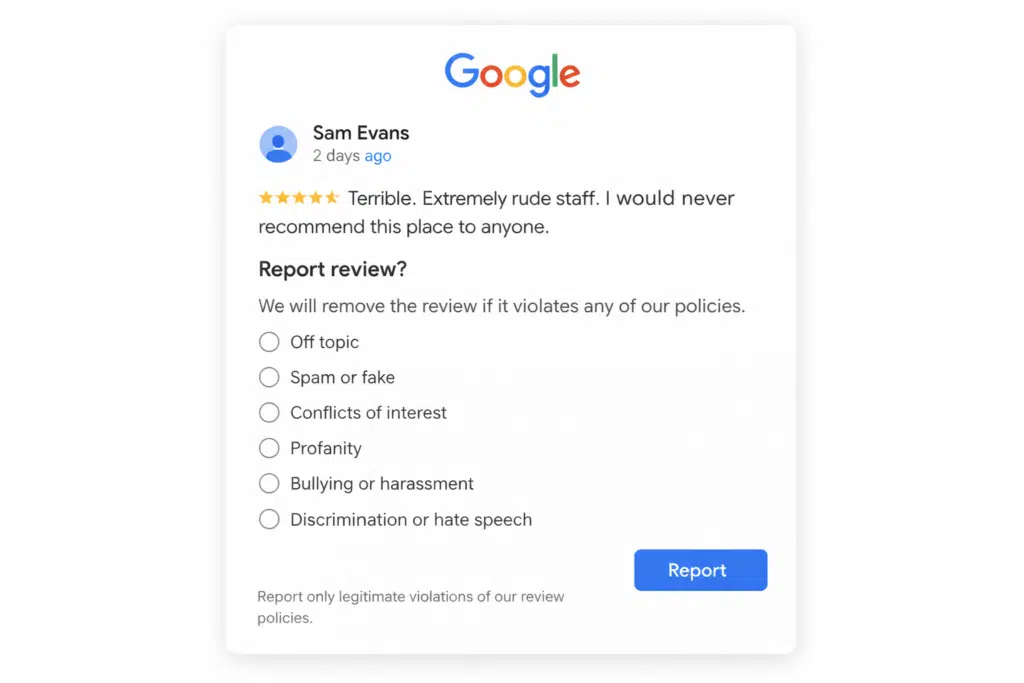
Can a business remove a Google review by itself?
No. Businesses cannot delete Google reviews on their own. Google reviews belong to the users who write them. Even verified business owners do not have administrative control over customer reviews. This applies regardless of whether the review is unfair, inaccurate, or emotionally charged. Searching for technical shortcuts or third-party “review removal services” is risky and often leads to policy violations or account penalties.
When is it possible to get a Google review removed?
A Google review can only be removed if it violates Google’s review policies. Valid reasons for removal include:
- Spam or fake reviews
- Reviews posted by competitors or ex-employees
- Hate speech, threats, or harassment
- Illegal or explicit content
- Reviews unrelated to the business
- Multiple reviews from the same account
- Bot-generated or coordinated attacks
If a review clearly falls into one of these categories, you can flag it for removal through Google’s review management tools. Google will then evaluate the content and decide whether it violates policy. Removal is not guaranteed, even in legitimate cases.
Please also see: https://reviewance.com/how-to-get-rid-of-bad-google-reviews-the-right-way/
Why most Google review removal requests Fail
Most removal requests fail because the review does not violate policy. Common examples of reviews that cannot be removed:
- Negative opinions
- Complaints about pricing
- Poor service experiences
- Emotional or harsh language without abuse
- One-star ratings with minimal explanation
Google protects the right of users to share subjective experiences, even if businesses disagree with them.
Is reporting a Google review always worth trying?
If a review clearly violates policy, reporting it is appropriate. However, repeatedly reporting reviews that do not violate policy can:
- Waste time
- Delay effective reputation management
- Create frustration without results
A smarter approach is to treat removal as an exception, not a strategy.
What should I do if I cannot get a Google review removed?
If a review cannot be removed, the correct response is to manage it rather than fight it. Google itself encourages businesses to:
- Respond professionally
- Clarify misunderstandings
- Demonstrate accountability
- Show future customers how issues are handled
A well-written response often reduces the impact of a negative review more effectively than removal would.
How can responding to reviews reduce their impact?
Public responses are visible to everyone reading your reviews. A calm and professional reply:
- Signals credibility
- Builds trust with future customers
- Shows transparency
- Demonstrates customer care
Many users read responses more carefully than the original complaint.
Is there a way to “bury” a bad Google review legally?
The only policy-compliant way to reduce the visibility of a bad review is to receive more genuine, recent reviews. As new reviews are added:
- Older reviews become less prominent
- Average ratings stabilize
- One-off negative experiences lose influence
This is not manipulation. It reflects real customer volume and ongoing activity.
Please also see: https://reviewance.com/how-to-get-a-link-for-google-review/
Why review volume matters more than review deletion
A single negative review is far more damaging when:
- A business has very few reviews
- Most reviews are outdated
- Feedback appears inconsistent
The same review becomes insignificant when surrounded by dozens or hundreds of recent, positive reviews. Google’s system is designed to reflect patterns, not isolated incidents.
How can businesses get more Google reviews the right way?
Ethical review collection focuses on accessibility, not persuasion. Best practices include:
- Asking all customers equally
- Asking immediately after service completion
- Making the process simple
- Never offering incentives
- Never filtering unhappy customers
Most customers are willing to leave a review if the effort required is minimal.
Why Understanding Review Removal Policy Is Only Half the Battle
Many business owners approach bad reviews with one question: “How do I get this review taken down?” The truth is that while Google does allow review removal under specific circumstances — such as spam, hate speech, or policy violations — most negative reviews do not meet removal criteria. They are simply opinions, and Google protects opinions under its content policies. Understanding this distinction is essential for SMB owners before they invest time and energy in aggressive removal attempts.
The first step is to recognize that removal policies are designed to protect authentic expression, not subjective dissatisfaction. This means that while a genuinely defamatory statement or clearly fake review might qualify for removal, a genuine customer expressing mild discontent usually does not. Misinterpreting the policy may lead business owners to waste time flagging or appealing reviews that will inevitably stay. Instead, focusing exclusively on removal can distract from the real work of improving customer experience and reputation.
For small business owners, the danger of over-emphasizing removal is psychological as well as operational. When owners fixate on deletion, they often overlook patterns in feedback that might help them improve products, services, or processes. A bad review can be an opportunity for insight. Even if it stays, how you respond to it — publicly and professionally — signals far more about your business to prospective customers than the review itself ever could.
When a Bad Review Can and Should Be Removed (and When It Shouldn’t)
Not every bad review should be flagged. Knowing when to pursue removal and when to let it stand is a strategic judgment that separates savvy business owners from frustrated ones. Reviews that clearly violate Google’s policies — such as violent content, discriminatory language, spam, impersonation, irrelevant content, or conflicts of interest — should absolutely be flagged for removal. Google’s removal process is designed to be straightforward in these cases, and well-documented violations stand a good chance of being taken down.
However, reviews expressing personal dissatisfaction (e.g., “The service was slow,” “I didn’t like the food”) do not typically qualify for removal. Trying to force removal in these cases can backfire. Google frowns on repetitive flags and can even penalize businesses that engage in coordinated flagging without cause. Rather than focusing only on removal, it’s wiser to combine a clear public response strategy with a broader review acquisition strategy. A balanced approach preserves trust and demonstrates professionalism.
For SMB owners, this means treating review removal as a tool — not the central strategy. Use it when there is a clear policy violation and document why, but do not treat it as a default option for any unfavorable review. Instead, adopt a mindset that incorporates improvement, response, and strategic accumulation of positive feedback as the pillars of long-term reputation management.
How Reviewance helps reduce the need to remove reviews
Reviewance is a QR-based review and feedback system designed to help businesses collect more Google reviews in a simple, compliant, and scalable way.
Businesses can register in the system in just a few minutes. Once the setup is complete, Reviewance automatically generates unique QR codes for the business. These QR codes can be placed at relevant touchpoints such as checkout counters, tables, reception desks, invoices, or digital screens.

Customers can scan the QR code at any time and are guided directly to the correct Google review flow. Because the system works 24/7 and removes the need for searching or manual navigation, it significantly increases the number of completed reviews.
By consistently collecting a high volume of recent, genuine reviews, businesses can naturally reduce the visibility and impact of older or unwanted reviews without attempting to remove them. This approach aligns fully with Google’s policies, as it does not influence review content, ratings, or customer selection. It simply makes the review process accessible and frictionless.
As a result, Reviewance helps businesses focus less on trying to remove reviews and more on building a strong, current, and resilient review profile over time.
Can more reviews replace review removal?
In practice, yes. While you may not be able to remove a specific review, you can reduce its impact to near zero by maintaining a steady flow of new reviews. A business with:
- 8 reviews and 1 negative comment appears risky.
A business with:
- 300 reviews and the same comment appears normal and trustworthy.
The review still exists, but it no longer defines the business.
Should I ever ignore a review I want removed?
No. Ignoring reviews signals disengagement. Even if a review feels unfair, a thoughtful response demonstrates professionalism and reassures potential customers. Silence often damages perception more than the review itself.
How should businesses think about Google review removal long term?
Google review removal is not a reliable or scalable strategy. A sustainable approach includes:
- Monitoring reviews regularly
- Responding consistently
- Understanding Google’s policies
- Collecting reviews continuously
- Using tools that reduce friction for customers
Reputation management is about resilience, not control.
Final thoughts on how to get a Google review removed
In most cases, you cannot get a Google review removed unless it clearly violates policy.
What you can do instead is:
- Respond professionally
- Follow Google’s rules
- Increase review volume
- Focus on recent, genuine feedback
- Build a strong review profile over time
When managed correctly, even negative reviews become less threatening and sometimes even beneficial.