
Bad Google reviews are not just a reputation issue. They are a signal. Sometimes they point to real problems. Sometimes they reflect a mismatch of expectations. And sometimes, despite doing everything right, they still happen. Especially for the last one, you may wonder how to get rid of bad Google reviews. The mistake many businesses make is trying to “remove” bad reviews directly. In reality, the most effective way to get rid of bad Google reviews is not deletion, but prevention, response, and dilution through strong positive feedback.
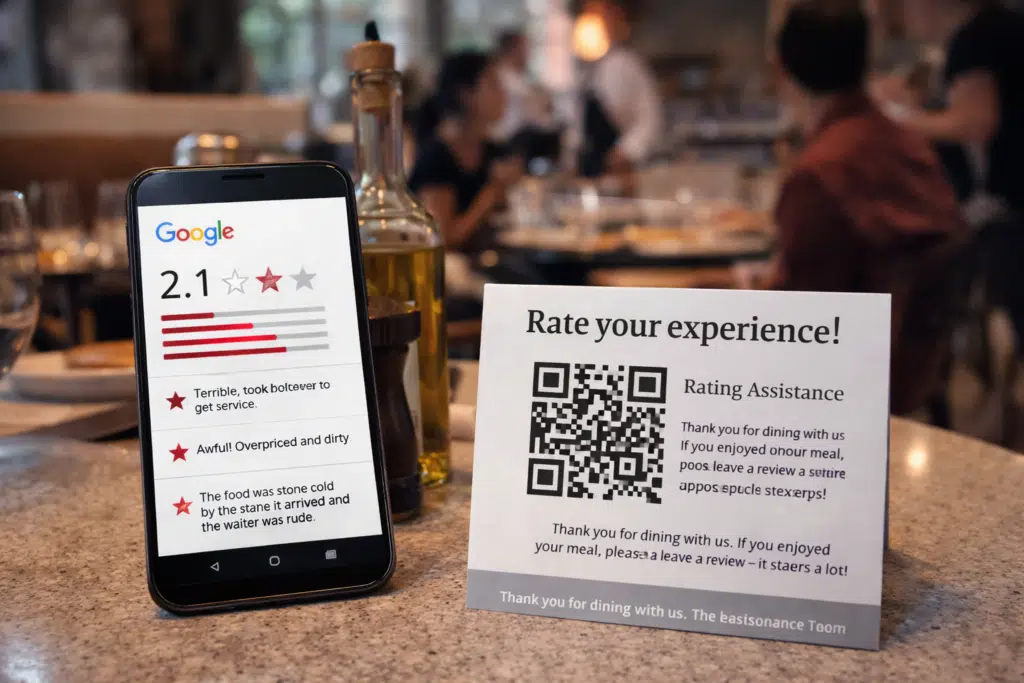
This article explains the correct, sustainable approach.
Start With What Actually Creates Reviews: The Experience
Before talking about responses or systems, one thing must be clear.
No review strategy can compensate for weak fundamentals. Google reviews are written about experiences, not intentions.
For food and hospitality businesses especially, the first priority is operational discipline.Food quality must be consistent, not exceptional one day and average the next. Service quality must be calm, respectful, and predictable. Hygiene must be visibly taken seriously, not just practiced behind the scenes. Customers notice clean restrooms, tidy tables, and staff habits more than owners realize.
Beyond the basics, environment plays a major role. Lighting that is too harsh increases stress and shortens visits. Poor acoustics or loud background music reduces comfort and makes conversations difficult. Temperature, seating comfort, and spacing between tables all influence how forgiving a customer will be if something goes wrong.
When these elements are managed well, bad reviews already become rare. But they never disappear entirely.
Accept the Reality: Even Good Businesses Get Bad Reviews
A single bad review does not mean your business is failing.It means expectations and perception did not align for one customer at one moment.What matters is how you respond.
- Ignoring bad reviews signals indifference.
- Arguing with customers signals defensiveness.
- Copy-paste apologies signal insincerity.
The correct response follows three principles: First, acknowledge the experience without validating exaggeration.Second, take responsibility where appropriate, without admitting to things that are not true. Third, show willingness to fix the issue offline.
A good response is calm, brief, and human. It is written for future readers, not just the reviewer. Google reviews are public conversations. Most potential customers read how you handle criticism more carefully than the criticism itself.
Handled well, even a negative review can build trust.
Why Deleting Bad Reviews Is the Wrong Goal
Many business owners search for ways to “remove” bad Google reviews. In reality, Google removes reviews only in very limited cases: spam, hate speech, fake accounts, or policy violations.Most negative reviews stay. The real objective is not removal. It is impact reduction.
When a business has only a few reviews, a single negative one dominates perception. When a business has dozens or hundreds of recent, genuine, high-rating reviews, the same negative review becomes background noise.
This is where strategy matters.
Please also see: https://reviewance.com/how-to-get-a-google-review-removed/
The Only Sustainable Solution: More High-Quality Positive Reviews
Google’s ranking and visibility algorithms strongly favor businesses that receive:
- A high volume of reviews
- Consistently high ratings
- Recent activity
- Diverse customer feedback
One or two bad reviews cannot compete with a steady stream of authentic positive ones. The challenge is not convincing customers to leave reviews. The challenge is making it easy and timely when customers already feel satisfied. This is where structured review systems become critical.
Please also see: https://reviewance.com/can-i-buy-google-reviews-yes-but-instead-use-this-method/
How a Strong Review Baseline Prevents Bad Reviews From Gaining Traction
Many business owners mistakenly assume that bad Google reviews retaliate for a single mistake. The reality is more nuanced. A solitary negative review has psychological weight only when your overall review profile is weak or unbalanced. If most of your reviews are recent and positive, a single bad review simply becomes one data point in a broader narrative — not a defining judgment on your business.
Establishing a strong baseline of reviews does two things: it builds trust with potential customers, and it acts as a buffer against occasional negative feedback. When prospective customers browse your profile and see a solid sequence of recent high ratings, their perception remains positive even if one review dips. This phenomenon is supported by both human psychology (confirmation bias toward patterns) and search algorithms (which weigh review velocity and consistency).
For SMBs, a strong review baseline serves as digital credibility capital. It frees you from overreacting to one-off criticisms and allows you to focus on continuous improvement. Bad reviews will always happen; what matters is that they don’t disproportionately shape perception. With a balanced and consistent stream of positive reviews, bad experiences become a footnote rather than a headline.
Turning Negative Feedback into Operational Insight
When a negative review arrives, it’s tempting to see it only as a reputation issue. But for SMBs that embrace continuous improvement, negative reviews can actually be a source of insight. A thoughtful approach to bad feedback involves not just responding online, but also asking whether there is a pattern in the critique — are customers consistently highlighting the same problem area? If so, that’s actionable data.
Not every bad review is valid, but patterns in feedback rarely lie. If multiple customers mention slow service, unclear directions, or hygiene issues, there is a process issue worth investigating. This is where small business owners often miss the opportunity: they respond publicly but fail to close the loop internally. Teams should treat recurring themes as signals, not noise, and adjust operations accordingly.
Equally important is communication. When customers see that you have taken their feedback seriously — whether by improving a service step, retraining staff, or tweaking your environment — future reviews start reflecting those changes. Turning negative feedback into operational improvements doesn’t just reduce bad reviews; it elevates the entire customer experience.
How Reviewance Helps Neutralize Bad Google Reviews
Reviewance is designed around a simple but powerful idea:
customers are most willing to leave a review at the moment they feel satisfied — not later, and not after being reminded multiple times. Instead of relying on verbal requests or generic follow-up messages, Reviewance enables businesses to present a clear, immediate path to leaving a Google review at the right emotional moment.
When customers enjoy the food, service, and environment, Reviewance helps capture that positive sentiment before it fades. This results in:
- More reviews overall
- Higher average ratings
- Faster accumulation of recent positive feedback
- If you want, you may get private feedback from your customers.
As positive reviews increase in number and frequency, the relative visibility of bad reviews decreases. They move lower in the list, carry less emotional weight, and lose influence over purchasing decisions.
Importantly, this does not manipulate reviews. It simply removes friction at the right time.
Turning a Weakness Into a Strength
When a business combines:
- Strong service and product quality
- Clean, comfortable, well-designed environments
- Calm, professional responses to criticism
- A reliable system for collecting positive reviews
- An optional private feedback mode
Bad Google reviews stop being a threat. They become context. Customers do not expect perfection. They expect honesty, consistency, and care. A business with many positive reviews and a few well-handled negative ones appears more trustworthy than a business with only a handful of perfect scores.
The Long-Term Solution to Bad Google Reviews
You do not get rid of bad Google reviews by fighting them. You get rid of their power by outperforming them.
Fix what can be fixed.
Respond where necessary.
Then build a steady flow of genuine positive reviews that reflects the real quality of your business.
That is how bad reviews disappear — not from the platform, but from relevance.