
Google reviews play a decisive role in how customers discover, trust, and choose local businesses. As competition increases, simply delivering a good experience is no longer enough; businesses must also make it easy for satisfied customers to leave a review at the right moment.
This is where Google review cards come in. However, not all review cards work the same way, and choosing the wrong one can result in low engagement, wasted money, or even customer frustration. This article breaks down all major types of Google review cards, explains their strengths and limitations, and shows how to select the most effective solution for your business.
What Is a Google Review Card?
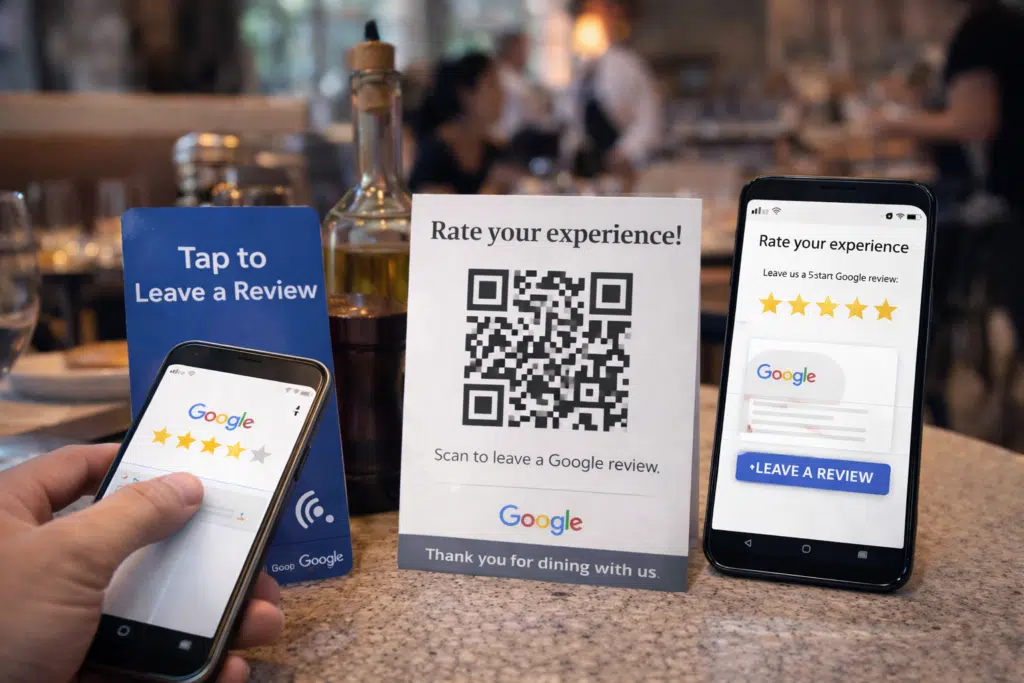
A Google review card is a physical or digital tool designed to guide customers directly to a business’s Google review page. Its purpose is simple: reduce friction between customer satisfaction and action. Most review cards rely on one of three technologies: QR codes, NFC (Near Field Communication), or tap-based smart cards. Some systems combine these methods, while others go further by adding analytics, control, and scalability.
Please also see: https://reviewance.com/make-your-google-review-card-easily-only-3-minutes/
QR Code Review Cards
QR code review cards are the most common and affordable option. Customers scan a printed QR code with their phone camera and are redirected to a Google review link.
Advantages:
QR codes are inexpensive, easy to print, and universally compatible with modern smartphones. They work well in casual environments and require no special hardware.
Limitations:
They rely entirely on customer initiative. If the card is poorly designed, badly placed, or forgotten at the table, it becomes invisible. QR codes also offer no insight into usage or performance. QR cards are best for very small businesses or early-stage operations with minimal review volume goals.
NFC Review Cards (Tap Cards)
NFC review cards allow customers to tap their smartphone on the card to open a Google review page instantly. These are often called “tap cards” or “smart review cards.”
Advantages:
They feel modern and effortless. No camera, no scanning, just a tap. This simplicity often increases conversion rates compared to QR codes.
Limitations:
Not all phones have NFC enabled by default. Some customers hesitate to tap unfamiliar cards. NFC cards are also more expensive and still provide little to no data on effectiveness.
NFC cards work well in tech-aware environments but can underperform in mixed-age customer bases.
Combined QR + NFC Review Cards
Some businesses use cards that include both a QR code and NFC functionality. This ensures compatibility regardless of device type.
Advantages:
They reduce friction by offering two access methods and increase the chance that at least one will work for the customer.
Limitations:
They still depend on physical placement and timing. Without a broader system, these cards remain passive tools with no optimization or measurement.
This option is often seen as a middle ground, but it does not solve the core issue of consistency at scale.
Table Stands, Stickers, and Payment-Area Cards
Beyond format, placement matters. Review prompts can appear as table tents, window stickers, receipt inserts, or counter displays.
Advantages:
High visibility when placed correctly, especially at checkout or payment moments.
Limitations:
Overexposure can feel pushy. Poor timing can break the emotional flow of the experience. Static placements cannot adapt to different customer journeys. These are useful supplements but weak as standalone strategies.
Digital-Only Review Links
Some businesses rely solely on digital links sent via SMS, email, or messaging apps after the visit.
Advantages:
No physical materials required. Easy to automate.
Limitations:
Timing is often wrong. Messages arrive when the emotional connection has faded. Open and conversion rates are typically low unless the brand already has strong loyalty. Digital-only approaches struggle to compete with in-the-moment prompts.
How to Choose the Best Google Review Card
The best review card is not defined by technology alone. It depends on four factors:
First, timing. The customer must encounter the review option when satisfaction is high.
Second, simplicity. One clear action works better than multiple explanations.
Third, visibility without pressure. The option should be obvious, not intrusive.
Fourth, scalability. As review volume grows, the system should remain manageable.
Most traditional review cards fail on the last point.
Why Placement and Timing Matter More Than Card Type
Once you understand the different types of Google review cards — NFC, QR, tap cards, stickers or table tents — the next question becomes: Where and when should you use them? For small businesses, the effectiveness of a review card depends far more on placement and timing than on whether it’s NFC or QR. A beautifully designed card that never gets noticed does nothing for review conversion.
Placement should coincide with moments when customers are already thinking about their experience. For restaurants, this may be immediately after the bill is presented or when a party leaves compliments for the staff. In retail, it may be at the receipt counter, near the exit, or on packaging where the customer is already holding something positive. Wherever customers are already mentally closing the experience, that’s where the review prompt should be.
Timing also matters. A card presented too early — before a customer has fully processed satisfaction — may be ignored. A card presented too late — when the customer is already disengaged — isn’t effective either. Smart placement and timing create a natural flow, turning satisfied moments into review actions. This behavioral optimization often outweighs the technical differences between card types.
Common Mistakes Businesses Make With Review Cards (And How to Avoid Them)
Many small business owners assume that review cards are a “set and forget” tool: print them, place them, and expect reviews to pour in. In reality, this approach often leads to cards going unnoticed, being discarded, or even creating annoyance. One common mistake is placing cards in areas with low foot traffic or where customers are focused on other tasks, like bathrooms or storage corners.
Another frequent error is poor design and unclear calls to action. If a card doesn’t clearly communicate the next step — for example, “Scan here to leave a Google review” — customers may not understand what you want them to do. Adding industry jargon or too much text can also confuse customers. A clear, simple message optimized for intended behavior reduces hesitation and increases participation.
Review cards also fail when they aren’t part of a bigger review strategy. Some businesses distribute cards only at random times or without any follow-up cues, relying solely on chance. Effective card use requires consistent placement, staff awareness that encourages gentle direction, and systems that reinforce the behavior over time. Addressing these common pitfalls helps SMBs get far better results from their review card efforts.
Please also see: https://reviewance.com/how-to-get-rid-of-bad-google-reviews-the-right-way/
Why Reviewance Goes Beyond Traditional Review Cards
Reviewance is not just a review card. It is a structured review acquisition&management system.
Instead of relying on a single physical object, Reviewance combines smart touchpoints with intelligent timing and centralized control. Customers are shown where and how to leave a review precisely when they feel ready, without being verbally pushed or disrupted.
Unlike basic QR or NFC cards, Reviewance allows businesses to:
- Generate a steady flow of high-quality reviews
- Increase average ratings through volume and consistency
- Reduce the impact of occasional negative reviews
- Maintain visual and brand consistency across locations thanks to ready-designed QR codes
- Scale review collection without operational friction
The key difference is intent. Traditional review cards wait for customers to act. Reviewance aligns with customer behavior and removes hesitation at the right moment.
Final Takeaway
QR cards, NFC cards, and tap cards all have their place. For small-scale or low-frequency use, they can be sufficient. However, businesses that depend on online reputation for growth need more than a card. They need a system that understands customer psychology, timing, and scale.
Choosing the best Google review solution is not about hardware. It is about making positive experiences visible, actionable, and repeatable.
That is where traditional cards end—and smarter systems begin.