In today’s local search and reputation landscape, reviews aren’t just feedback — they’re measurable competitive intelligence. Most business owners focus on star ratings and review counts, but they often miss how those reviews compare to nearby competitors. That’s where Reviewmeter a Google Review Calculator from Reviewance comes in: a smarter way to calculate your review strength and competitive position.
What Is a Google Review Calculator?
A Google Review Calculator is a tool that goes beyond merely tallying stars and counts; it provides a clear picture of how many reviews and what review quality a business needs to reach its goals or compete locally. Many basic calculators let you input your rating and target star score to estimate how many new positive reviews you need to climb to that score. These tools help set goals and plan review-generation strategies.
But Reviewmeter is more than a basic calculator.
Introducing Reviewmeter — A Competitive Google Review Calculator
Reviewmeter, developed by Reviewance, acts like a Google Review Calculator with competitive benchmarking built in. Instead of simply estimating how many reviews you need to improve your average score, it analyzes real Google Business Profile data for your business and nearby competitors.
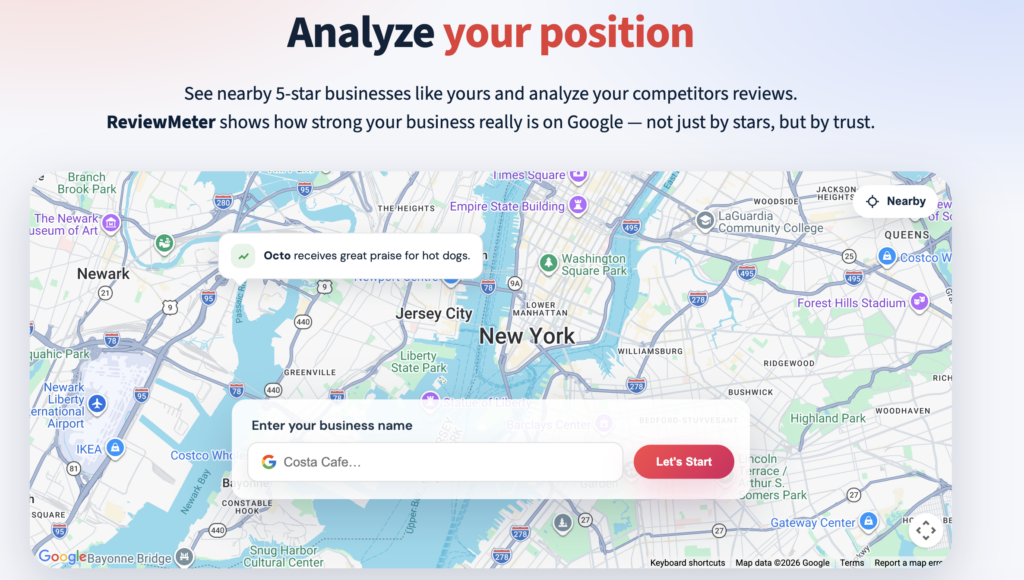
Using Reviewmeter, you can:
- See your current review signals — average rating, total reviews, and review recency.
- Compare your profile strength directly with competitors in your area.
- Understand not just how many reviews you have, but how powerful those reviews are relative to similar local businesses.
- Identify opportunities for improvement and prioritization.
Because recent reviews and competitive positioning are increasingly important for local SEO and visibility, a tool like Reviewmeter gives context — not just raw numbers.
How Reviewmeter Works
Reviewmeter aggregates and analyzes key review signals from Google Business Profiles:
1. Star Rating and Review Volume
The average rating (e.g., 4.2 stars) tells you how customers perceive your business overall. Total reviews indicate social proof and trust. This foundational review data is similar to what other Google review calculators use when projecting growth paths.
2. Review Recency
Google and customers both value recent reviews more heavily than older ones. Businesses that show frequent new feedback tend to rank higher and attract more clicks. Review recency influences perceived relevance.
3. Competitor Benchmarking
Reviewmeter doesn’t just look at you in isolation — it collects review signals from nearby businesses in the same category. This benchmarking allows you to see how you stack up locally, what score ranges competitors are achieving, and where you lag.
4. Relative Review Strength Score
Reviewmeter combines these metrics into a comparative score that reflects the relative strength of your review presence. Instead of guessing where you stand, you get data-driven insights into your local reputation ecosystem.
Why Review Quantity and Quality Must Be Balanced
Many business owners fixate on the total number of reviews as if that single figure determines everything. But search algorithms and human psychology both value a balance between quantity and quality. A business with hundreds of average reviews might still lose out to one with fewer but more recent, high-rating ones. It’s not just how many people commented — it’s how good and how relevant their feedback is.
Review quality matters because it reflects real customer experiences. Detailed reviews that mention specific aspects — like punctual service, product excellence, or welcoming staff — carry much more weight than generic “Good place” comments. These rich signals are interpreted by search algorithms as stronger indicators of customer satisfaction, and by prospective customers as more trustworthy. A high average rating paired with substantive comments builds confidence far more than a high count alone.
For smaller businesses, this balance is especially important. SMBs often serve fewer customers than larger brands, so each individual review carries proportionally more influence. Rather than chasing sheer numbers, focusing on encouraging meaningful, high-effort reviews often yields better local rankings and trust signals than simply pushing for volume.
How Review Velocity Reflects Business Momentum
Velocity refers to how frequently new reviews are coming in over time — not just how many you have accumulated. In many local search algorithms, review velocity plays a crucial role in ranking. A steady stream of recent reviews tells the search engine that your business is actively engaging customers and consistently delivering experiences worth talking about.
For SMBs, the challenge is not just generating reviews sporadically, but doing so consistently. A burst of reviews during a single promotion might create a temporary spike, but algorithms tend to favor sustained momentum. This means creating systems and habits where satisfied customers regularly share feedback, rather than relying on occasional flurries.
From a customer perception standpoint, review velocity also shapes credibility. A business with recent reviews signals relevance and freshness — customers see that others visited and were pleased just days or weeks ago. In contrast, a profile dominated by years-old reviews suggests stagnation, which can reduce trust even if the average rating is high.
Why Competitive Review Insights Matter
Simple review calculators can tell you how many additional 5-star reviews might boost your star average. But a pure number target doesn’t account for local competition. If your competitors have higher average ratings, more recent reviews, or simply more volume, your ranking and visibility in local search can be limited — even if your own rating is respectable.
- By establishing a benchmark with neighboring businesses, Reviewmeter helps you:
- Set practical review goals based on the competitive landscape.
- Identify whether you should focus on volume, recency, or rating improvements.
- Prioritize review and reputation-management efforts where they matter most.
Who Should Use Reviewmeter
Reviewmeter is ideal for:
- Local businesses seeking to outrank competitors in Google Maps and Search.
- Franchise owners comparing multiple locations.
- Marketing teams responsible for reputation strategy.
- SEO professionals who need quantitative insights beyond basic review counts.
Rather than guessing or relying on intuition, Reviewmeter gives you a data-driven Google Review Calculator and competitive scorecard.