Local SEO today is no longer about simply having a Google Business Profile. Visibility in local search and Google Maps is driven by how Google evaluates real-world trust, user satisfaction, and competitive positioning. At the center of this system sit Google reviews—not as decoration, but as one of the strongest signals of local prominence.
Businesses that consistently rank at the top of Maps results understand one fundamental truth: reviews influence both how Google ranks you and how users choose you.
How Google’s Local Ranking Mechanism Works
Google determines local rankings using three primary dimensions: relevance, distance, and prominence. While relevance and distance are often constrained by category and geography, prominence is dynamic and competitive.
Prominence reflects how well-known and trusted a business appears based on observable signals. Reviews are among the most influential of these signals because they are generated by real customers and updated continuously.
Google evaluates reviews across several dimensions simultaneously, including total volume, average rating, freshness, linguistic content, and behavioral engagement. A business with ongoing, recent reviews typically outperforms one with a higher rating but stagnant activity.
The Role of Reviews in Google Maps Rankings
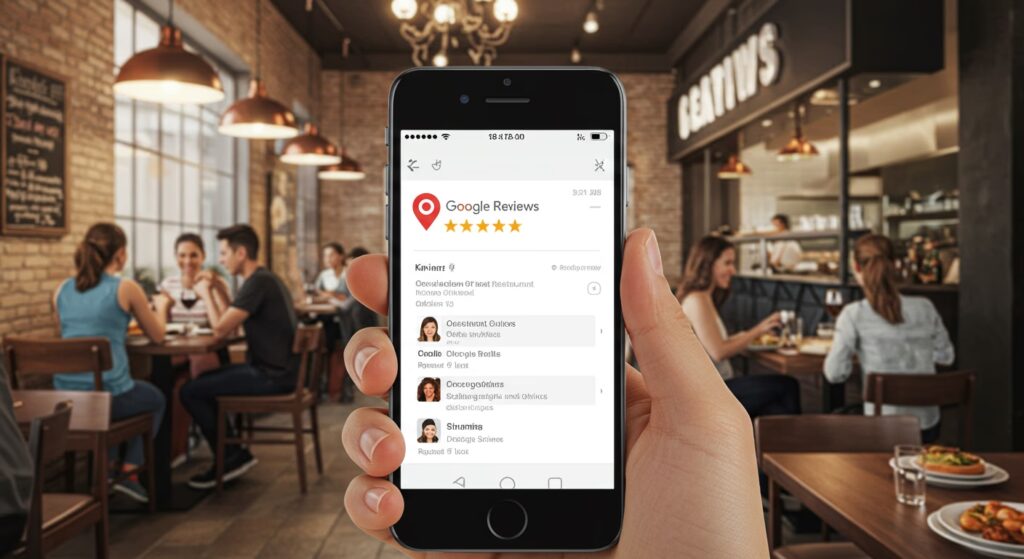
Google Maps is where reviews exert their strongest influence. In Maps results, reviews are not just persuasive—they are structural ranking inputs.
In practice, businesses that rank consistently in the local 3-pack tend to show:
- A review volume that matches or exceeds nearby competitors
- Continuous review activity rather than one-off campaigns
This explains why many businesses struggle to move up despite solid services or websites. The limiting factor is often review momentum, not technical SEO.
Review Quality and Consistency Matter More Than Perfection
Google does not reward only five-star ratings. It rewards credibility. Reviews that describe specific experiences, services, or outcomes help Google understand what the business actually does and how customers perceive it.
Equally important is review velocity. Google favors businesses that receive reviews steadily over time. Sudden spikes followed by long inactivity can dilute trust signals instead of strengthening them.
Consistency communicates legitimacy.
Why Local Search Signals Matter More Than You Think
For many small business owners, Google reviews are seen mainly as “stars” and “comments,” but their real value goes much deeper. Reviews are one of the strongest local search signals Google uses to evaluate how relevant and trustworthy a business is for nearby customers. In simple terms, reviews help Google understand not just who your business is, but whether people in your community actually value what you offer.
Imagine two businesses in the same neighborhood with identical services and similar keywords on their sites. If one business has dozens of fresh, positive reviews and the other has none, Google is far more likely to put the first one higher on the local map. This is not about manipulation — it’s about relevance. Reviews act as ongoing, real-world endorsements that signal sustained customer satisfaction.
For SMBs with limited marketing budgets, this means that local SEO isn’t just about on-page optimization or citations — it’s about community validation. Every review tells Google that your business matters to real people nearby. Understanding this shifts the focus from vanity metrics like “total stars” to strategic metrics like review recency, velocity, and diversity — all of which influence your local rank.
How Review Diversity and Freshness Influence Local Rankings
When Google evaluates reviews for local ranking, it doesn’t just count stars. It looks at how recently reviews were left, how frequently they occur, and how diverse the reviewers are. Fresh reviews demonstrate that your business is consistently earning feedback — not just a one-time burst. Frequent reviews tell Google that engagement with your brand is ongoing and relevant.
Diversity also plays a role. A steady stream of reviews from a broad range of customers — different devices, locations, and Google accounts — signals authenticity. If all your reviews come from one small group, Google’s local algorithm may discount them in ranking calculations. For SMBs, encouraging diverse feedback requires integrating review prompts throughout the customer journey, not just at one single moment.
Together, freshness and diversity create a dynamic review profile that Google favors. Businesses that understand this can turn mundane review collection into a core part of their local SEO strategy. Instead of passively hoping for reviews, proactive review acquisition aligned with customer experiences can significantly boost local visibility — and that directly leads to more foot traffic, calls, and conversions.
Understanding Local Competition with Reviewmeter by Reviewance
Most businesses evaluate their performance in isolation. They know how many reviews they have but not how that number compares within their local competitive landscape.
Reviewmeter by Reviewance fills this gap by analyzing your position relative to actual local competitors. By entering your business name, Reviewmeter identifies businesses in the same category and location and compares review count, rating, freshness, and sentiment.
Beyond surface metrics, Reviewmeter analyzes competitor reviews themselves. It identifies recurring praise, common complaints, and thematic patterns, then translates these insights into strategic recommendations. This allows businesses to position themselves intentionally rather than guessing how many reviews they “need.”
Turning Insight into Action: How Reviewance Helps You Get Reviews
Competitive insight alone does not generate reviews. Execution does.
Reviewance is built around a simple behavioral reality: customers are most willing to leave a review immediately after receiving a service, when satisfaction is still emotionally present. This is often called the moment of truth.
Instead of asking customers later via email or SMS, Reviewance enables businesses to capture reviews inside the business, at the exact point where the experience concludes.
How the Reviewance In-Store QR System Works
Reviewance provides specially designed QR labels that are placed throughout the business environment. These QR codes are directly linked to the business’s Google review page.
When a customer completes their service or payment, they can scan the QR code with their phone and land instantly on the Google review screen. There is no need to search for the business, type its name, or navigate Google Maps.
The effectiveness comes from timing and placement. QR labels are typically positioned in areas where the interaction naturally ends, such as payment counters, tables, reception desks, or exit points. This makes the review request feel natural and optional rather than intrusive.
Why In-Store Review Collection Outperforms Follow-Ups
Follow-up requests rely on memory. In-store QR review collection relies on immediacy.
When customers are still inside the business:
- The experience is fresh
- The emotional response is intact
- The effort required feels minimal
This leads to higher completion rates and more descriptive reviews, which in turn strengthens both trust and local ranking signals.
The Long-Term Impact on Local Rankings
When Reviewance is used consistently, review growth becomes predictable rather than sporadic. Review freshness improves, review volume increases steadily, and competitive gaps identified by Reviewmeter begin to close.
Over time, Google interprets this pattern as sustained customer validation. Visibility in Maps improves, click-through rates rise, and conversion trust strengthens.
The Strategic Takeaway
Boosting local rankings is not about chasing reviews randomly. It is about aligning customer behavior with Google’s evaluation model.
Google reviews influence:
- Local prominence
- Map positioning
- User trust and choice
By understanding how Google ranks local businesses, analyzing competition with Reviewmeter, and capturing reviews at the moment of truth using Reviewance’s in-store QR system, businesses can move from passive presence to deliberate local growth.