In today’s local-first economy, Google reviews are no longer a side metric or a “nice-to-have.” They are one of the strongest trust signals a business can generate. Long before a customer visits your website, calls your number, or walks through your door, they encounter your reviews. At that moment, decisions are already being made.
Modern consumers rely heavily on the collective judgment of others. This is a direct application of social proof. People assume that if many others had a good experience, the business is likely trustworthy. Research continues to confirm this behavior: the vast majority of consumers read reviews before choosing a local business, and many will not seriously consider a business with weak or sparse reviews.
From Google’s perspective, reviews are not just content; they are ranking signals. In local search, review-related factors contribute meaningfully to visibility, especially in Google Maps and local pack results. These signals include:
- The total number of reviews
- The average star rating
- Review freshness and velocity
- The language and context used in reviews
Together, these elements influence both where you appear and whether users choose you once you appear.
The Real Business Impact of Google Reviews
When business owners ask whether reviews actually bring customers, the answer is yes—but not in a simplistic one-review-equals-one-customer way. Reviews work by increasing confidence, reducing uncertainty, and improving conversion rates across the entire discovery journey.
Industry data consistently shows that improving your average rating by even one star can lead to a measurable increase in revenue. More importantly, businesses with strong review profiles receive:
- Higher click-through rates from search results
- More phone calls directly from Google Business Profiles
- Greater walk-in intent, especially for food, retail, and services
Once a business crosses key psychological thresholds—such as 30, 50, or 100 reviews—it stops feeling “new” or “unproven” and starts feeling established. That perception alone changes customer behavior.
This is why some restaurants and cafés around the world have accumulated thousands of reviews and turned their Google presence into a primary acquisition channel. In major cities, many highly reviewed venues receive a significant portion of their customers from Google discovery alone, without relying on paid ads or social media.
The Hidden Problem: Timing, Not Satisfaction
Most businesses do not lack reviews because customers are unhappy. They lack reviews because the request comes at the wrong time.
Customers are most emotionally engaged immediately after receiving good service. This is the psychological peak of the experience, often referred to as the moment of truth. Yet many businesses ask for reviews later, through emails or messages, when the customer is already back in daily life.
At that point, several things happen:
- Emotional intensity fades
- Attention shifts to other priorities
- The perceived effort of leaving a review increases
Even well-intentioned customers simply forget.
The problem is not motivation.
The problem is delay.
Why Most Review Requests Never Convert
Many business owners believe that simply asking for a Google review is enough. But the truth is that customers are bombarded with requests every day — from apps, services, stores, and online platforms. A simple “please leave a review” often gets ignored not because customers are ungrateful, but because the moment and context are wrong.
Customers are most likely to leave a review when the emotional residue of satisfaction is still fresh. If you ask too early — before the experience fully registers — you interrupt their enjoyment. If you ask too late — after they’ve left and shifted their attention — the intention to review drifts away. For small business owners, mastering this timing can dramatically increase conversion without extra incentives or gimmicks.
Another reason requests fail is lack of clarity. Customers often set out with good intentions, but if the path to the review page is unclear, they simply don’t complete the process. A review request that requires searching, navigating menus, or logging in becomes a task rather than an expression of satisfaction. Understanding these behavioral pitfalls helps SMBs design requests that feel natural and effortless to act on.
Making Reviews Part of the Customer Journey — Not an Afterthought
Viewing review collection as a separate task from the customer experience is a common mistake. For SMBs, the most effective review strategies are integrated, not added on. A review prompt should feel like a continuation of the customer journey, not an interruption. This means considering exactly where and when satisfaction peaks during the interaction.
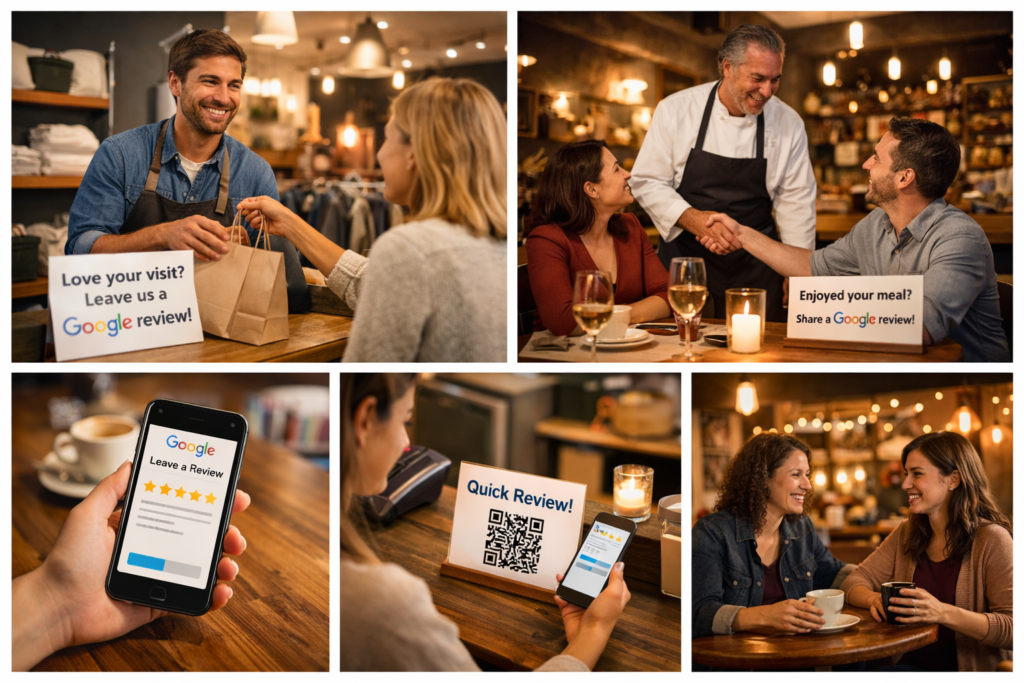
For example, in a restaurant environment, this might be right after the customer compliments the food or settles the bill with a smile. In a retail setting, it might be as they admire a purchase at checkout. In a service business, it could be right after the problem is resolved or the service is completed. The key is identifying the moment of appreciation and aligning your review prompt with it.
Small tweaks in process can make a big difference. Instead of verbal requests in passing, visual cues placed at key touchpoints reduce friction. Digital receipts with embedded review links, QR codes on thank-you cards, or gentle visual reminders at checkout all work better when they are organically attached to the experience. By embedding review opportunities in the flow of the customer journey, SMBs turn passive satisfaction into active endorsements.
Reviewance and Capturing the Moment of Truth
Reviewance is built specifically to solve this timing gap.
Instead of relying on follow-up messages or memory-based requests, Reviewance operates inside the physical business environment. It uses custom-designed QR review labels placed at strategic touchpoints within the venue, such as payment counters, tables, reception desks, or service completion areas.
The system works because it aligns three elements at once:
- The customer has just received the service
- Satisfaction is still emotionally present
- The action required is minimal
When a customer notices the QR label, they scan it and are taken directly to the Google review screen. No searching, no typing, no friction. The entire process takes less than a minute.
Why In-Store QR Reviews Convert Better
The strength of Reviewance is not the QR code itself, but the behavioral design behind it. It removes the three most common blockers to review completion: forgetting, postponing, and inconvenience.
Because the QR labels are placed naturally within the space, the request feels optional rather than intrusive. Customers act because it is easy and timely, not because they feel pressured.
Reviewance also allows businesses to place multiple QR labels throughout the location, increasing visibility while maintaining a consistent experience. Whether the customer scans the code at the table, the counter, or the exit, the system behaves the same way.
From Experience to Social Proof—Instantly
What Reviewance ultimately does is shorten the distance between experience and expression. A positive moment becomes public social proof almost immediately.
This leads to reviews that are:
- More authentic and emotionally accurate
- More detailed and context-rich
- Collected at a faster and more consistent pace
Over time, this creates a stronger, more stable review profile that supports both trust and local search visibility.
Final Perspective
Google reviews are not just feedback. They are long-term assets that compound over time. They influence how customers perceive you, how Google ranks you, and how confidently new customers choose your business.
Reviewance does not change what customers think about your business.
It changes when they act on that thought.
And in competitive local markets, that timing difference compounds into real growth.