Introduction
Reviews are ubiquitous in today’s economy. Whether deciding what hotel to book, which product to buy, or where to eat, consumers increasingly consult digital reviews before deciding. Scientific research shows that online reviews are not just “opinions”; they are social signals driven by deep psychological mechanisms, shaped by personality traits, social influence, cultural norms, and cognitive biases. Reviews influence decisions because they create trust, reduce perceived risk, and provide social proof that substitutes for firsthand experience—far more effectively than traditional advertising.
Why People Write Reviews: Motivations and Predictors
Research using behavioral theories such as the Theory of Planned Behavior and personality frameworks finds that multiple factors predict a person’s intention to provide a review.
Attitude and perceived pressure
People who hold positive attitudes toward expressing an opinion and feel some social pressure to contribute are more likely to write a review. Both neuroticism and conscientiousness from the Big-Five personality traits predict online review intention.
Trust and engagement
Trust in the platform and prior engagement increases the likelihood that a user will write a review. Engagement partially mediates between satisfaction and review intentions, and fully mediates between trust and intention to review.
Discrepancy and ego motives
Experiencing a significant difference between expected and actual experience motivates consumers to write, especially if their own experience was worse than prevailing reviews. This can trigger ego-defensive motives (reducing self-doubt) and the desire to contribute to community knowledge.
Feedback and reciprocity
People are more likely to share knowledge—including reviews—when they expect feedback such as likes or comments. This parallels findings in knowledge sharing that positive social reinforcement increases contribution.
Good Reviews vs. Bad Reviews: Distributions and Prevalence
Academic analyses show that online review distributions are often J-shaped, meaning overwhelmingly positive ratings dominate. This pattern arises not necessarily because experiences are overwhelmingly positive, but due to social psychological processes:
- Conformity pressure: People tend to give ratings that align with existing majority opinions to avoid standing out or being judged negatively. This normative influence pushes ratings toward positive norms.
Despite this positivity bias, negative reviews have disproportionate weight in consumer attention and decision-making:
- Eye-tracking experiments show shoppers fixate longer on negative comments than positive ones, especially female consumers. This aligns with the evolutionary negativity bias, where humans prioritize potential threats or risks in uncertain environments.
- Surveys also find a slight majority of consumers pay more attention to extremely negative reviews than positive ones when making purchase decisions.
Cognitive and Social Mechanisms Behind Reviews
1. Social Proof and the Bandwagon Effect
Reviews serve as social proof, a concept from social psychology where people assume the actions of others reflect the correct behavior in a given context. High volumes of positive reviews signal popularity and lower risk, creating a bandwagon effect that drives adoption.
2. Trust and Credibility
Consumers often trust peer-generated reviews almost as much as personal recommendations and greatly more than advertising. Trust forms when multiple reviewers provide consistent, transparent accounts, and perceived reviewer integrity is a strong predictor of trustworthiness.
3. Negativity Bias
Humans evolved to weigh negative outcomes more heavily than positive ones—a survival advantage in ancestral environments. This bias carries over to reviews: negative information captures more attention and has greater influence than equivalent positive information.
4. Group Identity and In-Group Similarity
Cultural background and group similarity influence how people assess the helpfulness of reviews. People are more influenced by reviewers they perceive as part of their own group or with shared identity traits.
5. Response Bias and Social Desirability
Writing a review is also subject to social desirability bias; people may over-report positive behavior or under-report negative feelings when they think they will be judged. This skews content and complicates interpretation.
The Function of Reviews in Decision Making and Social Support
Online reviews serve multiple social and economic functions:
Reducing risk and uncertainty
In digital marketplaces, buyers cannot physically inspect products. Reviews mitigate this risk by conveying collective experience, lowering perceived uncertainty.
Signalling reputation and accountability
Reviews act as reputation signals in marketplace ecosystems, holding sellers accountable and reducing fraud, thus functioning as decentralized market regulation.
Social support and identity affirmation
Sharing opinions publicly is a form of expressing identity, contributing to community knowledge, and gaining recognition. Positive feedback on reviews reinforces one’s sense of belonging and value.
Evolutionary Perspective
From an evolutionary lens, social learning—observing and adopting behaviors based on others’ experiences—was essential for survival in groups. Digital reviews extend this mechanism:
- Historically humans relied on oral information from others in the tribe about which foods were safe or dangerous.
- Today, reviews function similarly, allowing individuals to avoid costly mistakes (e.g., buying low-quality products) based on peer experience.
- The negativity bias reflects evolutionary priorities: paying more attention to potential threats reduced risk in ancestral environments.
Experiments and Empirical Evidence
Research methodologies to understand online review psychology include surveys, structural equation modeling, and eye-tracking. Key findings include:
- Big-Five personality traits predict reviewer behavior.
- More engaged and trustful users are likelier to write reviews.
- Negative reviews attract more visual attention and cognitive effort.
- Outlier reviews, though rare, can offer disproportionately informative content due to resistance to social conformity.
Top Countries Most Engaged with Online Reviews
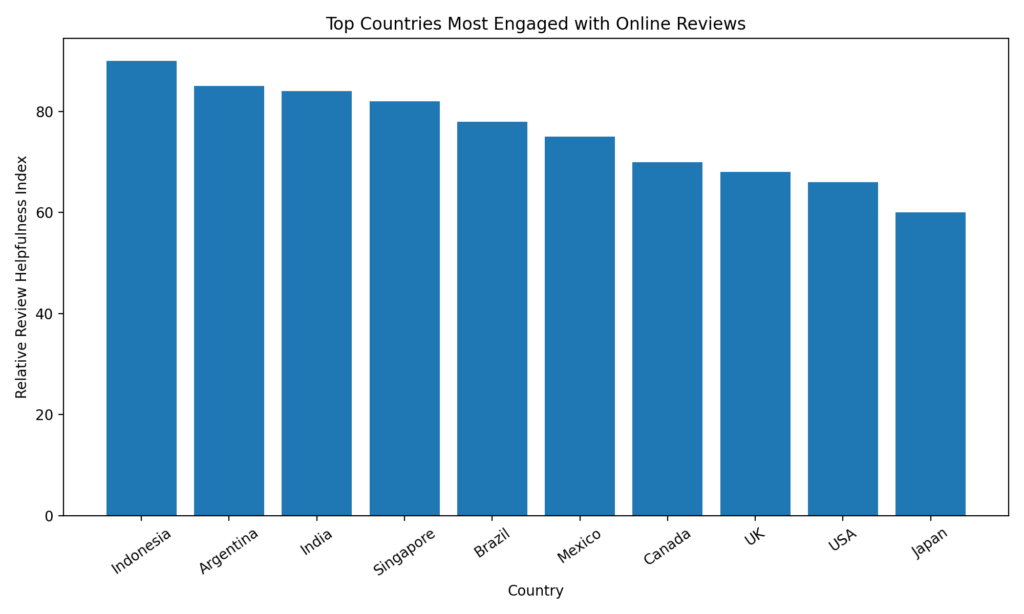
Below is a chart based on data showing consumer engagement with online reviews — specifically, the share of consumers who find online reviews helpful for purchase decisions in multiple countries. This is a proxy for countries most active or receptive to reviews (highest reported consumer engagement).
Sample countries from Statista’s 2025 global survey on review helpfulness indicate:
- Indonesia is the highest in consumers claiming online reviews are very helpful.
- Argentina, India, Singapore, Brazil, and Mexico also rank high.
Note: Exact numeric percentages are behind Statista’s paywall, but the ranking order is indicative. The dataset covers 50+ countries. Indonesia leads.
Chart A: Highest Consumer Engagement with Online Reviews (Helpful Ratings)
Interpretation
Indonesia, Argentina, and India stand out as countries whose consumers most often find online reviews helpful. High engagement usually correlates with heavy review reading and review writing activity.
Top Global Industries That Receive the Most Online Reviews
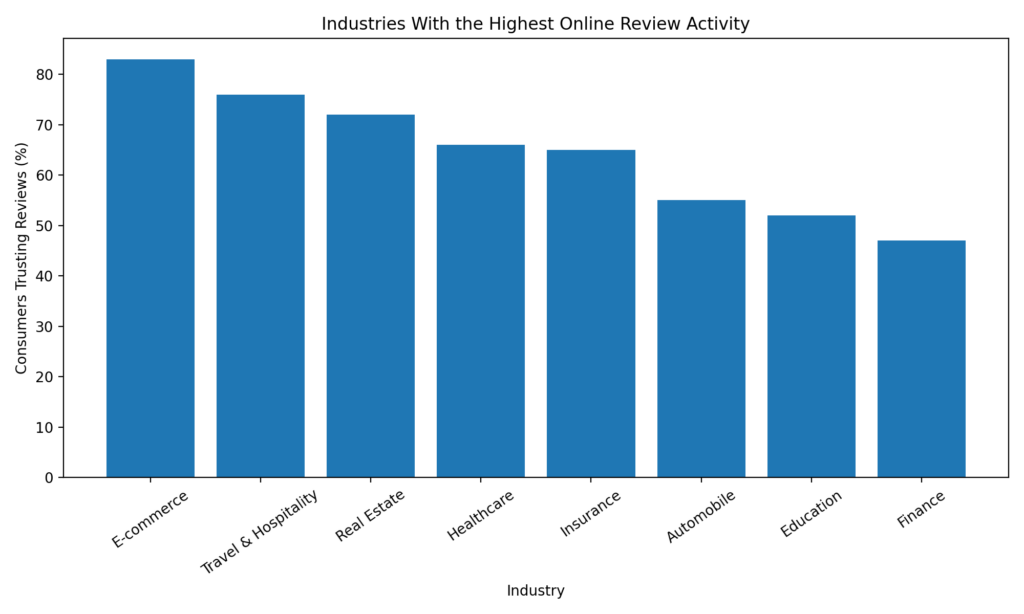
Based on market research survey insights aggregated by Goodfirms (2025–26), we can list the top sectors where customers most commonly check/write reviews:
Top 8 Review-Heavy Industries Globally
- E-commerce (Online Retail) – most checked and reviewed
- Travel & Hospitality (Hotels, Airlines, Tours)
- Real Estate Services
- Healthcare Providers
- Insurance Products / Services
- Automobile (Vehicles & Dealers)
- Education Services
- Finance & Banking
This comes from aggregated business and consumer insights on review importance and consumer behavior.
Chart B: Industries With Highest Review Activity
Source:
https://www.goodfirms.co/resources/online-reviews-consumer-buying-behavior-global-insights
Industries where consumers most frequently read and rely on online reviews before making purchasing decisions.
Most Frequently Reviewed Topics and Themes
Though global datasets with topics ranked globally are not fully public, several large data analyses provide domain signals:
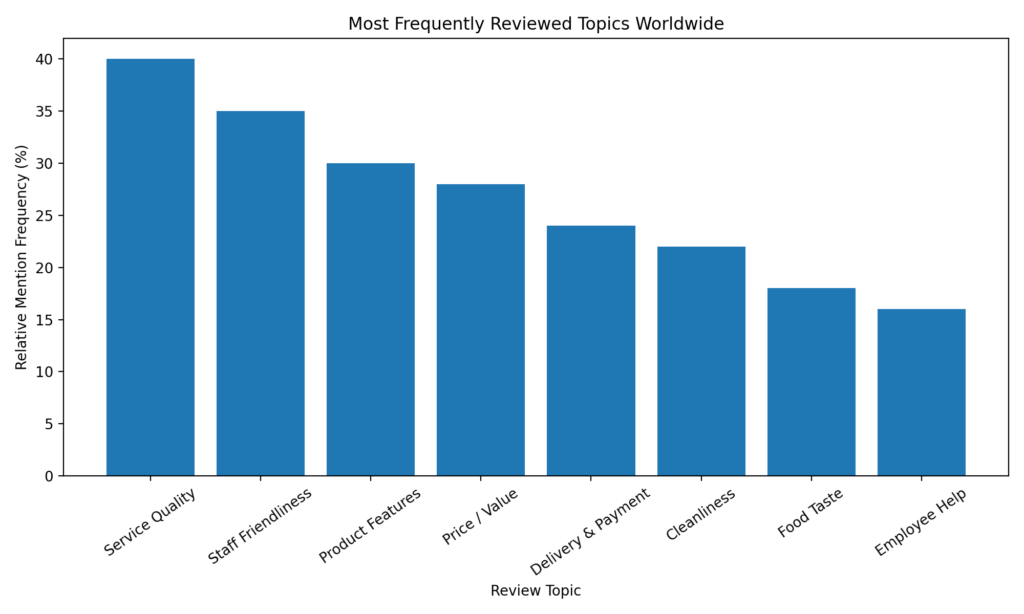
From studies of large review corpora (e.g., Google reviews of small businesses), common review subjects include:
- Service quality and staff friendliness (most cited)
- Price and value comparisons
- Product features and functionality
- Cleanliness and environment (especially in hospitality)
- Delivery and payment experience in ecommerce
For example, a dataset of 1 million Google reviews showed:
- “Staff friendliness” appears among the top mention categories.
- Restaurants have high mentions of food quality/taste.
- Small retailers frequently see feedback on employee helpfulness.
Chart C: Typical Topics Most Mentioned in Reviews (Example from Small Business Analysis)
Source:
https://www.sciencedirect.com/science/article/pii/S0747563210000075
Most common themes mentioned in online reviews across industries, based on large-scale review corpus analysis.
Summary Insights
- Countries with the most intensive review engagement include Indonesia, Argentina, India, Singapore, and Brazil — indicating both reading and likely writing activity.
- Industries where reviews are most pervasive are e-commerce and travel, followed by real estate, healthcare, and insurance — showing review influence beyond consumer goods.
- Common review topics lean toward service quality, pricing, delivery, and employee interaction themes derived from large review corpora.
Reviews vs. Traditional Advertising: The Future of Recommendation
Online reviews have long overtaken traditional advertising in influence for several reasons:
- Reviews carry authentic social proof consistently trusted more than curated ads.
- Reviews serve as user-generated content that reflects real experiences and diverse perspectives.
- Advertising communicates seller interests; reviews are perceived as peer interests.
Looking ahead:
- Artificial intelligence and recommendation engines are increasingly analyzing reviews (text sentiment, behavioral patterns, reviewer reliability) to tailor suggestions.
- As consumers rely more on peer experience, platforms may lean more on review-driven models rather than traditional ads to optimize relevance.
- AI systems can aggregate patterns of reviewer behavior to predict trustworthiness and bias, improving recommendation accuracy.
Conclusion
The psychology of online reviews is a multifaceted field involving personality traits, social influence, trust mechanisms, cognitive biases, and evolutionary heritage. Online reviews have become more influential than traditional advertising because they provide social proof, reduce risk, and build trust. So that every business shold consider using review collection tools like Reviewance. Scientific research shows that while most ratings skew positive due to social conformity, negative reviews carry greater informational weight in decision-making. As digital ecosystems evolve, reviews—and the AI analysis of them—will continue to shape how people choose products, services, and experiences.