
Unlike the "vibe-driven" decision of picking a café, Google reviews for dentist are crucial and choosing a dental clinic is a risk-mitigation exercise. People aren't looking for a "tasty" experience; they are looking for safety, expertise, and the absence of pain.
In this context, a Google Review acts as a Medical Trust Signal that bridges the gap between patient anxiety and clinical credibility.When a potential patient opens Google Maps to search for a dentist, they are rarely looking for "fun." They are looking for reassurance. In the healthcare sector, the psychological weight of a review is far heavier than in any other industry. While a bad café experience results in a bitter cup of coffee, a bad dental experience involves physical pain, high costs, and long-term health implications.
For a modern dental clinic, your Google rating is no longer just a digital "nice-to-have." It is your most critical Medical Credibility Engine.
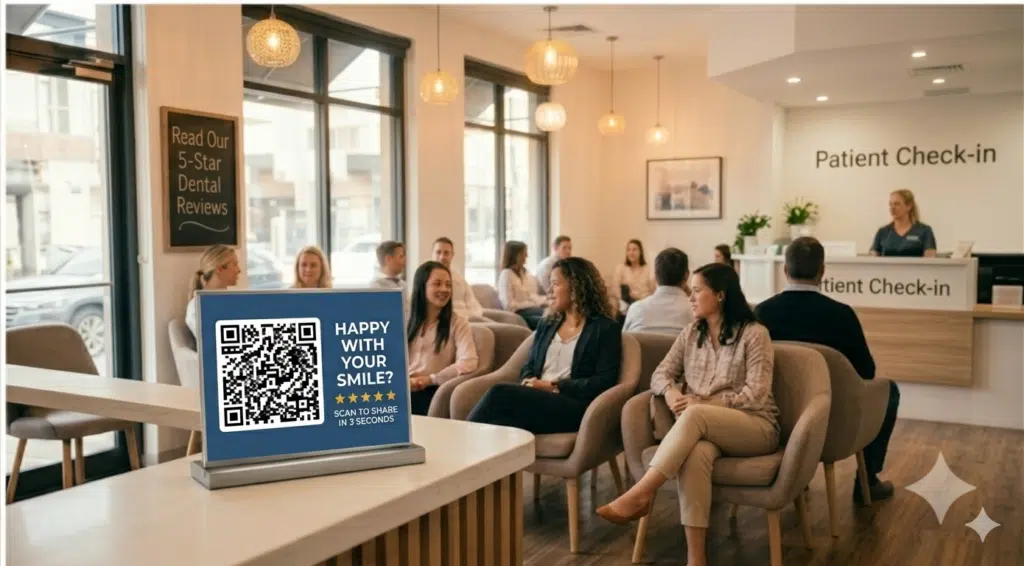
The Psychology of Selection: Social Proof as a Risk-Mitigation Tool
Choosing a dental clinic is a high-involvement, high-anxiety decision. Patients are primarily driven by fear reduction rather than benefit seeking. In this environment, Google Reviews perform a specific set of functions that go beyond simple "social proof":
1. The Eraser of Dental Anxiety (Fear Reduction)
Most patients approach a dental visit with a baseline level of stress. When they see reviews mentioning words like "painless," "gentle," "calm," and "reassured," it lowers the psychological barrier to entry. Your reviews act as a collective voice telling the prospect: "It’s okay, you won't be hurt here."
2. Validation of Clinical Credibility
In the absence of medical degrees hanging on your digital storefront, patients look for treatment outcomes. Reviews that detail successful complex procedures (implants, root canals, smile designs) serve as evidence of your technical skill. For the patient, 500 people vouching for your work is often more persuasive than the diplomas on your wall.
3. Local Intent and Immediate Accessibility
Dental needs are often urgent. When "Local Intent" (searching for an emergency dentist near me) meets high ratings, the decision is made in seconds. High visibility on Google Maps, backed by a strong rating, signals that your clinic is not only nearby but is the safest local choice.
Why Google Reviews Matter for Dental Clinics
In the healthcare sector, particularly for dental clinics, digital reputation is the new "word of mouth." For patients, choosing a dentist is a high-stakes decision involving both financial investment and physical trust. A Google Business Profile (GBP) and a consistent stream of positive reviews are essential for converting local searches into scheduled appointments.
The Impact on the Patient’s Decision Journey
- Trust and Professional Credibility: Unlike choosing a retail store, patients look for a "feeling of security" when selecting a dental provider. A clinic with a high volume of positive reviews immediately signals professional competence and patient safety.
- Local SEO and Map Visibility: When a patient searches for "dentist near me" or "emergency dental clinic," Google’s algorithm prioritizes clinics with high ratings and recent review activity. This is critical for appearing in the "Local 3-Pack" on Google Maps.
- Competitive Advantage: Patients compare star ratings and review counts first. A clinic with hundreds of authentic reviews will almost always be chosen over a competitor with fewer reviews, even if the competitor is closer geographically.
- Keyword-Rich Testimonials: Patient reviews often mention specific treatments like "painless root canal," "teeth whitening," or "orthodontist." These keywords help the clinic rank for specific service-related searches.
Key Local SEO Ranking Factors for Dental Clinics
To dominate the local search results, a dental clinic must optimize the specific signals Google uses to determine prominence:
| Ranking Criteria | Importance | Impact on Dental SEO |
| Review Quantity | High | Shows the clinic is established and popular. |
| Review Recency | High | Proves the clinic is currently active and maintaining standards. |
| Keywords in Reviews | High | Helps Google understand specific services offered (e.g., "implants," "braces"). |
| Response Rate | Moderate | Demonstrates that the clinic values patient feedback and care. |
Addressing Dental-Specific Challenges
Dental clinics often face unique hurdles in reputation management:
- The "Fear Factor": Many patients are anxious about dental work. Reviews that highlight "painless" or "gentle" care are incredibly effective at converting hesitant leads.
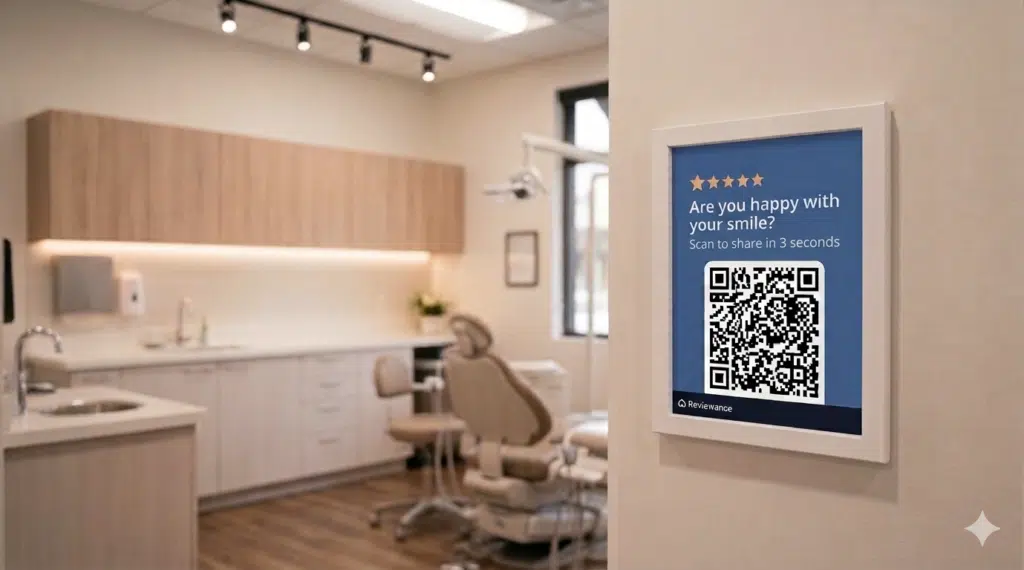
- Managing High-Volume Hours: During busy clinic hours, staff may forget to ask for feedback. Using a tool like Reviewance automates this process through QR codes placed at the reception or on appointment cards, ensuring no satisfied patient leaves without a prompt.
- Privacy and Negative Feedback: If a patient has a concern, it is vital to intercept it privately. Reviewance allows clinics to route operational complaints to management internally, preventing 1-star reviews from damaging the clinic’s public reputation.
By building a systematic approach to Google Reviews, dental clinics can strengthen their local authority, build long-term patient trust, and ensure they remain the first choice for dental care in their community.
How Patients Search for Dentists on Google
Understanding the psychology of a patient’s search journey is the first step toward capturing their interest. When a user experiences dental pain or desires a cosmetic improvement, they don't just "browse"; they search with high Commercial Intent. They are looking for a solution that provides both professional security and geographical convenience.
Understanding Search Intent: What Patients Are Typing
Google categorizes dental searches into specific "intent buckets." To rank higher, your clinic must align its review content and profile with these common queries:
- Proximity-Based (The "Near Me" Intent): Queries like "dentist near me" or "teeth whitening near me" are the most frequent. Google uses your clinic's location and review relevance to decide if you appear in these results.
- Urgency-Based (The "Emergency" Intent): A patient typing "emergency dentist" is in immediate need. Google prioritizes clinics that have recent reviews mentioning "fast service" or "emergency care".
- Quality-Based (The "Best" Intent): When someone searches for the "best dental clinic," the algorithm heavily weights your average star rating and total review count.
- Service-Specific (The "Specialist" Intent): Keywords like "dental implant clinic" or "cosmetic dentist reviews" trigger results based on whether your patients have mentioned those specific treatments in their feedback.
Google Maps: The Final Decision Screen
For local healthcare, the traditional blue links on page one of Google are no longer the primary destination. Instead, the Google Maps Local 3-Pack has become the "Main Decision Screen".
- The Zero-Click Reality: Many patients will choose a dentist without ever visiting the clinic's website. They look at the Google Maps profile, check the star rating, read the three most recent reviews, and click the "Call" button directly from the map.
- Visual Trust: Patients often scroll through the photos uploaded by other patients in the review section to see the cleanliness of the clinic and the results of treatments like whitening or braces.
- The Algorithm Gap: Even if your clinic has the most advanced technology, if your Google Maps profile lacks recent, keyword-rich reviews, Google will rank a "busier" competitor above you.
The Strategy for Success
To win on the decision screen, your clinic needs a system that ensures every satisfied patient leaves a digital footprint. Reviewance automates this by placing QR codes at the reception or on appointment cards, turning a routine check-up into a powerful ranking signal. By consistently generating reviews that mention specific locations and services, you ensure that when a patient searches, your clinic is the first one they see—and the first one they trust.
Why Reviews Are Critical in Healthcare Decisions
In the healthcare sector, the decision-making process is fundamentally different from purchasing a consumer product. Patients are not just looking for a service; they are looking for medical trust and a feeling of security. Because dental procedures often involve a high degree of physical and financial vulnerability, reviews act as the primary bridge between a patient's fear and their eventual confidence.
The Psychological Pillars of Healthcare Reviews
- Medical Trust & Professionalism: Unlike a restaurant review that focuses on taste, a dental review focusing on the clinic's "professional competence" and "patient safety" signals that the provider is a legitimate authority.
- Overcoming Treatment Fear: Dentistry is uniquely associated with anxiety. Reviews that mention "painless" or "gentle" care directly address the fear factor, making them the most powerful conversion tools for hesitant leads.
- Patient Confidence through Transparency: Reading about the experiences of others provides a layer of transparency that a clinic’s own website cannot offer. It allows patients to verify that the clinic’s claims about care and cleanliness are consistent with reality.
- Social Reassurance: High volumes of positive feedback act as social proof. Patients feel a sense of social reassurance when they see hundreds of others have successfully trusted the same clinic with their health.
The Power of the "Nervous Patient" Testimonial
In healthcare, the "perfect" review isn't just about the result; it’s about the emotional journey.
Example of a High-Conversion Review: "I was very nervous about my implant procedure, but the dentist made me feel comfortable. The staff explained every step, and the process was surprisingly painless."
Why This Review Converts:
- Empathy: It acknowledges a common emotion (nervousness) that many potential patients are feeling at the exact moment they are reading the review.
- The Comfort Signal: By mentioning the dentist made them feel "comfortable," it provides the "feeling of security" that is essential in brand identity for medical startups.
- Specific Keywords: It mentions the specific procedure (implant), which helps the clinic rank for high-value service queries on Google Maps.
Strategic Advantage with Reviewance
Because healthcare providers often manage high-volume patient flows, capturing these emotional testimonials can be difficult during daily operations. Reviewance solves this by using QR code technology at the point of service—such as at the reception desk or on appointment cards—to capture "satisfied customer reviews" the moment a patient feels that wave of relief and gratitude after a successful procedure.
Should Every Dental Clinic Have a Google Business Profile (GBP)?
In the healthcare industry, a Google Business Profile (GBP) is no longer an optional marketing tool; it is a fundamental requirement for operational success. For dental clinics, where local trust and physical proximity are the primary drivers of patient acquisition, GBP serves as the most critical "digital front door."
Maximum Location Visibility in the Local 3-Pack
Google Maps is the single largest source of leads in the dental sector. When a potential patient searches for a provider, Google’s algorithm prioritizes clinics within the Local 3-Pack based on their profile completeness, star ratings, and review recency. Without a verified and active GBP, your clinic remains invisible on the map, effectively conceding the vast majority of local traffic to your competitors before a patient even visits a website.
Capturing Emergency Intent and Mobile Search Behavior
Dental issues often involve Emergency Intent, characterized by high-urgency searches conducted almost exclusively on mobile devices. Patients in pain do not browse multiple pages of search results; they rely on Mobile Search Behavior, looking for the nearest "open now" clinic with a high rating. A well-optimized GBP allows these high-intent users to click the "Call" or "Directions" button directly from the search screen, capturing the lead at the exact moment of need.
Driving Appointment Conversions through Social Trust
Choosing a dentist involves a high stakes "feeling of security". A Google Business Profile provides the transparency and social proof necessary for Appointment Conversions by showcasing real patient experiences. While your staff may be too busy during peak hours to manually ask for feedback, integrating a solution like Reviewance ensures that your profile is constantly updated with fresh, positive reviews. This continuous stream of digital "word-of-mouth" validates your professional competence and turns skeptical searchers into scheduled patients.
How Dental Clinics Rank Higher on Google Maps
Ranking in the "Local 3-Pack" is not a matter of luck; it is a result of sending consistent signals to Google’s algorithm that your clinic is the most relevant, trustworthy, and active provider in the area. For dental practices, these signals are heavily weighted toward the quality and content of your patient feedback.
Treatment Keywords in Reviews
Google’s algorithm "reads" the text of your reviews to understand exactly what services you provide beyond your basic category. When patients mention specific treatments, it significantly boosts your ranking for those high-value searches.
- Targeted Keywords: Actively encouraging reviews that mention dental implants, Invisalign, veneers, or root canal tells Google you are a specialist in these areas.
- Niche Expertise: Reviews containing terms like pediatric dentist or teeth whitening help you capture patients looking for those specific needs.
Review Freshness
A high star rating from three years ago carries much less weight than a slightly lower rating from last week. Google prioritizes "freshness" because it proves the clinic is currently operational and maintaining high standards of care. A consistent stream of new reviews is a key indicator of a thriving practice.
Location Relevance
To dominate local search, your reviews should anchor your clinic to your specific neighborhood or city. When a patient mentions your location (e.g., "Best dentist in downtown"), it strengthens your Location Relevance, making you the primary choice for "dentist near me" queries.
Response Management
Interaction is a ranking signal. Responding to every review—both positive and negative—demonstrates that the clinic is managed professionally and values patient engagement. Using treatment keywords naturally within your responses (e.g., "We are so glad you are happy with your new veneers!") further reinforces your SEO.
Appointment Engagement Signals
Google tracks how users interact with your profile. High rates of "click-to-call," "request directions," and "book an appointment" clicks signal to Google that your clinic is a highly relevant result, which in turn pushes your ranking even higher.
Before-and-After Photo Activity
In dentistry, visual proof is paramount. Profiles that frequently update their "Photos" section—especially with patient-contributed images of successful treatments—see higher engagement. This activity signals to Google that your profile is an active, helpful resource for the community.
The Reviewance Strategy: By placing QR codes at your checkout desk or in recovery rooms, you can prompt patients to leave reviews while their successful treatment is top of mind. This ensures a steady flow of keyword-rich, fresh content that keeps your clinic at the top of the Map results.
Follow-up Question: Are your current reviews mostly general praise, or do they already mention specific treatments like implants or whitening?
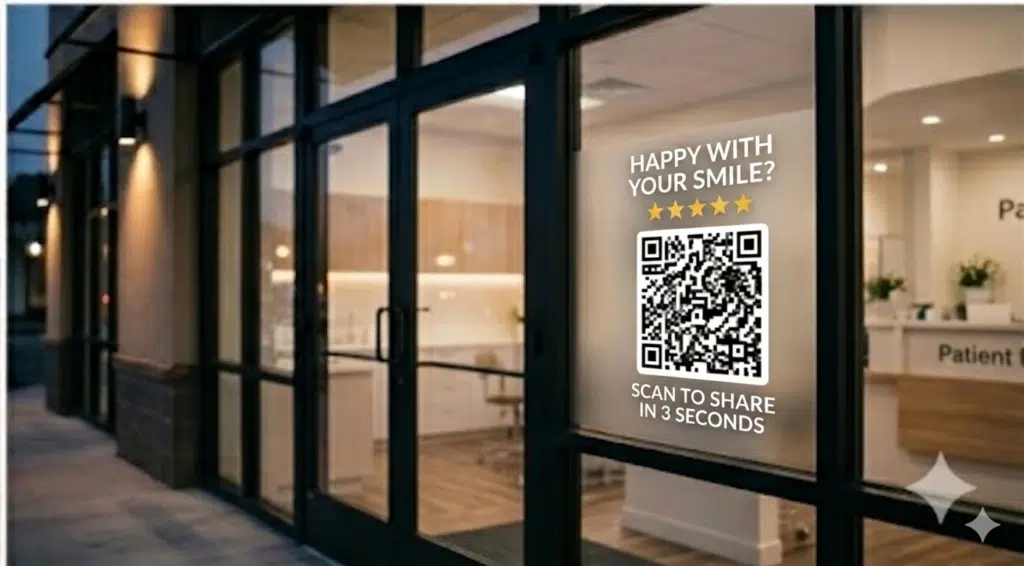
The Psychology Behind Dental Reviews
In the dental industry, a review is much more than a simple rating; it is a profound psychological tool that addresses deep-seated human anxieties. For most patients, selecting a dentist is not a rational comparison of prices—it is an emotional search for a feeling of security. Reviews provide a unique form of "Trust Transfer" that traditional advertising cannot replicate.
1. Fear Reduction & Pain Expectations
Dental anxiety is one of the most common barriers to treatment. Potential patients scan reviews specifically for "pain-related" keywords. When a review mentions a "painless root canal" or a "gentle touch," it recalibrates the reader's pain expectations. This social proof acts as a sedative for the patient’s fear before they even enter the clinic.
2. The Power of Trust Transfer
Patients instinctively trust other patients more than advertisements. A clinic’s website will always claim professional excellence, but a third-party review is perceived as objective truth. Seeing a high volume of positive feedback allows a new patient to "borrow" the trust that others have already established with the provider, facilitating a smoother Trust Transfer.
3. Embarrassment Reduction
Many patients avoid the dentist due to embarrassment regarding the state of their oral health. Reviews that highlight a "non-judgmental atmosphere" or a "kind and understanding team" are incredibly powerful. They signal to the reader that the clinic is a safe space, effectively lowering the psychological barrier to booking an appointment.
4. Emotional Reassurance & Social Proof
Beyond the clinical outcome, patients look for emotional reassurance. They want to know they will be treated as a human, not just a procedure. Reviews that focus on the "patience" of the staff or the "calming environment" provide the social reassurance necessary to convert a nervous searcher into a confident patient.
Psychological Comparison: Ad vs. Review
| Feature | Clinic Advertisement | Patient Google Review |
| Primary Voice | Sales-focused / Corporate | Empathetic / Authentic |
| Trust Level | Skeptical | High (Peer-to-Peer) |
| Emotional Impact | Low | High (Fear Reduction) |
| SEO Signal | Static | Dynamic (Keywords & Recency) |
The Reviewance Advantage: Our system is designed to capture these high-emotion moments. By using QR code technology during the "Peak Satisfaction Window"—the moment a patient feels relieved and grateful after a successful procedure—you ensure your Google profile is filled with the exact psychological triggers that convert new patients.
Why Most Dental Clinics Struggle to Get Reviews
Even the most clinically skilled dental practices often find their Google Business Profile stagnant. This isn't due to a lack of patient satisfaction, but rather a set of psychological and operational barriers unique to the healthcare environment. Understanding these friction points is the first step toward building a high-performing reputation.
1. Patients Forget After Treatment
In dentistry, the "relief window" is extremely short. Once a patient leaves the chair and the local anesthesia wears off, their focus shifts from gratitude to their daily schedule or the physical sensation of recovery. Without an immediate prompt, the intention to leave a review evaporates before they even reach their car.
2. Staff Feel Uncomfortable Asking
Many dental professionals and front-desk coordinators feel that asking for a review feels "transactional" or "unprofessional." There is a deep-seated fear of appearing commercial in a medical setting. Staff often worry that asking for a rating devalues the clinical relationship, leading them to avoid the conversation entirely.
3. Patients Leave Immediately After Appointments
Unlike a restaurant where guests linger over coffee, dental patients are typically eager to exit the clinic as soon as their procedure is complete. This "rapid exit" behavior means there is rarely a natural moment for a verbal review request that doesn't feel rushed or intrusive.
4. No Systematic Review Process
Most clinics rely on "random acts of asking." Without a systematic review process, feedback collection is inconsistent. If the request isn't a standardized part of the patient checkout workflow, it only happens when a staff member happens to remember it—usually during slow hours rather than peak satisfaction moments.
5. The "Feedback Friction" Barrier
Even a willing patient may give up if the process is too complex. If a patient has to search for the clinic name, find the "Review" tab, and log in, the friction is too high. In a high-speed clinical environment, any barrier longer than 15 seconds results in a lost opportunity.
Overcoming the "Asking Anxiety"
| Barrier | Psychological Root | The Reviewance Solution |
| Staff Hesitation | Fear of appearing "salesy". | QR Code Technology: Shifts the "ask" from a verbal request to a professional, passive digital prompt. |
| Patient Forgetfulness | Post-treatment mental fatigue. | Strategic Placement: QR codes in the recovery room or on appointment cards capture feedback at the peak of relief. |
| Rapid Exit | Desire to return to normal life. | Frictionless Feedback: A single scan takes the patient directly to the review screen, requiring zero searching. |
The Reviewance Advantage: By integrating QR code technology into your "Welcome Kit" and physical touchpoints, you remove the burden from your staff. It transforms the review request from a "commercial ask" into a professional invitation for feedback, ensuring that your clinic’s online reputation finally reflects its real-world excellence.
Follow-up Question: Do you find that your front-desk team is currently hesitant to ask patients for Google reviews during the checkout process?
Best Moments to Ask Patients for a Review
Timing is the most critical factor in converting a positive patient experience into a high-value Google review. In a dental setting, you must capture the "Peak Satisfaction Window"—the brief moment when the patient’s relief or joy is at its highest point.
1. After Immediate Pain Relief
The moment a patient realizes their acute pain is gone is a powerful psychological trigger. A patient who enters the clinic in distress and leaves with a "feeling of security" is highly motivated to share their gratitude. This is the ideal time for a Trust Transfer to happen through a digital testimonial.
2. After Seeing Cosmetic Results
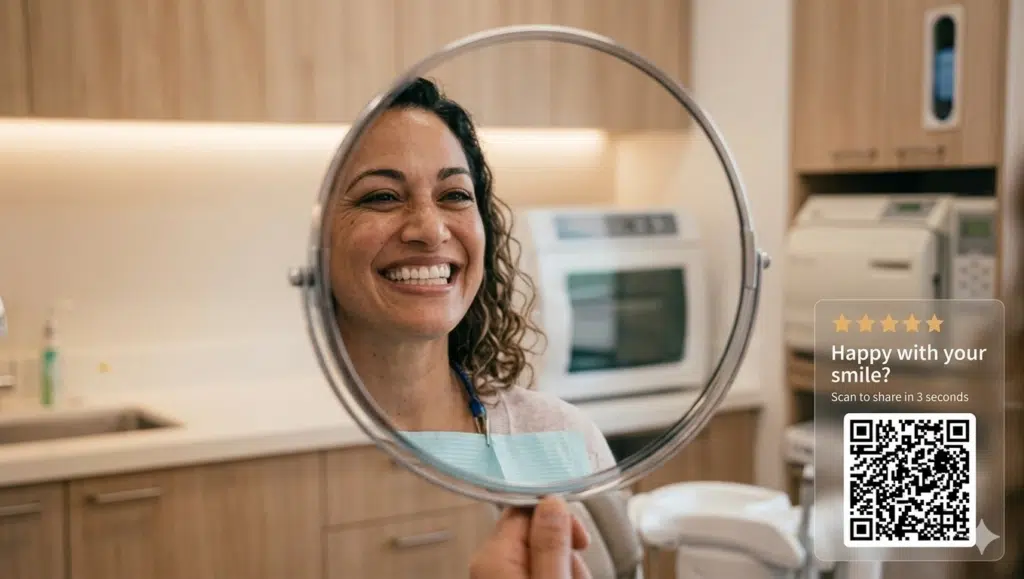
When a patient looks in the mirror after a whitening session, veneers, or the removal of braces, they experience a surge of confidence. This "wow" moment is the perfect time to prompt for a review, as they are likely to use specific Treatment Keywords like "Invisalign" or "veneers" in their feedback.
3. During the Checkout Process
The administrative hand-off at the front desk is a natural operational touchpoint. Placing QR codes on the reception desk or including them in the "Welcome Kit" makes the request a professional part of the workflow rather than a "commercial ask".
4. Following a Successful Consultation
Even if a procedure hasn't happened yet, a patient who feels heard and understood during a consultation has already built a connection. Capturing reviews at this stage highlights your clinic’s transparency and "non-judgmental atmosphere."
5. During Follow-Up Messages or Emails
Automated follow-up messages sent 24 hours after a procedure act as a gentle reminder once the patient is back in their daily routine. This helps overcome the barrier of patients "forgetting" once they leave the physical clinic environment.
Critical Insight:
“A patient who just overcame dental anxiety is far more likely to leave an emotional and detailed review.”
Patients who were previously nervous provide the highest conversion value for your SEO. Their reviews address fear reduction and pain expectations, which are the exact psychological triggers that other potential patients are looking for on Google Maps.
| Peak Moment | Psychological Driver | Best Tool |
| Pain Relief | Intense Gratitude | QR Code at Reception |
| Cosmetic Reveal | Joy & Confidence | In-Room QR Placement |
| Anxiety Overcome | Emotional Relief | Direct Staff Request |
The Reviewance Advantage: Our Frictionless Feedback system is designed to live at these specific touchpoints. By strategically placing QR codes where these emotional peaks occur, you ensure your clinic captures the most authentic and keyword-rich reviews possible.
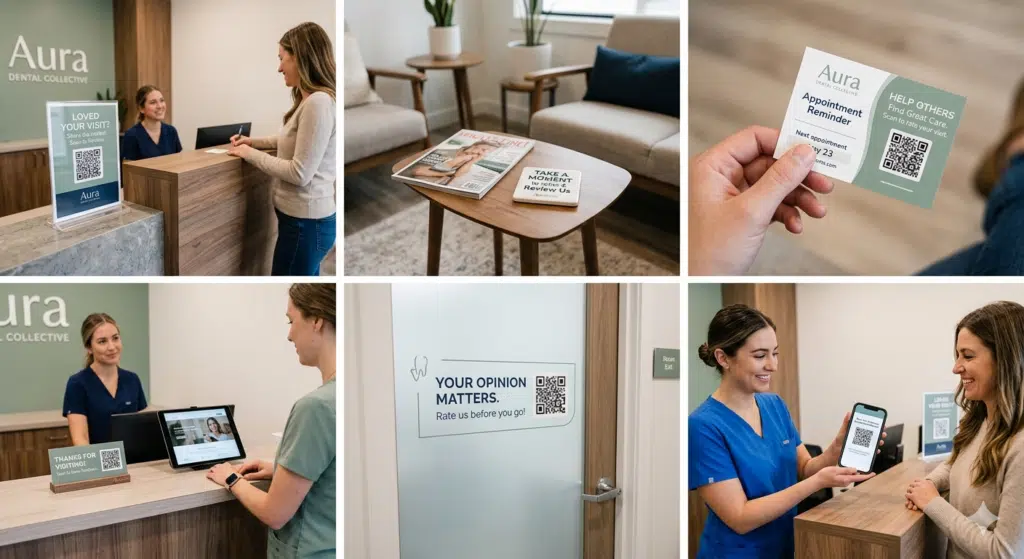
Best QR Code Placement Ideas for Dental Clinics
In a dental environment, the physical atmosphere must maintain a high standard of professionalism and a "feeling of security". Strategically placing QR codes ensures that the review process is seamless and non-intrusive, respecting the patient’s clinical experience while maximizing feedback collection.
1. Reception Desk & Waiting Room Displays
The reception area is the patient's first and last point of contact.
- Waiting Room Displays: Placing QR codes on digital screens or elegant table tents allows patients to engage while they are already on their phones during the "waiting" period.
- Reception Desk: A discreet, high-quality QR stand at the front desk provides a natural prompt as patients check in or wait for their name to be called.
2. Checkout Counter
The checkout counter is a high-conversion zone because the patient has just successfully completed their treatment.
- Immediate Feedback: Capturing a review during the payment process utilizes the "peak satisfaction window," especially for those who have just experienced pain relief.
- Staff Integration: It allows the front-desk team to offer a professional invitation for feedback without it feeling like a "commercial ask".
3. Appointment Cards & Welcome Kits
Integrating QR codes into physical takeaway items ensures the clinic remains top-of-mind even after the patient leaves.
- Appointment Cards: Including a small QR code on the back of reminder cards makes it easy for patients to leave a review from the comfort of their home.
- Welcome Kits: For new patients, including instructions and a QR code in their initial "Welcome Kit" helps establish a culture of transparency and feedback from day one.
4. Printed Treatment Folders
For complex procedures like implants or Invisalign, clinics often provide detailed aftercare folders.
- Professional Alignment: Placing a QR code within these folders aligns the request with the "specialist" care the patient received.
- Educational Context: Patients reviewing these folders are often in a focused, appreciative mindset, leading to more detailed and keyword-rich reviews.
5. Reviewance Mobile QR Display
For maximum flexibility, staff can use the Reviewance mobile interface to present a QR code directly to the patient.
- Personalized Interaction: If a patient expresses verbal gratitude to a dental assistant or dentist, the staff member can simply show their phone screen for an instant scan.
- Frictionless Transition: This method removes all search barriers, taking the patient directly to the Google review screen in seconds.
How Reviews Influence New Patient Acquisition
In the digital-first era of healthcare, Google reviews act as the primary engine for growth. For a dental clinic, high-quality feedback does more than just improve visibility; it directly impacts the bottom line by accelerating the transition from a "window shopper" to a committed patient.
Accelerating Appointment Conversion
The path from a search result to a booked appointment is often dictated by social proof. When a patient sees a high volume of positive ratings, it reduces the perceived risk of choosing a new provider. A profile filled with consistent, recent feedback streamlines appointment conversion by providing the final "nudge" needed for a user to click the "Call" button or use the online booking tool.
Driving Treatment Acceptance
Reviews play a silent but critical role in treatment acceptance rates. When a patient is presented with a complex or high-cost treatment plan, such as implants or orthodontics, they often look for external validation. Seeing testimonials from other patients who have undergone the same procedures and achieved life-changing results builds the necessary cosmetic procedure trust, making them much more likely to say "yes" to your recommendations.
Capturing High-Intent Emergency Patients
For patients in acute pain, speed is the priority. These emergency patient decisions are made in seconds based on a clinic’s map ranking and immediate reputation signals. A clinic that consistently generates fresh reviews will appear at the top of these urgent searches, capturing high-intent leads who are ready to book immediately.
Digital Word-of-Mouth and Family Referrals
While traditional family referrals used to happen over the phone or in person, they now happen via shared links. A strong Google profile acts as a digital storefront that reinforces personal recommendations. When a friend recommends a dentist, the first thing the recipient does is check their Google Reviews; a stellar profile ensures that the referral actually turns into a new patient.
The Strategic Edge: By implementing a frictionless system like Reviewance, your clinic ensures that every successful patient outcome is documented online. This continuous loop of feedback ensures that your acquisition cost stays low while your patient volume grows through the power of authentic, peer-to-peer trust.
Google Review Examples for Dentists
To rank higher on Google Maps and convert hesitant searchers, your reviews need to do more than just say "great job." The most effective reviews contain specific markers that satisfy both Google's algorithm and the patient's psychological need for a feeling of security.
High-Conversion Review Templates
Example 1: The Cosmetic Success
"I just finished my Invisalign treatment at this clinic in Chicago, and the results are amazing. The professional staff made the whole painless process so easy."
- Treatment Keyword: Invisalign (Tells Google exactly what high-value service you provide).
- Location Signal: Chicago (Strengthens your Location Relevance for local searches).
- Professionalism Signal: Professional staff (Validates your medical competence to new patients).
- Emotional Reassurance: Painless process (Addresses common treatment fear and lowers the barrier to booking).
Example 2: The Emergency Relief
"I called with a massive toothache and they saw me immediately for a root canal. Dr. Smith provided so much emotional reassurance, and I felt zero pain."
- Treatment Keyword: Root canal (Captures high-intent emergency patient decisions).
- Emergency Intent: "Saw me immediately" (Signals to Google that you are a reliable provider for urgent needs).
- Emotional Reassurance: Addresses pain expectations and fear reduction simultaneously.
Example 3: The Family & Pediatric Choice
"Best pediatric dentist in the area. My kids used to be scared of the dentist, but the gentle touch here changed everything."
- Treatment Keyword: Pediatric dentist (Targets specific family-oriented demographics).
- Fear Reduction: "Used to be scared" (Provides social reassurance for parents searching for a safe environment).
Why These Examples Work for SEO
Google’s algorithm "reads" the text within these reviews to categorize your clinic. By utilizing a system like Reviewance to prompt patients at the "peak satisfaction window," you ensure your profile is consistently updated with these high-value signals.
| Review Element | SEO Benefit | Patient Benefit |
| Treatment Keyword | Ranks you for specific services (e.g., implants, veneers). | Confirms you solve their specific problem. |
| Location Signal | Boosts visibility in the Local 3-Pack. | Confirms proximity and convenience. |
| Emotional Reassurance | Increases click-through rates on mobile searches. | Reduces treatment fear and builds patient confidence. |
How Many Reviews Does a Dental Clinic Need?
In the competitive dental landscape, the "ideal" number of reviews is not a fixed figure but a relative benchmark based on your specific specialization and local competition. While a general practice may thrive on volume, a luxury clinic relies on the depth and sophistication of its feedback.
Segment-Based Review Benchmarks
Local Family Dentist
For a general practice, volume and consistency are the primary goals to dominate the "Local 3-Pack". A local family dentist should aim for at least 150+ reviews with a steady stream of at least 3–5 new entries per month. This demonstrates to parents that the clinic is a reliable, active part of the community.
Cosmetic Clinic & Orthodontics
These segments require a high level of cosmetic procedure trust. Patients looking for Invisalign or veneers often read deep into the text, so 75–100 high-quality reviews featuring specific treatment keywords and "before-and-after" descriptions are more valuable than 300 generic ratings.
Implant Center
Because dental implants are a significant financial and physical investment, patients seek maximum emotional reassurance. An implant center needs 50+ highly detailed testimonials that specifically address pain expectations and long-term results to facilitate successful treatment acceptance.
Luxury Dental Practice
For high-end boutique clinics, quality is the ultimate ranking signal. Rather than massive volume, a luxury practice should focus on 30–50 elite-level reviews that emphasize the "feeling of security," professional aesthetics, and personalized care. In this segment, one negative, unaddressed review can be more damaging than having fewer reviews overall.
The "Recency over Quantity" Rule
Google’s algorithm prioritizes review freshness. A clinic with 500 reviews from two years ago will often rank lower than a competitor with 100 reviews, 10 of which were posted this month.
| Clinic Segment | Targeted Volume | Primary Focus |
| Family Dentist | High (150+) | Location Relevance & Volume |
| Cosmetic/Ortho | Medium (75+) | Treatment Keywords & Joy |
| Implant Center | Quality-Focused (50+) | Trust Transfer & Expertise |
| Luxury Practice | Selective (30+) | Professionalism Signal & Experience |
The Reviewance Advantage: Our Frictionless Feedback system ensures that regardless of your segment, your clinic maintains a consistent flow of reviews. By placing QR codes at key touchpoints like the checkout counter or within welcome kits, you turn every satisfied patient into a permanent boost for your Google Maps ranking.
How Dental Clinics Should Respond to Reviews
In the dental sector, response management is not just a polite gesture; it is a critical component of building a feeling of security. How a clinic interacts with feedback online serves as a public demonstration of their professionalism and commitment to patient care.
Responding to Positive Reviews
Positive reviews are an opportunity to reinforce your clinic's professionalism signal. When a patient leaves a glowing testimonial, your response should be appreciative and personalized. By naturally incorporating treatment keywords—such as thanking them for choosing you for their Invisalign or teeth whitening—you strengthen your SEO while making the patient feel valued.
Responding Without Violating Privacy
Privacy is the most critical boundary in healthcare marketing. Even if a patient discloses their entire medical history in a public review, the clinic must remain strictly compliant with HIPAA/GDPR sensitivity considerations. You must never confirm that the reviewer is a patient or mention specific clinical details. A safe approach is to speak in general terms, such as, "We strive to provide every visitor with a gentle and professional experience."
Handling Negative Experiences
Negative reviews are inevitable, but they can be neutralized through calm and professional engagement. The goal is to move the conversation offline as quickly as possible. Avoid getting defensive; instead, offer a clear path for resolution. This demonstrates to prospective patients that the clinic takes response management seriously and is accountable for the patient experience.
Responding to Treatment Complaints
When a review mentions a specific clinical issue, such as a root canal complication or dissatisfaction with veneers, the response must be extremely cautious. Address the emotional aspect—such as the patient's discomfort—without admitting clinical fault or confirming the procedure details publicly. Invite the individual to contact the clinic director directly to ensure their concerns are handled with the necessary privacy and care.
Privacy-Safe Response Framework
| Situation | What to Say | What to Avoid |
| Positive Review | "Thank you for the kind words about our team and office atmosphere!" | "We are glad you liked your dental implants specifically!" |
| Negative Review | "We value all feedback and would like to learn more. Please call our office at..." | "We remember your appointment on Tuesday and the issue with your filling..." |
| Privacy Breach | "Our policy is to protect all visitor confidentiality. Please reach out to us directly." | "As we discussed during your consultation, the treatment plan was..." |
The Strategic Insight: Professional responses act as a "Trust Transfer" for future patients. By maintaining high standards in your digital interactions, you provide the emotional reassurance that searchers need to choose your clinic over a competitor.
Follow-up Question: Would you like to see specific, "copy-paste" response templates that are fully compliant with privacy regulations for your front-desk team?
Common Dental Review Mistakes
Building a reputable online presence requires avoiding specific pitfalls that can damage your clinic's credibility or even lead to legal complications. In the dental industry, these mistakes often stem from a lack of a systematic review process or an over-eagerness to boost numbers without considering long-term reputation.
Asking Too Early
Timing is everything. Asking for a review before a patient has experienced pain relief or seen their final cosmetic results can lead to lukewarm or even negative feedback. If a patient is still in discomfort or mid-treatment, they are not yet in the "peak satisfaction window" required for a high-value testimonial.
Fake and Incentivized Reviews
Google’s algorithm is highly sophisticated at detecting unnatural patterns. Buying fake reviews or offering direct incentivized reviews (like discounts or gift cards) violates Google’s terms of service and can lead to your profile being suspended. Beyond the technical risk, patients can often spot "manufactured" praise, which destroys the trust transfer that authentic reviews provide.
Generic and "Bot-Like" Responses
One of the most frequent response management mistakes is using the same template for every patient. Generic responses signal that the clinic views patients as transactions rather than individuals. Failing to naturally include treatment keywords or a personalized note of thanks misses a massive opportunity to reinforce your professionalism signal.
Ignoring Negative Reviews
Staying silent after a negative experience is a signal to prospective patients that the clinic is unmanaged or indifferent to patient care. Ignoring negative reviews allows one person’s bad experience to become the "final word" on your profile. A professional, privacy-conscious response is necessary to provide emotional reassurance to others that you are accountable.
Violating Patient Privacy
This is the most dangerous mistake a dental practice can make. In an attempt to defend their reputation against a complaint, staff may accidentally confirm a patient's identity or clinical details. Violating patient privacy is a direct breach of HIPAA/GDPR sensitivity considerations. Even if a patient is critical, your response must remain general to protect the feeling of security and legal standing of your practice.
Mistake vs. Strategic Solution
| Common Mistake | Potential Consequence | Reviewance Strategic Solution |
| Incentivizing | Account suspension / Loss of trust. | Focus on Frictionless Feedback via QR codes at peak emotional moments. |
| Privacy Breach | Legal fines and loss of reputation. | Using professional, standardized response frameworks that prioritize privacy. |
| Asking Too Early | Low-quality or confused reviews. | Placing QR codes at the checkout counter or in aftercare folders. |
The Reviewance Edge: Our system helps you avoid these errors by providing a structured, professional way to capture feedback. By shifting the focus from "getting a rating" to "capturing a success story," you ensure your Google Maps profile grows authentically and safely.
Google Reviews for Cosmetic Dentistry
Cosmetic dentistry is a high-stakes, high-reward segment where Google Reviews function as a digital gallery of clinical excellence. Because these procedures are elective and often high-ticket, prospective patients have a significantly higher commercial intent. They aren't just looking for a dentist; they are looking for an artist they can trust with their smile.
The Power of "Smile Design" Keywords
In cosmetic dentistry, generic praise is not enough. To capture search traffic for "Smile Design" or "Veneers," your reviews must contain specific treatment keywords. When a patient describes their journey—from the initial consultation to the final reveal—they are providing Google with the data it needs to rank your clinic for high-value searches.
Invisalign and Clear Aligner Social Proof
Patients researching Invisalign are often concerned with the lifestyle impact and the duration of the treatment. Reviews that mention "comfortable trays," "discreet treatment," or "faster results than expected" directly address these before/after expectations. This specific feedback helps bridge the gap between a lead’s curiosity and their decision to start treatment.
Teeth Whitening: The Gateway Review
Whitening is often the "entry point" for new cosmetic patients. Reviews highlighting "immediate results" or "zero sensitivity" serve as a low-friction trust transfer. A patient who is happy with a whitening treatment is far more likely to return for more complex procedures like bonding or veneers, and their review acts as the first step in that long-term relationship.
Managing Before/After Expectations
The most valuable cosmetic reviews are those that manage expectations. When patients write about how the clinic explained the process or how the final result matched the digital mock-up, it builds professionalism signals. This transparency is crucial for high-intent patients who are fearful of "unnatural" results.
High-Intent Keyword Analysis
| Treatment | SEO Value | Patient Psychological Trigger |
| Veneers | Very High | "Will I look like myself?" (Confidence) |
| Invisalign | High (Competitive) | "How will this affect my daily life?" (Convenience) |
| Smile Design | High (Specialized) | "Can they fix my specific smile?" (Artistry) |
| Whitening | High Volume | "Is it worth the cost/time?" (Instant Gratification) |
The Reviewance Advantage: For cosmetic procedures, we recommend placing QR codes in the "Reveal Zone"—near the mirrors where patients first see their new smile. Capturing their reaction in that moment ensures the review is filled with the genuine emotion and specific detail that converts other high-intent leads.
Multi-Location Dental Clinic Reputation Management
Managing the reputation of a dental franchise or multi-location group requires a balance between a unified brand identity and the unique local presence of each branch. For large-scale operations, a "systematic review process" is not just an advantage—it is an operational necessity to ensure that every location maintains a high standard of "professionalism".
Maintaining Branch Consistency
For multi-location groups, the greatest challenge is ensuring that a patient receives the same "feeling of security" in a suburban branch as they do in a flagship city clinic. Reviews provide a critical feedback loop for monitoring "branch consistency". By analyzing sentiment across different sites, management can identify locations that may need additional training in staff-patient interaction or clinical workflows.
Optimizing for Local SEO
Each clinic location must compete in its own "Local 3-Pack". A centralized approach that treats all clinics as one entity will fail because Google ranks businesses based on "location relevance". Each branch needs its own unique stream of reviews to signal to Google that it is an active and trusted provider in its specific neighborhood.
Centralized Review Monitoring
For a startup or corporate dental group, manual oversight is impossible. Implementing "centralized review monitoring" allows management to track performance across the entire network from a single dashboard. This ensures that "response management" is handled uniformly and that "privacy sensitive" guidelines are strictly followed by every administrative team, regardless of location.
Doctor-Specific Reviews
In dentistry, patients often build loyalty to a specific practitioner rather than the brand itself. Encouraging "doctor-specific reviews" helps build individual authority for your specialists—whether they are focusing on "smile design," "implants," or "pediatric care". This personalizes the large-scale corporate brand and provides "emotional reassurance" to new patients looking for a specific provider.
Scale vs. Local Impact
| Management Focus | The Challenge | The Multi-Location Solution |
|---|---|---|
| Brand Image | Inconsistent service across branches. | Standardized "Welcome Kits" and QR placements to ensure a uniform "Frictionless Feedback" experience. |
| Local Search | One branch outranking others. | Dedicated review targets for each location to boost individual "Local SEO". |
| Risk Control | Privacy breaches at a local level. | Centralized "Response Management" templates to ensure "GDPR/HIPAA" compliance across all sites. |
E-Tablolar'a aktar
The Reviewance Advantage: Our platform is designed for the "entrepreneur" and startup founder managing multiple touchpoints. By deploying our "Frictionless Feedback" system across all locations, you can maintain a bird's-eye view of your entire group's reputation while ensuring each clinic dominates its local market.
Reviewance is engineered to bridge the gap between high-quality clinical care and digital authority. By focusing on "Frictionless Feedback," we ensure your clinic captures the authentic patient experiences that drive growth in the most competitive dental markets.