
In the hair transplant industry, reputation (Google Reviews for Hair Transplant Clinics) is not simply a marketing advantage — it is one of the strongest factors influencing patient decisions. Hair restoration is deeply emotional. Patients are not only investing money into a cosmetic procedure; they are investing in confidence, appearance, self-image, and long-term personal satisfaction. Because of this, people spend weeks or even months researching clinics, comparing results, reading patient experiences, and searching for signs they can trust before booking a consultation.
Today, that research process happens primarily on Google. Potential patients search terms like “best hair transplant clinic,” “FUE hair transplant reviews,” or “hair transplant near me,” then compare ratings, before-and-after photos, and detailed patient feedback. In many cases, the clinic with the strongest and most authentic Google review profile wins the consultation — even if competing clinics offer lower prices.
Unlike many other industries, Google reviews for hair transplant clinics function as a form of emotional reassurance. Patients look for very specific trust signals inside reviews: Did the results look natural? Was the doctor experienced and transparent? Was the recovery process comfortable? Did the clinic provide proper aftercare? Did previous patients feel more confident after the procedure? These emotional indicators strongly influence whether a prospective patient feels safe enough to move forward.
Google also uses review signals to determine local visibility on Google Maps. Clinics with a high volume of recent, detailed, and positive reviews are far more likely to appear in competitive searches related to hair restoration and cosmetic procedures. Reviews that mention treatment-specific keywords such as “FUE,” “hairline design,” “natural results,” or “dense implantation” further strengthen local SEO relevance and increase discovery potential.
Reviewance helps hair transplant clinics systematically collect more Google reviews, strengthen online reputation, and improve Google Maps rankings through smart QR-based review collection systems and frictionless patient feedback flows. Whether you operate a boutique hair restoration center, a large cosmetic clinic, or an international medical tourism facility, Reviewance helps transform satisfied patients into visible public trust signals that attract the next generation of patients searching for confidence and results.
Why Google Reviews Matter for Hair Transplant Clinics
In the specialized field of hair restoration, a clinic's Google Business Profile does not just list its location; it serves as the ultimate digital proof of technical skill and aesthetic judgment. For prospective patients, choosing a clinic is a life-altering decision fraught with financial and physical vulnerability. Google Reviews provide the necessary trust verification, bridging the gap between a marketing claim and a real-world, successful transformation.
The primary engine of conversion in this niche is experience visualization. Hair loss is deeply personal, and prospective patients prioritize detailed reviews that chronicle the entire journey, not just the final outcome. These testimonials offer essential quality signals, discussing factors like the surgeon's demeanor, the cleanliness of the clinical environment, and the helpfulness of the aftercare team. This peer-to-peer validation is the most potent form of social proof, mitigating "procedure anxiety" and replacing diagnosis uncertainty with a strong feeling of security.
From a technical perspective, a consistent stream of fresh reviews is the lifeblood of local visibility. Google’s algorithms favor clinics that are active and highly rated, directly dictating their prominence in the Local 3-Pack during critical, high-intent searches. Crucially, when patients include service keywords—like "FUE transplant" or "DHI technique"—it enhances the clinic’s semantic SEO, ensuring they rank for the exact procedures they offer.
Ultimately, a strong presence of positive feedback reduces the hesitation associated with high-ticket repair acceptance. By providing honesty validation and safety reassurance through visible, authentic outcomes, reviews transform casual inquiries into confirmed bookings, making them the single most valuable asset for long-term growth and referral business.
How Patients Search for Hair Transplant Clinics on Google
The journey to hair restoration always begins with a search bar. Because hair transplants represent a significant financial investment and a highly visible physical change, patient search behavior is defined by deep research and a critical need for trust verification. Understanding these specific search patterns allows clinics to optimize their digital presence for maximum reputation impact.
1. "Hair Transplant Near Me" Searches
When patients utilize localized search terms, they are looking for convenience, immediate proximity, and local accountability.
- The Intent: These users are looking for a reliable clinic within driving distance where they can attend physical consultations and follow-up care.
- The Search Behavior: They rely heavily on Google’s Local 3-Pack. Because proximity triggers these searches, the clinic with the highest review freshness and localized social proof almost always wins the click.
2. International Medical Tourism Searches
Hair restoration is a global market, with destinations like Turkey, Spain, and Mexico attracting millions of international patients.
- The Intent: Patients typing in queries like "best hair transplant clinic in Istanbul" or "top surgeon for hair restoration abroad" are expanding their horizons to find world-class expertise or better value.
- The Search Behavior: Because these patients cannot visit the clinic beforehand, their diagnosis uncertainty is incredibly high. They rely strictly on international Google Reviews to vet the facility's safety standards, English-speaking staff capabilities, and logistical coordination before booking a flight.
3. Before-and-After Research Behavior
Prospective patients do not buy a surgical procedure; they buy a visual transformation.
- The Intent: Users are looking for proof that a clinic can successfully treat their specific hair loss pattern (e.g., Norwood Scale 3 vs. Norwood Scale 5).
- The Search Behavior: Patients frequently cross-reference review text with user-uploaded images on Google Business Profiles. They look for detailed experience visualization where past patients document their month-by-month hair growth progress. Reviews that include high-quality images act as the ultimate quality signal to clear up any hesitation.
4. Price Comparison Behavior
Due to the wide variance in medical costs globally and locally, cost-related searches are highly competitive.
- The Intent: Patients want to balance their budget with their desire for premium care, navigating an intense fear of overpaying or, conversely, the fear of a "cheap" botch job.
- The Search Behavior: When comparing prices, users scan reviews specifically for mentions of fair pricing, hidden costs, and overall value. Testimonials that explicitly state "no hidden fees" or "the results were worth every penny" provide the honesty validation and feeling of security needed to move a patient forward into the booking funnel.
Why Trust and Visible Results Drive Hair Transplant Decisions
Choosing to undergo hair restoration is a deeply emotional milestone wrapped in significant financial and physical commitment. Because a hair transplant permanently alters a person’s face, the decision-making process is entirely dominated by a psychological need for trust verification and undeniable, visible proof.
Overcoming the Fear of Unnatural Results
The single greatest barrier for a prospective patient is the fear of looking artificial.
- The Psychological Hurdle: Memories of outdated "hair plugs" or poorly angled hairlines create severe diagnosis uncertainty.
- The Review Impact: Patients scan Google reviews looking for specific quality signals regarding the naturalness of the results. Testimonials that praise the surgeon’s artistic eye for hairline design provide immediate safety reassurance, creating the vital feeling of security a patient needs to move forward.
Mitigating Concerns About Scarring
Whether considering an FUE (Follicular Unit Extraction) or FUT (Follicular Unit Transplantation) procedure, patients carry intense anxiety about permanent marks on the donor area.
- The Visual Validation: Long-form reviews that detail the healing phase act as crucial experience validation.
- The Conversion Factor: When past patients write about "invisible donor healing" or "micro-scarring that completely faded," it dramatically reduces traveler anxiety for those traveling for care, encouraging high-ticket repair acceptance—or in this case, premium surgery confirmation.
Establishing Clinic Credibility and Infrastructure
With thousands of clinics competing globally in the social proof economy, basic marketing claims no longer convert high-intent leads.
- Operational Trust: Patients look for proof of a clinic's operational structure. Reviews that mention a pristine, sterile environment, advanced medical technologies, and professional patient coordination validate the facility's baseline credibility.
- Transparent Communication: A profile rich in reviews detailing accurate pre-op assessments helps combat the fear of being misled by bait-and-switch commercial tactics.
Vetting Doctor Reputation and Hands-On Expertise
In hair restoration, the doctor's individual skill is the brand's ultimate currency.
- The "Human" Signal: Patients actively look for the specific name of the surgeon in Google reviews. They want to know if the doctor actually performed the critical extractions and incisions or if the work was entirely outsourced to technicians.
- Honesty Validation: Reviews celebrating a doctor's transparency—such as telling a patient they aren't a good candidate for surgery—build an unbreakable foundation of honesty validation that driving long-term referral business.
The Power of Raw, Real Patient Experiences
Before committing to surgery, a prospective patient wants to walk in the shoes of someone who has already crossed the finish line.
- Experience Visualization: Detailed, month-by-month narratives paired with patient-uploaded photos provide raw, unfiltered proof of success.
- The Emotional ROI: Reading about another patient’s transition from hiding under hats to confidently styling their new hair triggers a profound relief moment, converting a skeptical researcher into a booked surgery.
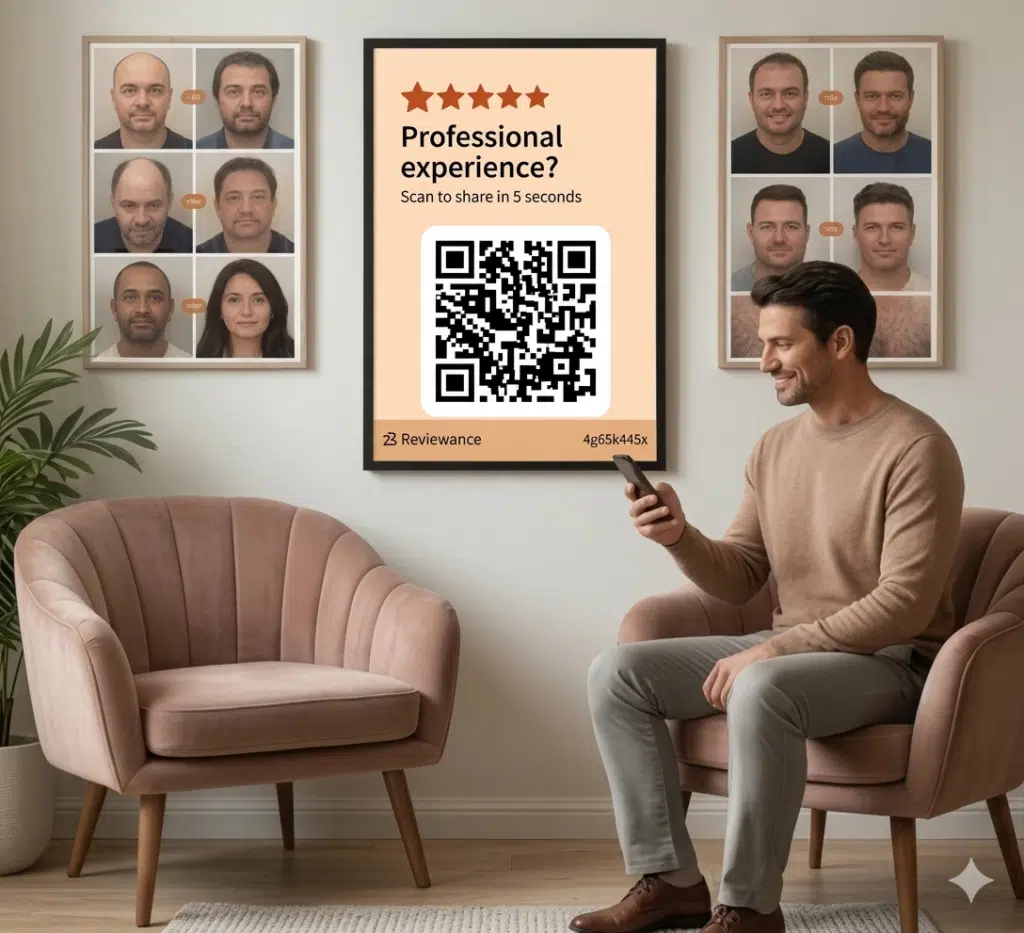
Should Every Hair Transplant Clinic Have a Google Business Profile (GBP)?
In the modern social proof economy, a Google Business Profile is not an optional marketing accessory; it is a foundational pillar of an aesthetic clinic's operational structure. For hair restoration centers, omitting a GBP means completely disconnecting from the primary channels where high-intent patients conduct risk assessment and research.
Operating a specialized surgical clinic without a verified profile immediately triggers consumer skepticism and a fear of being misled. Because hair restoration requires immense trust verification, the absolute absence of a public Google presence signals a lack of transparency, intensifying a prospective patient’s diagnosis uncertainty. Without a centralized, public profile to display honesty validation and surgical track records, a clinic will struggle to build the feeling of security required for high-ticket repair acceptance.
Furthermore, a optimized GBP is the single most powerful driver of local visibility and organic patient acquisition. Whether a business is targeting local regional patients through "near me" mobile searches or trying to capture international market share via medical tourism queries, Google Maps ranking dictates market share. A clinic’s presence in the Local 3-Pack provides an immediate quality signal and a competitive reputation impact that paid advertising simply cannot duplicate.
Ultimately, every serious clinic needs a GBP to tap into the compounding benefits of automated review freshness. It acts as a permanent, searchable archive of real patient transformations and experience verification that continuously builds referral business around the clock.
The Reviewance Strategy: For medical startups and expanding clinics, Reviewance eliminates the operational friction of profile management. By turning the post-operative follow-up into a painless and frictionless feedback loop, our platform automatically channels patient satisfaction directly into your Google Business Profile, permanently accelerating your local SEO growth.
How Hair Transplant Clinics Rank Higher on Google Maps
Ranking in Google’s Local 3-Pack is the ultimate competitive advantage for hair restoration centers. When high-intent patients search for surgical solutions, Google Maps acts as the primary gatekeeper. Achieving a dominant position requires a strategic mix of algorithmic optimization and real-world trust verification signals that prove your clinic's authority and proximity.
1. Treatment Keywords in Reviews
Google's local algorithm relies heavily on semantic data to understand the exact capabilities of your medical team.
- The SEO Impact: When past patients organically include specific service-specific keywords—such as "FUE hair transplant," "DHI technique," or "beard restoration"—directly into their review text, it builds massive location relevance for those exact search queries.
- The Conversion Value: These keyword-rich testimonials act as deep experience verification for prospective patients researching specific clinical methods, significantly reducing their initial diagnosis uncertainty.
2. Review Freshness and Consistency
A high overall rating is meaningless to Google's ranking algorithm if your last review was posted six months ago.
- The Algorithmic Signal: Search engines prioritize review freshness to ensure they are recommending active, functional clinics with consistent standards of guest satisfaction.
- The Velocity Strategy: A steady, predictable stream of monthly reviews tells the algorithm that your operational structure is consistently delivering successful outcomes, which sustains your long-term reputation impact.
3. Location Relevance & Geo-Targeting
To dominate local mobile searches, a clinic must anchor its digital profile to its physical coordinates and target service areas.
- Proximity Mapping: Google matches user search locations with your Google Business Profile data. Ensuring absolute consistency in your Name, Address, and Phone number (NAP) across the web reinforces this geographic authority.
- Local Intent: Reviews that naturally reference regional landmarks or cities (e.g., "traveled from North London to the clinic") further solidify your regional authority, turning local proximity into a primary driver of emergency or targeted intent bookings.
4. Patient Photo Engagement
Hair restoration is a deeply visual field, and user-generated media is an incredibly heavily weighted ranking signal for local SEO.
- The Visual Proof: When a patient uploads raw, unedited photos of their month-by-month hair growth progress directly to your Google Maps profile, it serves as the ultimate quality signal.
- Engagement Boost: Profiles with high patient photo interaction experience increased dwell time, which signals to Google that your profile provides valuable experience visualization, directly boosting your rank over competitors who only use stock photos.
5. Active Response Management
Your engagement with patient feedback is a direct reflection of your clinic's communication standards and professional brand identity.
- The Trust Factor: Consistently responding to all reviews—both positive and negative—proves your commitment to patient care and transparent communication.
- Algorithmic Value: Active response management increases the overall activity metrics of your profile. Crafting thoughtful, unique responses that subtly reference your dedication to safety and care reinforces your clinic's overall honesty validation.
6. International Patient Signals
For clinics operating in major medical tourism hubs, signaling global appeal is vital for attracting traveling patients.
- Multi-Lingual Social Proof: Reviews written in various languages or explicitly mentioning terms like "traveled from the US," "airport transfer," or "hotel coordination" expand your semantic reach.
- Mitigating Traveler Anxiety: These international markers tell Google your clinic serves a global audience, while providing prospective medical tourists with the safety reassurance and feeling of security they need to confidently accept a high-ticket international procedure.
The Psychology Behind Hair Transplant Reviews
When a potential hair transplant patient spends hours scrolling through Google reviews, they are not just gathering information. They are searching for emotional reassurance. They want to know if someone like them—someone who felt embarrassed, anxious, or hopeless about their hair loss—found a solution that worked. They are looking for permission to trust.
This is the psychology that drives hair transplant reviews. Understanding it is essential for any clinic that wants to collect authentic testimonials that convert prospects into patients.
The Heavy Emotional Burden of Hair Loss
Hair loss is rarely just a cosmetic issue. Research published in the Journal of Cosmetic Dermatology confirms that hair loss is associated with significant psychological distress, exacerbating depression, anxiety, and social withdrawal . For many patients, the experience disrupts self-image, reduces self-esteem, and impairs social functioning .
Patients frequently report feeling embarrassed, ashamed, and self-conscious. A cross-sectional study found that 48.33% of patients with androgenetic alopecia reported significant self-consciousness about their appearance . Many adopt avoidance behaviors—avoiding photos, mirrors, or social events—as their hair loss becomes more visible .
The impact extends beyond personal discomfort. A 2025 narrative review found that patients with hair loss perceive themselves as significantly older than their actual age and report quality-of-life burdens comparable to or exceeding those of chronic dermatologic conditions like psoriasis and eczema . One patient quoted in clinical literature described it simply: "My self-confidence was low and I was worried about getting a bad hair transplant, which would have made me feel worse" .
For clinics, understanding this emotional baseline is critical. A patient arriving for a consultation is not just seeking hair—they are seeking relief from years of embarrassment, self-doubt, and social anxiety. The reviews they leave will reflect whether that relief was achieved.
What Patients Look for in Reviews: The Trust Transfer
Insight: Patients often trust previous patients more than clinic advertisements.
This is the central psychological mechanism at work. Clinic marketing showcases polished "after" photos and confident claims. But prospective patients have learned to be skeptical. According to industry data, an estimated 30 to 40 percent of online testimonials are fabricated, incentivized, or selectively curated . Patients know this. They have been burned before.
What they trust instead is the unfiltered voice of another patient who has nothing to gain. This phenomenon is called trust transfer: the credibility a patient feels toward a reviewer transfers to the clinic the reviewer endorses.
The most effective reviews facilitate trust transfer by including specific elements:
- Full transparency: Patients who show their face and allow their name to be used carry more weight than anonymous accounts
- The complete journey: Reviews that document the full process—not just the happy ending—feel authentic
- Specific details: Genuine reviews include rich narratives about the search process, the consultation, the procedure experience, the recovery journey, and the final outcome
- Honest struggles: Reviews that mention pain, anxiety, or the "ugly duckling" phase paradoxically build more trust than those that describe everything as perfect
One patient who documented his complete experience captured this dynamic: "I could tell that Dr. Leonard had a lot of experience doing this procedure. His confidence made me feel relaxed and comfortable the entire time. I didn't feel rushed and everything happened the way Dr. Leonard said it would" . The specificity—mentioning feeling rushed, or rather the absence of it—makes the endorsement credible.
Conversely, short, generic reviews trigger suspicion. As one hair restoration expert notes, "Often you see very brief review, then that might question the authenticity of things" . A one-line "Good service" or a five-star rating with no narrative lacks the gravitas of a genuinely satisfied patient's account.
The Emotional Arc Hidden in Great Reviews
The most powerful hair transplant reviews are not about the final result alone. They trace an emotional arc that mirrors the actual patient experience. Research on patient journeys identifies five distinct emotional stages :
| Stage | Timeline | Emotional State | What Reviews Capture |
|---|---|---|---|
| Pre-Surgery | Before procedure | Fear, shame, research paralysis | The vulnerability that motivated action |
| Procedure Day | Day of surgery | Anxiety mixed with relief | The reality of the experience (pain, duration, care quality) |
| Shock Loss | Months 1-3 | Panic, doubt, fear of failure | The hardest moment—and the clinic's support through it |
| Cautious Optimism | Months 4-6 | Hopeful but guarded | The first signs of growth and emotional lift |
| Full Transformation | Months 9-12+ | Pride, confidence, relief | The final outcome and restored self-image |
Reviews that skip the difficult middle stages—especially shock loss and the "ugly duckling" phase—may feel incomplete or misleading to informed readers. One patient described this period candidly: "Those 18 months were the worst of my life. It consumed my life. I was angry, depressed and annoyed" . While negative, this level of honesty from a patient whose story ultimately resolved (through repair surgery) helps other patients understand what they are signing up for.
The clinics that earn the best reviews are those that prepare patients for this arc. As one expert explains, patients who understand the density ceiling (40-50% of original density is the realistic maximum), the ongoing hair loss problem (transplants require medical maintenance), and the emotional arc report the highest satisfaction—because their results meet or exceed informed expectations .
Why Appearance Confidence and Self-Esteem Are the Real Outcomes
When patients leave reviews, they are not reviewing grafts or surgical techniques. They are reviewing how they feel about themselves after the procedure.
A 2023 study published in the Journal of Cosmetic Dermatology found statistically significant improvement in self-esteem and quality of life in androgenetic alopecia patients after hair restoration surgery . Patients reported appearing nearly six years younger at six months post-procedure .
These psychological benefits surface repeatedly in authentic reviews:
- Appearance confidence: One female patient who underwent 2,655 grafts for a naturally high hairline said after one year: "The impact it's had on my life in the last year is just out of this world—it sometimes leaves me speechless"
- Emotional transformation: A male patient who had been losing hair since his twenties reported: "I have more self-confidence now than at any other time in my life"
- Anxiety reduction: Another patient simply said: "I don't have to worry about my hair anymore"
These statements are not about hair density measurements. They are about freedom from a preoccupation that dominated the patient's mental energy for years. The review captures not just satisfaction but relief—and that is what prospective patients are truly searching for.
The Risk of Bad Outcomes and What Reviews Reveal
Not all reviews are positive, and the negative ones are often the most psychologically revealing—and the most important for clinics to address.
A hair transplant that goes wrong does not just fail to restore hair. It actively damages mental health. One patient who received a botched transplant described the aftermath: "I was angry, depressed and annoyed... Everyone told me I should never have had the transplant in the first place. Even my kids said I looked stupid. I felt like it was my fault and I was embarrassed" .
The ISHRS 2025 Practice Census reported that repair cases now account for 6.9% of all hair transplants, up from 5.4% in 2021, with black-market repair cases comprising 10% of ISHRS member caseloads . These statistics represent thousands of patients whose psychological state worsened after surgery rather than improving.
What do these negative reviews teach clinics? They highlight the critical importance of:
- Honest expectation management before surgery
- Transparent credentialing (who actually performs the procedure)
- Proper psychological screening for conditions like body dysmorphic disorder (BDD), which is considered a contraindication for elective cosmetic procedures
- Responsive aftercare when problems arise
One patient who experienced a disastrous outcome noted that the clinic initially reassured him everything was normal—only to later admit problems when it was too late . This breakdown in communication transformed a poor surgical outcome into an actively traumatic experience.
How Reviewance.com Helps Capture Authentic Psychological Testimonials
The psychological power of a review depends on its authenticity. Generic, rushed, or incentivized reviews lack the emotional depth that facilitates trust transfer.
Reviewance helps clinics collect better reviews by capturing them at the optimal psychological moment:
- Immediate post-treatment capture via QR code: When a patient sees their results in the mirror for the first time—whether that is immediately after a procedure or at a 12-month follow-up—their emotional state is at its peak. Reviewance QR codes placed in treatment rooms capture that moment before it fades
- No delayed SMS or email: Traditional review platforms send requests hours or days later, by which time the patient has returned to daily life and the intensity of the emotional experience has diminished
- In-the-moment specificity: Patients asked to review immediately after seeing their results remember details—what the provider said, how the procedure felt, what they were worried about beforehand—that would otherwise be forgotten
- Physical presence builds trust: A QR code displayed prominently in a clinic signals transparency. Patients who scan it know they are leaving feedback for a clinic confident enough to ask for reviews in person
For hair transplant clinics specifically, Reviewance enables collection at key emotional milestones:
- After the initial consultation (capturing pre-surgery anxiety and trust in the provider)
- At the 12-month follow-up (capturing full transformation pride)
- During the cautious optimism phase (capturing the relief of seeing first results)
The Review as Emotional Artifact
A hair transplant review is never just about hair. It is a document of psychological transformation—or psychological damage. It records the journey from shame to confidence, from anxiety to relief, from distrust to trust transfer.
Clinics that understand this psychology do not just collect reviews. They earn them by delivering honest expectations, transparent communication, and genuine emotional support throughout the patient journey. And by using tools like Reviewance to capture patient feedback at the precise moments of peak emotion, they build a collection of authentic testimonials that speak directly to the fears and hopes of every prospective patient who comes after.
As one satisfied patient said, closing the loop on his own emotional arc: "Now when I look in the mirror, I feel fantastic and I don't have to worry about my hair anymore" . That is the outcome every review should document—and every prospective patient hopes to find.
Why Most Hair Transplant Clinics Struggle to Collect Reviews
A hair transplant is one of the most emotionally significant—and logistically complex—procedures a patient can undergo. The results take twelve months to fully develop. The recovery involves shedding, shock loss, and weeks of visible healing. And yet, most clinics struggle to convert satisfied patients into visible, authentic Google reviews.
This is not because patients are unwilling to share their experiences. It is because clinics systematically fail to ask at the right time, through the right channels, with the right follow-up systems in place. Understanding why most hair transplant clinics struggle to collect reviews is the first step toward fixing the problem.
Problem 1: Patients Focus on Recovery, Not Reviews
In the days and weeks following a hair transplant, the patient's world shrinks to a single focus: recovery.
The first 48 hours are consumed by managing donor area discomfort, protecting grafts while sleeping, and following precise washing instructions. Days 3 through 14 involve scab formation, crusting, and the delicate process of gentle washing. Weeks 2 through 6 bring the onset of shock loss—the sudden shedding of transplanted hairs that can panic even the most prepared patient .
During this entire period, the patient is not thinking about leaving a Google review. They are thinking about whether their grafts are surviving, whether the redness will fade before they return to work, and whether the bald patches they see in the mirror are normal or a sign of failure.
The psychological reality is this: a patient in the thick of recovery is in a state of heightened anxiety, not enthusiasm . Asking for a review during this window is not only ineffective—it actively risks capturing feedback that reflects temporary distress rather than final satisfaction.
Yet many clinics continue to send automated review requests at 7 days or 14 days post-procedure, precisely when patients are most anxious about shedding and slow growth. The timing is misaligned with the patient's emotional state, and the result is low response rates or reviews that mention unresolved concerns.
Problem 2: Clinics Ask Too Early (or At the Wrong Milestones)
The hair transplant review ecosystem is systematically biased toward early reviews—feedback written in the first days, weeks, or months after the procedure, before the actual result is visible .
These early reviews capture the consultation experience, the clinic's hospitality, the logistics of travel and accommodation, the communication style of the staff, and the patient's hope and optimism. They do not capture whether the hair actually grew well, whether the hairline looks natural, or whether the patient is ultimately satisfied .
A clinic with hundreds of enthusiastic early reviews and mediocre clinical outcomes is entirely plausible, because the review cycle is decoupled from the outcome cycle . Clinics with excellent patient management will generate positive early reviews regardless of their clinical quality—because the early experience and the clinical outcome are separate things being evaluated by the same patients at different times.
The irony is that clinics that wait too long lose the momentum of patient enthusiasm. Clinics that ask too early capture reviews that do not reflect the final result. Clinics that never follow up get nothing at all.
The optimal window for asking for a hair transplant review is after the 12-month follow-up appointment, when the patient has seen their final results and can comment on density, naturalness, and overall satisfaction . However, most clinics lack the systematic follow-up infrastructure to reach patients at this distant milestone.

Problem 3: No Follow-Up System
Across the hair transplant industry, one pattern emerges consistently: clinics lack structured follow-up systems for review collection.
A Care Quality Commission assessment of a hair transplant clinic in 2025 found that while the service conducted post-operative courtesy calls for all patients—including questions on satisfaction and service rating—there was "no evidence that this feedback was formally collated or reviewed, despite the potential for higher response rates compared to paper questionnaires" .
The report noted that response rates remained low, with only 12 responses out of approximately 800 FUE service users seen annually at that clinic . This represents a 1.5% response rate—a massive missed opportunity.
The fundamental issue is that review collection is treated as an afterthought rather than an engineered system. Clinics may have good intentions about asking for reviews, but without automated workflows, standardized timing, and assigned accountability, those intentions rarely translate into results .
A clinic cannot rely on individual staff members to remember to ask every patient. A clinic cannot rely on patients to remember to leave a review months after their procedure. A clinic needs a system that triggers review requests at the right moment, through the right channel, with a direct link that requires zero effort from the patient.
This is precisely where Reviewance changes the equation. By placing QR codes in treatment rooms and at checkout counters, clinics capture reviews immediately—while the patient is still in the building, still looking at their results, and still feeling the emotional satisfaction of a successful outcome. No follow-up needed. No delayed SMS. No email that gets ignored.
Problem 4: Fear of Looking "Commercial"
Many hair transplant clinic owners hesitate to actively collect reviews because they worry about appearing desperate or commercial.
There is a cultural belief in medicine that "excellent care speaks for itself"—that if you do good work, patients will naturally leave reviews without being asked. This belief is demonstrably false. Research across healthcare settings shows that fewer than 10% of satisfied patients leave reviews unprompted .
The fear is understandable but misplaced. A clinic that asks for reviews is not acting desperate. It is acting systematic. And patients understand the difference between a pressured request ("Please leave us a five-star review right now") and an invitation ("If you are happy with your results, we would love to hear about your experience").
The key distinction is timing and tone. A QR code placed at the checkout counter with a simple message—"Loved your results? Scan to share your experience"—does not feel commercial. It feels like an invitation from a confident clinic that is proud of its work.
Clinics that avoid asking for reviews out of fear of appearing commercial are not protecting their reputation. They are surrendering it to the small minority of dissatisfied patients who will leave negative reviews regardless of whether they were asked.
Problem 5: No Easy Review Process
Even when clinics remember to ask for reviews, they often make the process unnecessarily difficult.
Common friction points include:
- Asking patients to "find us on Google" rather than providing a direct link
- Sending review requests via email (open rates 20-28%) instead of SMS (98% open rates)
- Requiring patients to log into accounts they have forgotten the passwords for
- Placing QR codes in locations that are hard to scan or poorly lit
Every additional second of friction between a patient's desire to leave a review and their ability to do so reduces the likelihood that the review will be completed. A patient who is willing to leave a review at the checkout counter will not be willing to type out your clinic name, search for your listing, and navigate to the review section fifteen minutes later when they are already in their car.
The solution is a zero-friction process. A QR code that links directly to your Google review page. A code placed at eye level at the checkout counter. A code that is large enough to scan easily (minimum 1 inch), with sufficient contrast, and on a flat surface .
Reviewance provides exactly this: a simple, scannable QR code that takes patients directly to your review page in under five seconds. No typing. No searching. No logging in. Just one scan and the review form is open.
The Reputation Lag Problem: Why Delayed Collection Hurts Most
Hair transplantation has a unique structural characteristic that makes review collection particularly challenging: the delayed feedback loop .
Unlike a restaurant meal or a hotel stay—where the experience is evaluated immediately—a hair transplant's outcome takes six to twelve months to fully develop . This means:
- The patient's satisfaction level changes over time
- Early reviews (days or weeks post-procedure) do not reflect final outcomes
- Late reviews (12+ months) are difficult to collect because the patient has moved on
A 2025 analysis of the hair restoration industry noted that "reputation is delayed—but once established, it compounds (positively or negatively)" . Clinics that take early operational shortcuts do not see the consequences immediately—but those consequences surface later, often all at once .
This creates a structural risk for clinics that do not systematically collect reviews at the twelve-month milestone. They may have excellent clinical outcomes, but because they never asked patients to document those outcomes, their online reputation is built entirely on early procedural reviews—which may underrepresent the quality of their final results.
What Successful Review Collection Looks Like: The System Approach
The clinics that successfully collect reviews do not rely on memory, luck, or individual staff effort. They rely on engineered systems .
A systematic review collection process for hair transplant clinics includes:
1. QR Code Placement at Strategic Points
- Checkout counter (primary collection point)
- Treatment rooms (captures post-procedure enthusiasm)
- Follow-up appointment areas (captures final result satisfaction)
2. Multiple Collection Milestones
- Immediate post-procedure (captures care quality and early satisfaction)
- 12-month follow-up (captures final outcome and long-term satisfaction)
3. Zero-Friction Technology
- Direct links to Google review page
- No login or account creation required
- Optimized for mobile phones
4. Staff Training
- Every provider knows how to direct patients to the QR code
- Scripts are provided and practiced
- Asking for reviews is normalized as part of excellent care
Reviewance delivers all of these elements in a single platform. By placing QR codes in your clinic, you transform every patient interaction into an opportunity for authentic, immediate review collection—without SMS, without email, and without follow-up delays.
Most hair transplant clinics struggle to collect reviews not because their results are poor, but because their processes are broken. They ask too early, when patients are focused on recovery rather than reflection. They lack systematic follow-up, losing the connection with patients at the twelve-month milestone when final results are visible. They fear appearing commercial, so they do not ask at all. And when they do ask, they make the process too difficult.
The solution is not to try harder. The solution is to install a system that captures reviews at the right moment, through the right channel, with zero friction.
Reviewance provides that system. A QR code. A mobile phone. A direct link to your Google review page. No SMS. No email. No delays. Just real-time reviews from patients who are still in your clinic, still looking at their results, and still feeling the confidence that your work restored.
Best Moments to Ask Patients for Reviews
In hair transplantation, timing is everything—not just for clinical outcomes, but for capturing the authentic patient testimonials that build your online reputation. Ask too early, and the patient is still anxious about shedding, swelling, and the "ugly duckling" phase. Ask too late, and the emotional high of transformation has faded into everyday life, and the patient has moved on.
The best review moment usually comes when patients first notice visible transformation. That moment varies by patient, by procedure, and by the natural growth cycle of transplanted hair. Understanding where and when to capture that moment is the difference between a clinic that struggles for reviews and one that earns a steady stream of authentic, detailed five-star testimonials.
Here are the five optimal moments to ask hair transplant patients for reviews—and how Reviewance helps you capture each one.
Moment 1: After Visible Hair Growth Results (The "Transformation Moment")
The single most powerful moment to ask for a review is the first time a patient visibly notices their new hair growing. This is not a date on the calendar—it is an emotional event.
Hair transplantation follows a predictable but uneven growth timeline. Transplanted hairs typically shed at weeks 2 to 6 (shock loss). New growth begins to emerge at months 3 to 4. By month 6, patients typically see 40-50% of their final density. At month 9 to 12, the full result is visible .
The "transformation moment" varies by patient. For some, it happens at month 5 when they catch their reflection and realize their hairline is visible for the first time in years. For others, it happens at month 9 when a friend comments, unprompted, that something looks different—in a good way.
How to capture this moment: Train your clinical team to recognize verbal cues during follow-up appointments. When a patient says, "I looked in the mirror this morning and actually liked what I saw" or "My wife said my hair looks great" —that is your signal. Hand them a Reviewance QR code card immediately, while the emotion is fresh.
The Reviewance advantage: Unlike SMS or email platforms that send requests hours or days later—missing the emotional peak—your Reviewance QR code captures the review right there in the consultation room. The patient scans, types, and submits before they leave.
Moment 2: During Post-Operative Follow-Up Visits
Post-operative follow-up visits are built into every reputable hair transplant clinic's protocol. These visits occur at predictable intervals: day 1 (donor area check), day 7-10 (scab removal and washing instruction), month 3 (first growth assessment), month 6 (density evaluation), and month 12 (final result documentation).
Each of these visits represents a structured opportunity to collect feedback. However, not all follow-up visits are equal for review collection purposes.
Optimal follow-up visits for review collection:
| Visit Timing | Emotional State | Review Quality |
|---|---|---|
| Day 1 | Anxious, focused on recovery | Low—patient not ready |
| Day 7-10 | Healing, still uncertain | Low—results not visible |
| Month 3 | Cautiously optimistic, first sprouts | Medium—early hope but not final |
| Month 6 | Confident, visible transformation | High—strong transformation moment |
| Month 12 | Fully satisfied, final results | Highest—complete story available |
The month 6 and month 12 visits are your prime collection windows. At month 6, patients can see clear growth and feel confident enough to recommend the clinic. At month 12, the full transformation is visible, and the patient can speak to the entire journey from pre-operative anxiety to post-operative satisfaction.
How to capture this moment: Place Reviewance QR codes in every consultation and examination room. At the conclusion of the month 6 or month 12 visit—after the patient has seen their photos, compared them to pre-operative images, and expressed satisfaction—the provider says: "We are so glad you are happy with your results. Would you scan this code and share your experience? Other patients really need to hear from someone who has been through it."
The Reviewance advantage: The QR code is already there, on the counter or the wall. No staff member needs to remember to send a link later. No patient needs to remember to check their email. The review happens immediately, while the before-and-after photos are still fresh in the patient's mind.
Moment 3: After Patient Satisfaction Conversations
Sometimes the best review opportunities are unscripted. A patient spontaneously expresses gratitude—for the way they were treated, for the results they are seeing, for the clinic's responsiveness during a difficult recovery moment.
These satisfaction conversations happen in examination rooms, at checkout counters, over the phone, or even via email. The common thread is that the patient has voluntarily offered positive feedback. This is the easiest conversion in review collection: the patient is already in an advocacy mindset.
How to capture this moment: Train every team member—from surgeons to front-desk staff to patient coordinators—to recognize satisfaction statements and respond with a simple, low-pressure invitation:
Patient says: "I am so happy I chose your clinic. This has changed my life."
Staff responds: "That means everything to us. Would you be willing to share that same message on Google? Other patients really need to hear real experiences like yours. Here is our QR code—it takes about 30 seconds."
The Reviewance advantage: Because the Reviewance QR code is physical and always present—on the checkout counter, on the examination room wall, on a card in the patient's take-home folder—the staff member is never scrambling to find a link or remember a process. The QR code is always there, ready to be scanned.
Moment 4: After Before-and-After Photo Sessions
Before-and-after photo sessions are emotional moments. The patient sees their pre-operative self side-by-side with their current results. For many patients, this is the first time they fully appreciate the magnitude of the transformation.
Clinics typically document photos at multiple time points: pre-operative (baseline), day of surgery (graft placement), month 3 (early growth), month 6 (significant growth), and month 12 (final result). The month 6 and month 12 photo sessions are particularly powerful because the visual evidence of transformation is undeniable.
How to capture this moment: After the photo session is complete and the patient has viewed their side-by-side images, the clinical photographer or provider says:
"The difference is remarkable. Would you be willing to share your experience on Google? What you are feeling right now—other patients need to know that this is possible. Scan this code right here."
The Reviewance advantage: The Reviewance QR code can be placed directly next to the photo viewing monitor or on the photo consent form itself. The patient does not need to move, search, or remember anything. The review happens in the same room, at the same moment they are experiencing the emotional impact of their transformation.
Moment 5: Through Post-Treatment Messaging (as a Secondary Channel)
While Reviewance specializes in immediate, in-person review collection via QR codes, there is still a role for post-treatment messaging—particularly for patients who have already left the clinic but have not yet left a review.
The key difference between effective and ineffective messaging is timing and channel. Email requests have low open rates (20-28%) and are easily ignored. SMS requests have higher open rates (98%) but still suffer from the fundamental problem of delay: the patient is not in the emotional moment when the message arrives.
When to use post-treatment messaging:
- As a gentle reminder for patients who did not scan the QR code during their visit
- For follow-up appointments conducted via telemedicine (where physical QR code placement is not possible)
- For patients who have completed their 12-month result but live far away and cannot attend an in-person follow-up
What to avoid: Do not rely on post-treatment messaging as your primary review collection method. It is a secondary channel at best. The research is clear: the longer you wait to ask, the lower the response rate, and the less emotionally resonant the resulting review will be.
The Reviewance alternative: Instead of sending SMS or email requests, include a Reviewance QR code on appointment reminder cards, take-home instruction sheets, and even on the clinic's website for patients who want to leave a review from home. These QR codes work exactly the same way as the in-clinic codes—one scan, direct to Google review, zero friction.
The "Transformation Moment" Framework: A Practical Guide
Because every patient experiences their transformation moment at a different time, clinics need a systematic way to identify and capture it. Here is a practical framework:
Step 1: Educate patients about what to expect. During the consent process, explain the growth timeline clearly. Tell patients that results take time, that the "ugly duckling" phase is normal, and that you will be asking for their honest feedback when they see results they are happy with.
Step 2: Train staff to recognize verbal cues. Specific phrases indicate a patient is ready to leave a review:
- "I can finally see it growing."
- "People have started noticing."
- "I wish I had done this years ago."
- "This has changed how I feel about myself."
- "Thank you for everything."
Step 3: Make QR codes ubiquitous. Place Reviewance QR codes at every point of patient interaction: checkout counter, examination rooms, photo documentation area, waiting room, and on take-home materials. The patient should never be more than a few feet from a scannable code.
Step 4: Use the simple script. When a patient expresses satisfaction, respond immediately: "Would you scan this code and share that on Google? It helps others who are where you used to be."
Step 5: Document what works. Track which collection moments generate the highest volume and highest quality of reviews. Adjust your training and QR code placement accordingly.
What to Avoid: The Worst Moments to Ask
Just as there are optimal moments to ask for reviews, there are moments that guarantee failure—or worse, attract negative feedback.
Do not ask for a review:
- During the shock loss phase (weeks 2-6). The patient is anxious and may associate their temporary shedding with your clinical quality.
- Immediately after surgery. The patient is groggy, uncomfortable, and focused on recovery, not reflection.
- When the patient has expressed any dissatisfaction. Resolve first, then ask.
- Via email as the primary method. Email requests have low open rates and feel impersonal.
- Without a direct link. Asking patients to "find us on Google" adds friction that kills response rates.
Why Immediate, In-Person Collection Beats Delayed Digital Requests
The hair transplant industry has long relied on delayed digital requests—SMS and email messages sent days, weeks, or months after the patient's visit. This approach is fundamentally flawed for three reasons:
1. Emotional decay. The emotional high of seeing results fades within hours. A patient who would have written an enthusiastic, detailed review at the moment of transformation writes a brief, generic "thanks" two days later—or nothing at all.
2. Forgetting details. By the time a delayed request arrives, the patient has forgotten specific details: the provider's name, the exact timing of milestones, the specific conversation that put them at ease. Generic reviews lack the detail that makes testimonials credible.
3. Lower response rates. An SMS request sent days after an appointment converts a fraction of willing patients. An email request converts an even smaller fraction. A QR code presented at the moment of peak satisfaction converts the majority.
Reviewance solves all three problems by eliminating delay entirely. The QR code captures the review at the exact moment of visible transformation—when emotions are highest, details are freshest, and willingness to advocate is strongest.
The best moment to ask a hair transplant patient for a review is not a fixed date on a calendar. It is an emotional event: the moment they first notice visible transformation. For some patients, that happens at month 6. For others, month 9 or month 12. For all patients, it happens when they are in your clinic, looking at their results, and feeling the relief and confidence that successful hair restoration provides.
By placing Reviewance QR codes at every point of patient interaction—examination rooms, checkout counters, photo documentation areas, and take-home materials—you ensure that you are ready to capture that moment whenever it arrives. No SMS. No email. No delayed follow-up. Just immediate, authentic reviews from patients who are standing in your clinic, looking at their new hair, and ready to tell the world about their transformation.
Best QR Code Placement Ideas for Hair Transplant Clinics
You have invested in Reviewance to capture real-time reviews from your hair transplant patients. You have your QR codes ready, linked directly to your Google review page. Now comes the critical question: where should you put them?
A QR code that is never seen never gets scanned. Placement is everything. Hair transplant clinics have unique patient journeys—from the first consultation to the 12-month follow-up—and each stage presents distinct opportunities for review collection. The key is placing QR codes at the specific moments when patients are most likely to feel satisfied and motivated to share their experience.
Here are the five most effective QR code placement strategies for hair transplant clinics, optimized for the Reviewance real-time collection method.
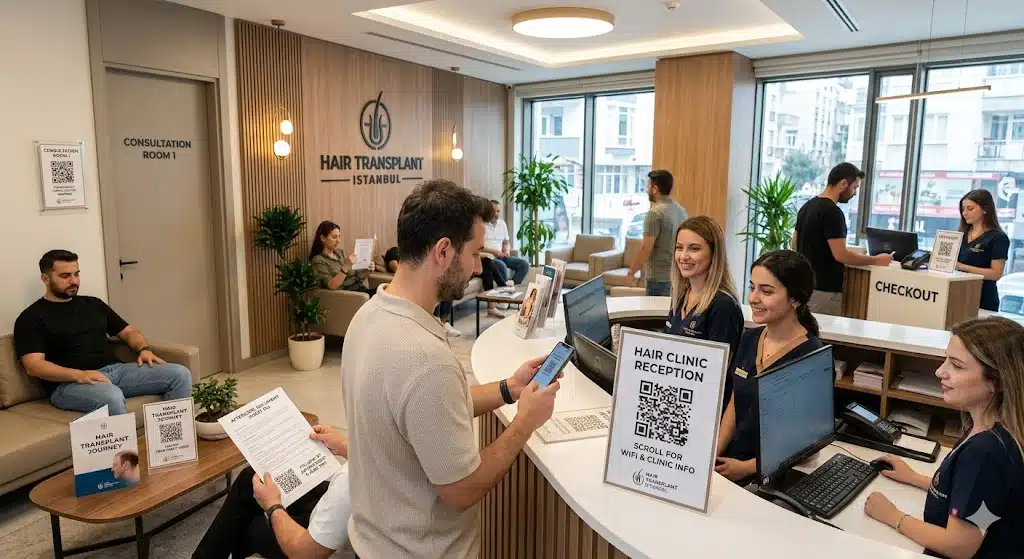
1. Reception Desk: The First and Last Touchpoint
The reception desk is where every patient journey begins and ends. It is the first thing new patients see during their initial consultation. It is the last thing they pass on their way out after surgery, after follow-up appointments, and after their 12-month final result visit.
Why it works: Patients naturally pause at the reception desk to check in, pay, schedule follow-up appointments, or ask questions. These pauses create natural moments for review collection—especially at the end of a visit when the patient is leaving satisfied.
Placement tips from QR code experts:
- Position the QR code at natural eye level—not hidden behind a monitor or buried under brochures
- Ensure the code is at least 1 x 1 inch for close-range scanning
- Use a durable vinyl sticker that can withstand daily cleaning by your front-desk staff
- Add a clear call-to-action above or below the code: "Loved your results? Scan to share your experience"
The Reviewance advantage: Unlike SMS or email platforms that ask for contact information and send delayed requests, your Reviewance QR code at reception captures the review immediately—while the patient is still in your clinic, still feeling the satisfaction of their appointment, and still standing right in front of you.
Pro tip: Place QR codes at both the check-in window (for returning patients who want to leave a review while waiting) and the check-out window (for patients leaving after a satisfying appointment). Different placements serve different patient states.
2. Consultation Rooms: Capturing Trust and Confidence
The consultation room is where patients make their most important decisions. It is where a nervous, balding patient decides whether to trust your clinic with their appearance and self-confidence. A successful consultation ends with the patient feeling informed, respected, and confident in their decision.
Why it works: After a consultation where the patient has decided to move forward, they are in a state of relief and trust. They have chosen your clinic over competitors. They feel good about their decision. This is an underutilized moment for review collection—not for the final result (which has not happened yet), but for the consultation experience itself.
Placement tips:
- Affix a small QR code sticker to the corner of the consultation desk or on a small acrylic stand
- Ensure the code is visible but not intrusive—it should feel like a helpful tool, not a pushy sales tactic
- Train your patient coordinators to mention the QR code at the end of a successful consultation: "We are so glad you have chosen us. If you felt comfortable with our team today, would you mind scanning this code and sharing your experience? Other patients in your situation really need to hear from someone who has been through this decision."
The Reviewance advantage: Reviews captured at the consultation stage document the patient's pre-surgery trust and confidence. These reviews are especially valuable for prospective patients who are still in the research phase and need reassurance that your clinic is the right choice.
Important distinction: Consultation reviews are different from result reviews. They capture the patient's experience of your team's communication, transparency, and empathy. Both types of reviews are valuable, and Reviewance QR codes in consultation rooms help you collect both.
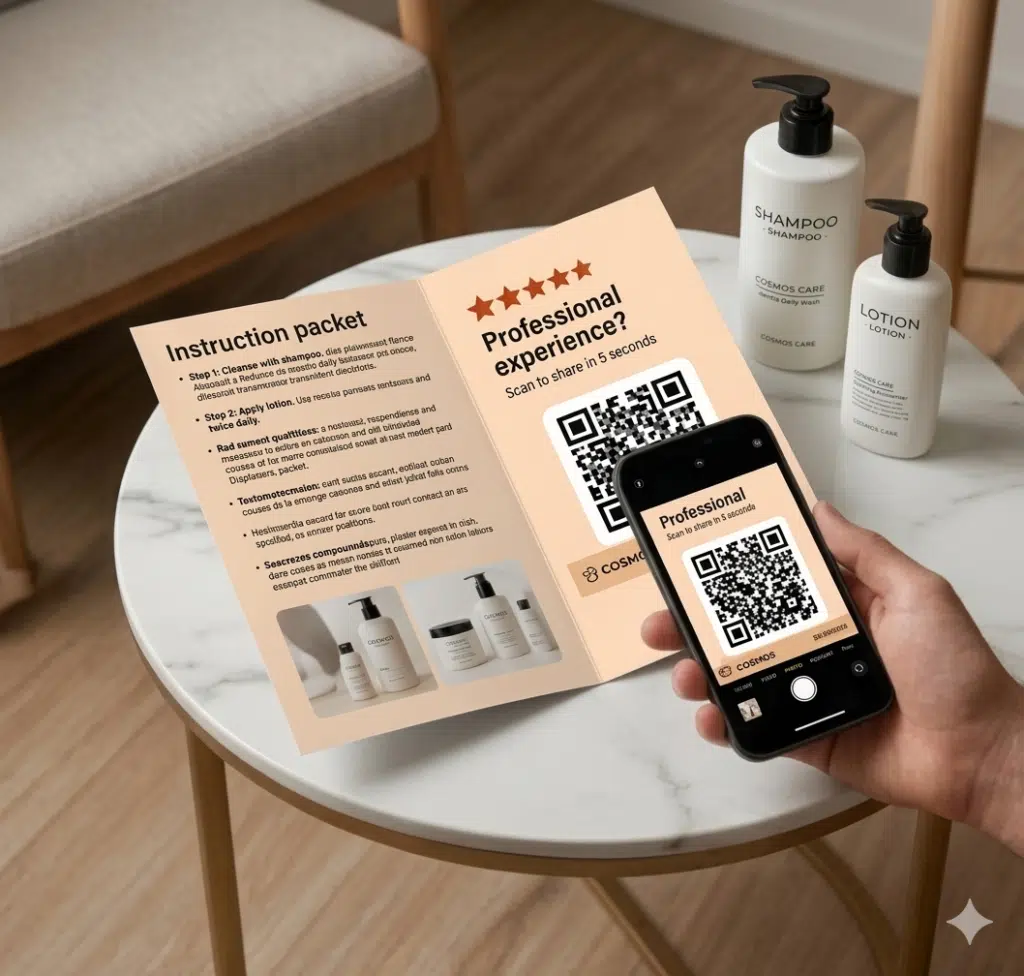
3. Treatment Folders: The Take-Home Reminder
Every hair transplant patient leaves your clinic with a folder of materials: pre-operative instructions, post-operative care guides, medication schedules, washing protocols, and follow-up appointment information. This folder goes home with the patient and sits on their counter or desk for weeks.
Why it works: The treatment folder is a physical object the patient handles repeatedly. Every time they open it to check instructions, they see your QR code. This creates multiple opportunities for review collection—not just immediately after the appointment, but throughout the recovery period when the patient is reflecting on their experience.
Placement tips:
- Print the QR code directly on the inside cover or back page of the treatment folder—not as a sticker that can fall off
- Include a brief instruction: "When you see results you love, scan this code to share your experience on Google"
- Ensure sufficient "quiet zone" (white space) around the code so scanners can read it clearly
- Test the code on your specific paper stock before mass printing—some glossy or textured papers interfere with scanning
The Reviewance advantage: Unlike SMS or email platforms that send a single request at a fixed time (which may not align with the patient's transformation moment), a QR code on a treatment folder is always available. The patient scans it when they are ready—which often coincides with their personal transformation moment.
Pro tip: Include a small note on the folder: *"Your results will take 6-12 months to fully develop. When you see growth you are happy with, scan this code and tell us about it."* This sets appropriate expectations and primes the patient to leave a review at the optimal time.
4. Aftercare Documents: Embedded in Daily Routine
Aftercare documents are the practical guides patients use every day during the critical first weeks of recovery: washing instructions, sleeping position guides, medication schedules, and activity restrictions. These documents are referenced multiple times daily.
Why it works: The patient is already engaging with these documents. Adding a QR code does not require extra effort from the patient—it simply places a review opportunity in a document they are already using. Additionally, aftercare documents are often kept for the entire recovery period, meaning the QR code remains accessible for months.
Placement tips:
- Include a QR code on the first page of your aftercare instruction sheet
- Place the code near the bottom of the page, after the clinical instructions, so it does not distract from critical medical information
- Use a clear, non-intrusive call-to-action: "Happy with your recovery? Scan to share your experience"
- Consider a dynamic QR code that allows you to change the destination later without reprinting thousands of documents
The Reviewance advantage: The QR code on aftercare documents serves as a long-term reminder. A patient who is not ready to leave a review at week 2 may be ready at month 6—and the QR code is still there, waiting on their refrigerator or desk.
Pro tip: For clinics using digital aftercare platforms (patient portals, mobile apps, or email sequences), include the same QR code as an image within those digital materials. Patients can scan the QR code from their computer screen or second device.
5. Checkout Area: The Final Moment of Satisfaction
The checkout area is where the patient completes their financial transaction, schedules their next appointment, and receives any final instructions before leaving your clinic. For many patients, this is the moment they express satisfaction with their visit.
Why it works: Checkout is the natural conclusion of the patient's in-clinic experience. They have just seen their provider. They have just reviewed their results (whether immediate post-op or at a follow-up). They are about to walk out the door. This is your last chance to capture a review in person before the patient leaves the building.
Placement tips:
- Place the QR code on the checkout counter, directly in the patient's line of sight
- Use a small acrylic stand or a high-quality vinyl sticker—make it look intentional, not like an afterthought
- Train checkout staff to use a simple script: "Before you go, if you were happy with your visit today, would you scan this code and leave us a Google review? It takes about 30 seconds."
- Keep a tablet at the checkout desk with the Google review page already loaded for patients who prefer not to use their own phones
The Reviewance advantage: SMS and email platforms lose patients at the door. The patient leaves, the emotional moment passes, and the delayed request arrives hours later to an inbox full of distractions. Reviewance captures the review before the patient leaves—when satisfaction is highest and the experience is freshest.
Pro tip: For patients who have just completed their 12-month final result appointment, the checkout area review is especially powerful. They have just seen their before-and-after photos. They have just confirmed their satisfaction with their provider. The QR code at checkout captures this peak emotional moment before it fades.
QR Code Design Rules for Hair Transplant Clinics
Great placement means nothing if your QR code is illegible. Follow these design rules:
| Rule | Why It Matters | Implementation |
|---|---|---|
| High contrast | Scanners need distinction between dark and light areas | Dark code on light background (or reverse, but keep contrast strong) |
| Minimum 1-inch size | Cameras cannot focus on tiny patterns | 1" minimum for close range; larger for distance (e.g., 2" on wall) |
| Quiet zone | Surrounding elements confuse scanners | At least 4x the width of one QR module of blank space around the code |
| Flat surfaces | Curved surfaces distort the pattern | Apply only to flat or gently curved areas |
| Test before printing | Lighting, material, and angle affect scannability | Test with multiple phones and under different lighting conditions |
| Include a call-to-action | Patients need to know why they should scan | "Scan to leave a Google review" or "Share your experience" |
What NOT to Do: Common QR Code Placement Mistakes in Hair Clinics
❌ Placing codes only at reception. Patients spend most of their time in consultation rooms, treatment areas, and examination rooms. If your only QR code is at reception, you are missing the moments of highest emotional impact.
❌ Using paper stickers outdoors or in high-touch areas. Paper degrades with cleaning products, hand oils, and moisture. Use vinyl for surfaces that are touched or cleaned frequently.
❌ Putting codes at floor level. No patient wants to crouch down and scan a QR code near their feet. Keep codes at waist level or higher—typically 40-60 inches from the floor.
❌ Forgetting mobile optimization. If your QR code links to a page that is not mobile-friendly, patients will bounce immediately. Test your Reviewance review link on a phone before printing.
❌ No call-to-action. A naked QR code with no context gets ignored. Always tell patients what they will get by scanning and why they should do it.
❌ One code for all moments. Different patients at different stages need different prompts. Consider using different QR code designs or accompanying text for consultation rooms (trust-focused) versus 12-month follow-up areas (result-focused).
The Reviewance Difference: Capture the Moment, Not the Number
Traditional review platforms ask you to collect phone numbers and email addresses—then send delayed SMS or email requests that patients ignore. They turn a 30-second review opportunity into a multi-day follow-up sequence with diminishing returns.
Reviewance works differently. Your QR codes capture reviews immediately, at the exact moment of peak satisfaction—whether that is trust after a consultation, relief after surgery, or transformation at the 12-month follow-up.
By placing Reviewance QR codes at the five strategic locations outlined above—reception desk, consultation rooms, treatment folders, aftercare documents, and checkout area—you transform your entire clinic into a review collection engine. No SMS. No email. No delays. Just real-time reviews from happy patients who are already in your building.
Start with the checkout area and consultation rooms—these will generate the highest volume of immediate reviews. Add treatment folders and aftercare documents for long-term reminders. Place a QR code at reception as your catch-all for every patient who walks through your door. With consistent placement and clear calls-to-action, your review profile will grow steadily, authentically, and automatically.
How Google Reviews Influence Hair Transplant Bookings
For hair transplant clinics, a Google review is never just a rating. It is a conversion tool, a trust signal, an international credential, and a referral engine all wrapped into one five-star package. In an industry where patients are making life-changing decisions about their appearance—often spending thousands of dollars or traveling across borders—reviews are the single most powerful factor separating clinics that are fully booked from those that struggle to fill consultation slots.
Here is how Google reviews directly influence hair transplant bookings across five critical dimensions.
1. Consultation Conversion Rates: From Research to Reality
The journey from online researcher to booked consultation is fragile. Hair transplant patients spend weeks or months reading, comparing, and agonizing over their decision. At every step, Google reviews either push them forward or send them back to search.
Research across specialty healthcare clinics shows that clinics with 4.5+ stars get 200–300% more appointment bookings than lower-rated competitors . Conversely, clinics with 3.5 stars or less lose approximately 70% of potential inquiries before they even pick up the phone .
Why such a dramatic difference? Because the hair transplant consultation is not just about information—it is about trust. A prospective patient who has read five detailed, authentic five-star reviews arrives at the consultation already 80% convinced. They are there to confirm, not to decide. A patient who finds limited reviews or mixed ratings arrives skeptical, defensive, and ready to spot red flags.
The consultation conversion rate is directly proportional to the quality and quantity of your Google reviews. Each positive review is a pre-sold conversation.
The Reviewance advantage: By placing QR codes at strategic moments—after visible growth, during follow-up visits, and after before-and-after photo sessions—you capture reviews from patients at their highest moment of satisfaction. These emotionally rich, detailed testimonials become the conversion fuel for your next wave of consultations.
2. International Patient Trust: The Cross-Border Credential
Hair transplantation is a global industry. Patients routinely travel from the UK to Turkey, from the US to Mexico, from Australia to Thailand. But international travel introduces a critical vulnerability: the patient cannot visit your clinic before booking. They cannot see the facility, meet the staff, or assess the hygiene standards in person.
In this context, Google reviews become the virtual site visit .
The cautionary tale of Tom Brett, a 31-year-old from Portsmouth, illustrates what happens when international patients trust advertising over reviews. Drawn by online ads promising top-end treatment for £1,300 in Turkey, Brett flew to Istanbul for his procedure . The doctor who had communicated with him before the trip appeared briefly, then handed the operation to an assistant and never returned. Staff spoke little English. Within months, his transplanted hair fell out in clumps, leaving patchy bald spots, nerve damage, and a result he described as "devastating" .
When he tried to contact the clinic for help, his messages were ignored. The clinic told him their responsibility ended at 12 months and suggested he pay for another transplant .
This story is not rare. Another patient who had his first hair transplant in Turkey described the experience as feeling like "just another number being rushed through the process" with "very little personal care, hardly any proper aftercare advice, and the attention to detail simply wasn't there" .
For international patients, the only defense against this outcome is the visible, verifiable track record of authentic patient experiences. A clinic with hundreds of detailed, consistent, positive Google reviews has already proven itself across multiple dimensions: communication, clinical quality, aftercare, and results.
The Reviewance advantage: International patients cannot scan a QR code in your clinic. But they can read the reviews that your in-person patients left during their visits. By systematically collecting reviews at the 12-month follow-up—when results are fully visible—you create an international marketing asset that works 24/7, regardless of geography.
3. Premium Pricing Perception: Justifying Higher Fees
Hair transplant pricing varies enormously—from £1,300 budget packages to £10,000+ premium procedures. The difference is not just clinical quality; it is perceived value. And perceived value is built on trust.
Research indicates that patients trust high-rated specialty clinics enough to pay higher fees, choose premium treatments, and commit to long-term plans . A clinic with a 4.8-star average across 500+ reviews can charge significantly more than a competitor with a 4.0-star average across 50 reviews—even if their clinical outcomes are comparable.
Why? Because patients are not just paying for grafts. They are paying for confidence. A review that says "I was nervous about the pain, but the team was incredible" or *"I am 12 months post-op and could not be happier"* is worth hundreds of pounds in perceived value.
The Harley Street Hair Transplant Clinics exemplify this dynamic. Their Google review page shows patient after patient describing the same themes: "first class from start to finish," "professional, caring, and incredibly skilled," "the support and guidance I received were amazing" . These reviews do not just describe satisfaction—they describe a premium experience. And that premium experience commands premium pricing.
Conversely, clinics that cannot demonstrate this level of documented patient satisfaction are forced to compete on price alone—a race to the bottom that erodes margins and attracts price-sensitive patients who are often the most difficult to satisfy.
The Reviewance advantage: Premium reviews require premium timing. A generic "great clinic" review left immediately post-op does not command the same pricing power as a detailed 12-month review that describes full transformation. Reviewance QR codes placed at 12-month follow-up appointments capture the reviews that justify premium pricing.
4. Before-and-After Credibility: When Photos Are Not Enough
Hair transplant marketing has a credibility problem. As one industry expert bluntly states: "Photos lie. Videos don't."
Before-and-after photos can be manipulated through changing lighting, angles, hair length, or image size to exaggerate results. More concerning, some clinics present "before and after" photos from two different individuals entirely . Others photograph patients after multiple hair transplant procedures and present those images as if they reflect the outcome of a single surgery .
Patients know this. They have become skeptical of marketing materials and polished gallery images. What they trust instead is the independent, unfiltered voice of another patient—documented in a Google review that includes their own before-and-after photos .
On the Hair Restoration Network forum, one patient shared a critical insight: "I was just an inch away from booking a hair mill based on Google reviews before I stumbled upon this goldmine of a forum" . Another forum member advised: "Simple question: are there any independent reviews posted by patients of this doctor on forums from start to finish? Otherwise you're just hoping that what you see posted on social media (which is typically cherry-picking the doctor's best results) is what you're going to get" .
The most credible reviews are those that document the full journey—from pre-operative anxiety through the ugly duckling phase to the final 12-month transformation. These reviews typically include photos taken by the patient themselves, not curated by the clinic. They show the reality of the process, not just the highlight reel.
The Reviewance advantage: The 12-month follow-up appointment is the ideal moment to capture this comprehensive review. The patient has just seen their before-and-after photos. They are holding their phone. A Reviewance QR code on the examination room counter captures this documentation at the exact moment of peak credibility.
5. Referral Growth: The Viral Multiplier
Google reviews do not just influence the person reading them. They influence everyone that person tells—and everyone those people tell.
A single detailed, authentic review can generate multiple referrals. The patient who leaves a five-star review at 12 months is not just endorsing your clinic. They are providing content that their friends, family, and social media connections will see and trust.
The referral multiplier works like this:
| Review Element | Referral Impact |
|---|---|
| Named provider | Friends ask: "Who did yours?" |
| Specific results | Colleagues notice: "Your hair looks great" |
| 12-month update | Social media shares generate inquiries |
| Photo documentation | Screenshots sent to others researching clinics |
One patient who underwent a repair procedure after a failed Turkish transplant described the contrast: "The difference between the two experiences is unbelievable – it honestly feels like two completely different worlds... The quality of the work, the natural design, and the care I received are on another level" . A review like this does not just bring one booking. It brings everyone that patient knows who is considering a hair transplant.
The Harley Street clinic's Google review page shows patients explicitly making referrals: "I would highly recommend Harley Street Hair Transplant clinics" and "I honestly can't recommend Harley Street Hair Clinic enough" . Each of these statements is a referral trigger.
The Reviewance advantage: The best referral-generating reviews come from patients who have completed their full journey and can speak to the entire experience with confidence. By capturing these reviews at the 12-month milestone—via QR codes in the examination room or checkout area—you transform every satisfied patient into a referral engine.
The Cumulative Effect: Reviews as Your Digital Sales Team
When all five factors align—consultation conversion, international trust, premium pricing, photo credibility, and referral growth—Google reviews become more than a reputation metric. They become your most effective sales team, working 24 hours a day, 365 days a year, across every time zone and language.
A patient researching hair transplant clinics typically reads between 4 and 7 Google reviews before booking a consultation. Each review they read either builds confidence or erodes it. Each specific detail—a named provider, a described outcome, a documented 12-month result—adds weight to the decision.
The clinics that dominate their markets are not necessarily the best surgeons. They are the best documented surgeons. They have systematic review collection processes that capture patient satisfaction at the moments it matters most: after visible growth, during follow-up visits, and at the 12-month transformation milestone.
Reviewance provides the infrastructure for this systematic collection. By placing QR codes at reception desks, in consultation rooms, on treatment folders, and throughout aftercare documents, you create a review collection engine that requires no SMS, no email, and no delayed follow-up. Your patients leave reviews when they are happiest—and those reviews drive bookings, justify premiums, and generate referrals for years to come.
Google reviews are not a vanity metric for hair transplant clinics. They are a direct driver of consultation volume, international patient acquisition, premium pricing power, before-and-after credibility, and organic referral growth. A clinic with a strong, recent, detailed review profile will consistently outperform a clinic with superior clinical skills but inferior documentation of patient satisfaction.
The evidence is clear across patient forums, industry research, and real-world booking data: patients trust previous patients more than clinic advertisements. And they act on that trust by booking consultations, paying premium prices, traveling internationally, and referring their friends.
Reviewance helps you earn that trust systematically—capturing reviews at the moments when your patients are most satisfied, most credible, and most motivated to share their transformation with the world.
Google Review Examples for Hair Transplant Clinics
A single Google review can be the difference between a prospective patient booking a consultation or scrolling to the next clinic. But not all reviews are created equal. The most effective reviews for hair transplant clinics contain specific elements that address the deepest fears and desires of potential patients: trust, treatment quality, professionalism, and emotional reassurance.
Below are real-world examples of effective Google reviews for hair transplant clinics, analyzed to reveal why they work and how you can collect more reviews like them using Reviewance
Example 1: The Trust + Quality + Professionalism + Reassurance Review
Review Text:
"Very natural-looking results and professional staff. The doctor explained the entire process clearly."
Analysis:
This short review is remarkably dense with persuasive power. Let us break down what each element communicates to a prospective patient:
| Element | What It Signals | Why It Matters |
|---|---|---|
| "Natural-looking results" | Treatment quality | The single biggest fear of hair transplant patients is looking "pluggy" or artificial. This phrase directly assures them that won't happen. |
| "Professional staff" | Professionalism | Patients worry about being treated like a number in a "hair mill." This signals a caring, competent team. |
| "Doctor explained the entire process clearly" | Trust signal + Emotional reassurance | Pre-operative anxiety is driven by fear of the unknown. A doctor who communicates clearly reduces that anxiety before the patient even walks in. |
Why this works: The review addresses the three questions every prospective patient is asking: (1) Will it look natural? (2) Will I be treated well? (3) Will I know what is happening to me? It answers all three in under 20 words.
What to ask for: When a patient thanks you for explaining things clearly, ask: "Would you mention that in a review? Other patients are really nervous before surgery, and hearing that we explain everything helps them feel safe."
How Reviewance helps: Place QR codes in consultation rooms. After a patient has just had their questions answered and feels relieved, they can scan and leave this exact type of trust-building review before they even leave the building.
Example 2: The Emotional Transformation Review
Review Text:
*"I was losing my hair at 24 and it destroyed my confidence. Now at 25, eight months post-op, I look in the mirror and actually smile. The team at [clinic name] gave me my self-esteem back. Cannot recommend them enough."*
Analysis:
This review works because it documents a psychological journey, not just a medical outcome.
| Element | What It Signals | Why It Matters |
|---|---|---|
| "Losing my hair at 24... destroyed my confidence" | Vulnerability | The patient admits to the emotional pain that most prospective patients feel but rarely articulate. This creates instant identification. |
| "Eight months post-op... I look in the mirror and actually smile" | Emotional reassurance | The review provides hope—not just for hair, but for happiness. |
| "Gave me my self-esteem back" | Trust signal + Treatment quality | The patient attributes their emotional recovery directly to the clinic. This is the ultimate endorsement. |
Why this works: Hair loss is rarely just about hair. It is about identity, attractiveness, aging, and social confidence. This review speaks directly to those deeper concerns. A prospective patient reading this thinks: "If this happened for him, maybe it can happen for me."
What to ask for: When a patient expresses emotional relief during a follow-up appointment—"I feel like myself again" or "I don't avoid photos anymore" —hand them a QR code and say: "What you just said—other patients need to hear that. Would you scan this and share it?"
How Reviewance helps: The 12-month follow-up is the prime moment for these emotional transformation reviews. Place QR codes in examination rooms and at the checkout counter. When the patient has just seen their before-and-after photos and expressed joy, capture it immediately.
Example 3: The "I Did My Research" Review
Review Text:
"I spent over a year researching clinics across four countries. I read hundreds of reviews, joined forums, and spoke to former patients. I chose [clinic name] and I made the right decision. The results at 12 months exceed my expectations. If you are on the fence like I was, just book the consultation."
Analysis:
This review is powerful because the reviewer positions themselves as a skeptical, informed consumer—not an easy-to-please patient.
| Element | What It Signals | Why It Matters |
|---|---|---|
| "Spent over a year researching... four countries... hundreds of reviews" | Credibility | The reviewer has done more homework than most patients. Their endorsement carries extra weight. |
| "I made the right decision... results exceed my expectations" | Trust signal + Treatment quality | The informed skeptic is satisfied. This is the hardest person to please. |
| "If you are on the fence like I was, just book the consultation" | Emotional reassurance | Direct permission-giving. The reviewer tells hesitant prospects to stop researching and take action. |
Why this works: Many hair transplant prospects get stuck in "analysis paralysis." They read, compare, worry, and delay. This review is written specifically for them—by someone who was exactly where they are now.
What to ask for: When a patient tells you they researched extensively before choosing your clinic, ask: "Would you mention that in a review? There are so many people out there stuck in research mode. Your story could help them move forward."
How Reviewance helps: These patients often leave their most detailed reviews at the 12-month milestone. A Reviewance QR code on the examination room counter or treatment folder ensures they can leave that review immediately after their final result appointment.
Example 4: The "I Was Terrified of Pain" Review
Review Text:
"I almost didn't book because I was terrified of the pain. I have a low threshold and the idea of needles in my scalp made me nauseous. I wish I had done this years ago. The local anesthesia was the only uncomfortable part and it was over in minutes. The rest of the procedure I barely felt. Recovery was easier than expected."
Analysis:
This review directly addresses the #1 procedural fear: pain.
| Element | What It Signals | Why It Matters |
|---|---|---|
| "I almost didn't book because I was terrified" | Vulnerability | The reviewer admits to a fear that many prospects feel but are embarrassed to voice. |
| "Low threshold... needles made me nauseous" | Credibility | The reviewer is not a tough guy. If they could handle it, anyone can. |
| "Only uncomfortable part... over in minutes... barely felt the rest" | Emotional reassurance + Professionalism | Specific, honest pain description that paradoxically reduces fear by being realistic rather than dismissive. |
Why this works: Pain is a top-three concern for first-time hair transplant patients. Most clinic marketing avoids the topic or makes vague promises. This review addresses it directly and honestly—which builds more trust than pretending pain does not exist.
What to ask for: When a patient tells you post-op that "it was not as bad as I expected," ask: "Would you share that in a review? So many people are terrified of the pain and your honest experience could really help them."
How Reviewance helps: Place QR codes in the recovery area or at the day 1 follow-up. Patients who are relieved that the procedure was manageable can leave reviews immediately, capturing that relief while it is fresh.
Example 5: The Repair Patient Review (High Trust Signal)
Review Text:
"I had a botched transplant elsewhere. Spent 18 months feeling angry, depressed, and embarrassed. I looked worse than before I started. Dr. [Name] took me on as a repair case when two other clinics said I was too difficult. One year after my repair surgery, I finally have a hairline that looks natural. I cannot describe what it feels like to not hide under hats anymore. If you have been damaged by another clinic, do not give up. These people can fix you."
Analysis:
This review is extraordinarily powerful because it comes from the most skeptical, most burned patient population: repair cases.
| Element | What It Signals | Why It Matters |
|---|---|---|
| "Botched transplant elsewhere... angry, depressed, embarrassed" | Vulnerability + Credibility | The reviewer has been harmed by the industry. Their trust is hard-earned. |
| "Two other clinics said I was too difficult" | Treatment quality + Professionalism | The clinic took on a case others rejected. This signals skill and confidence. |
| "Finally have a hairline that looks natural... not hide under hats anymore" | Emotional reassurance | The transformation is described in behavioral terms (no more hiding), not just clinical terms. |
| "If you have been damaged... these people can fix you" | Trust signal | Direct permission-giving to the exact patient population that needs this clinic most. |
Why this works: Repair patients are the most loyal and most vocal advocates because they have experienced both failure and success. Their reviews carry weight that first-time patient reviews cannot match. They also attract other repair patients—a high-value, high-fee patient segment.
What to ask for: At the 12-month repair follow-up, when the patient expresses relief and gratitude, ask: "Your journey has been so hard. Would you be willing to share it on Google? There are other people out there right now who have been damaged by bad clinics and feel hopeless. Your story could be exactly what they need to read."
How Reviewance helps: Repair patients often have complex, emotional stories that take time to tell. A QR code on a treatment folder or aftercare document allows them to write their review at home, at their own pace, while still having a direct link to your Google review page.
Example 6: The "Worth the Money" Review (Premium Pricing Justification)
Review Text:
"Yes, it was expensive. Yes, I hesitated because of the cost. But 18 months later, I understand why. The cheap clinics in Turkey quoted me half the price, but the research I did showed too many horror stories. I paid for quality and I got it. My hairline is undetectable. My donor area healed perfectly. The aftercare was exceptional. Sometimes you get what you pay for."
Analysis:
This review directly addresses the price objection—one of the most common barriers to booking premium procedures.
| Element | What It Signals | Why It Matters |
|---|---|---|
| "Yes, it was expensive. Yes, I hesitated" | Vulnerability | The reviewer admits to the same cost concerns every prospect has. |
| "Cheap clinics in Turkey quoted me half the price... too many horror stories" | Trust signal | The reviewer explicitly compares premium against budget options and explains why premium won. |
| "I paid for quality and I got it... you get what you pay for" | Treatment quality + Premium pricing perception | Direct justification of the clinic's pricing model. |
Why this works: Every premium hair transplant clinic faces price competition from budget providers. This review does the clinic's sales work for it, explaining to price-sensitive prospects why paying more is actually the smarter financial decision.
What to ask for: When a patient tells you they are glad they did not go to a cheaper clinic, ask: "Would you put that in a review? Other patients are tempted by the low prices, but they need to hear from someone who made the right choice."
How Reviewance helps: These reviews are best captured at the 12-month milestone when the patient has full visibility of their results. A QR code at the checkout counter after the final result appointment captures this endorsement immediately.
What Makes a Great Hair Transplant Review? Key Patterns
Analyzing hundreds of effective reviews reveals consistent patterns. The most persuasive reviews typically include:
| Element | Why It Matters | Example Phrase |
|---|---|---|
| Natural results mention | Addresses fear of "pluggy" appearance | "natural-looking," "undetectable," "no one knows" |
| Provider name | Personalizes the experience, rewards staff | "Dr. Smith was incredible" |
| Timeline reference | Validates the long waiting period | "8 months post-op," "at 12 months" |
| Emotional language | Connects with prospective patients' feelings | "confidence," "smile," "relief," "freedom" |
| Pain honesty | Builds credibility by not pretending perfection | "the numbing was uncomfortable but brief" |
| Comparison to other clinics | Signals informed choice, justifies premium pricing | "I researched four clinics before choosing this one" |
| Recovery description | Manages expectations for future patients | "first week was swollen, but manageable" |
What to Avoid: Weak Review Examples for Hair Transplants
Not all reviews are equally helpful. Here are examples of reviews that provide limited value:
Too vague:
"Great clinic. Would recommend."
Why it is weak: No specific information about results, naturalness, pain, or recovery. Does nothing to address prospective patient fears.
Missing timeline:
"Just had my procedure yesterday. Staff were nice."
Why it is weak: The patient has not seen results yet. This review has no credibility about the actual outcome that matters.
No emotional component:
"Technically competent procedure. Graft count accurate."
Why it is weak: Reads like a clinical audit, not a patient testimonial. Does not address the psychological reasons people seek hair transplants.
How Reviewance Helps You Collect Better Reviews
The quality of a review is directly correlated to when it is collected. A patient asked to review at the moment of peak satisfaction—after seeing their 12-month results, after expressing emotional relief—will write a detailed, specific, emotionally resonant review. A patient asked via delayed SMS or email will write a brief, generic review—or none at all.
Reviewance ensures you capture reviews at the optimal moment by placing QR codes at strategic points in your clinic:
| QR Code Location | Best Review Type Collected |
|---|---|
| Consultation room | Trust signals, professionalism, clear communication |
| Treatment folder | Long-term reminders for 12-month reviews |
| Aftercare documents | Pain honesty, recovery reality, emotional reassurance |
| Examination room (12-month follow-up) | Natural results, emotional transformation, premium pricing justification |
| Checkout counter | All types—final capture before patient leaves |
By making review collection immediate, friction-free, and emotionally timed, Reviewance helps you build a portfolio of Google reviews that do not just look good—they convert skeptical prospects into booked consultations.
The most effective Google reviews for hair transplant clinics contain four critical elements: trust signals (the clinic is reliable), treatment quality (results look natural), professionalism (staff are competent and caring), and emotional reassurance (the patient feels better about themselves).
The example review—"Very natural-looking results and professional staff. The doctor explained the entire process clearly"—contains all four elements in under 20 words. It is short, specific, and persuasive.
By using Reviewance to capture reviews at the moments patients are most satisfied—after consultation clarity, after visible growth, after emotional breakthroughs, and after 12-month results—you can build a collection of testimonials that speaks directly to the fears, hopes, and questions of every prospective patient who finds your clinic on Google.
How Many Reviews Does a Hair Transplant Clinic Need?
The short answer is: it depends on your business model.
A local clinic serving a single city does not need the same review volume as an international medical tourism clinic competing for patients from London, Berlin, and Stockholm. A boutique premium practice justifies its pricing through review quality as much as quantity. Understanding your specific category's benchmarks is essential for setting realistic targets and allocating resources effectively.
Here is how many reviews different types of hair transplant clinics need to remain competitive, based on 2026 data and industry benchmarks.
Category 1: Local Hair Transplant Clinics
Target: 50–150 reviews with 4.6+ stars
Local clinics serve a defined geographic area—typically a single city or metropolitan region. Their patients live within a 30-60 minute drive and found the clinic through searches like "hair transplant near me" or "FUE London."
Why this range matters: For local professional services like clinics, research indicates that 50 to 150 well-managed reviews is the competitive range to stand out in local search results . Clinics with fewer than 50 reviews struggle to compete against established local providers.
The benchmark data supports this. Among aesthetic clinics, those with 50 or more Google reviews see a 20-30% increase in search visibility compared to those with fewer than 10 . The difference is stark: a clinic with 45 reviews sits in a different competitive tier than one with 150.
What recent data shows: A leading aesthetics clinic with multiple locations maintains 4,500+ positive reviews and a 4.8-star rating across its locations . While this represents an elite performer, it demonstrates what is possible for local clinics that prioritize systematic review collection.
Recency matters more than volume: For local rankings, review velocity—how frequently you receive new reviews—is actually more important than total count. Clinics that generate 3 to 5 new reviews each month often rank 40% to 60% higher than competitors with stagnant review activity . A clinic with 75 reviews and 3-4 new reviews per month will typically outrank one with 150 reviews but no recent activity.
The threshold effect: Crossing the 10-review threshold moves your clinic from "unverified" status to recognized, often triggering a rankings boost . However, true local competitiveness begins around 50 reviews and strengthens significantly at 150.
Bottom line for local clinics: Focus first on reaching 50 reviews, then target 150. Maintain a steady flow of 3-5 new reviews per month. Your star rating should stay between 4.5 and 4.9—perfect 5.0 ratings can appear suspicious to Google's fraud detection systems .
Category 2: International Medical Tourism Clinics
Target: 300–1,000+ reviews with detailed patient journey documentation
Medical tourism hair transplant clinics—particularly those in Turkey, Thailand, Mexico, and Eastern Europe—compete on a global scale. Their patients travel across borders, often spending thousands on flights and accommodation in addition to the procedure itself.
Why the volume needs to be higher: International patients cannot visit your clinic before booking. They cannot see the facility, meet the staff, or assess hygiene standards in person. In this context, Google reviews become the virtual site visit. High volume signals that many patients have trusted you before—a critical trust signal for someone considering international travel.
The global hair transplant market was valued at approximately **10.74billionin2026∗∗andisprojectedtoreach59.89 billion by 2035 . Turkey has emerged as a global hub for medical tourism due to cost advantages and international patient inflows . With intense competition, review volume becomes a primary differentiator.
What patients are looking for: International patients specifically seek:
- Reviews from patients from their home country (trust transfer across borders)
- Detailed accounts of the full journey (airport pickup, hotel, procedure, aftercare)
- 12-month follow-up results (proving durability of results)
- English-language reviews (accessibility for international audiences)
The repair case warning: Black market clinics are a growing threat. In 2025, 59% of ISHRS members reported black market hair transplant clinics operating in their cities, up from 51% in 2021 . Repair cases now account for 6.9% of all hair transplants, up from 5.4% in 2021 . International patients burned by low-quality clinics become hyper-vigilant about review volume and authenticity.
How volume signals safety: A clinic with 500+ detailed, consistent, authentic Google reviews has already proven itself across multiple dimensions: communication across language barriers, clinical quality, aftercare for traveling patients, and verifiable results. A clinic with 50 reviews—even if all are positive—lacks the statistical weight to reassure international prospects.
Bottom line for medical tourism clinics: Target 300 reviews as your entry point to serious international competition. Clinics dominating this space often have 500-1,000+ reviews. Every review should include timeline details (e.g., "I am 8 months post-op") and preferably photos. English reviews are essential, but reviews in multiple languages (German, French, Arabic) expand your geographic reach.
Category 3: Premium Cosmetic Clinics
Target: 150–300 reviews with premium-specific keywords
Premium cosmetic clinics charge above-market rates and justify pricing through exceptional quality, renowned surgeons, and white-glove service. These clinics do not compete on price—they compete on perceived value and trust.
Why quality matters more than quantity: For premium clinics, the content of reviews matters as much as the count. A premium clinic with 150 reviews that explicitly mention "natural results," "worth the investment," "world-class surgeon," and "exceptional aftercare" will outperform a budget clinic with 500 generic "good service" reviews.
The pricing justification function: Research indicates that patients trust high-rated specialty clinics enough to pay higher fees, choose premium treatments, and commit to long-term plans . Each positive review serves as justification for your pricing.
What premium reviews need to include:
- Surgeon name (builds individual reputation)
- Natural results mention ("no one can tell," "undetectable hairline")
- Comparison to lower-cost alternatives ("I am glad I did not go to Turkey")
- Long-term satisfaction (12+ months post-op)
- Care quality (staff attentiveness, facility standards)
The volume floor: Premium clinics need at least 50 reviews to be taken seriously, but 150-300 is the competitive sweet spot. Below 50, prospects wonder why so few patients have reviewed you. Above 300, you enter the territory of high-volume clinics, which may actually attract price-sensitive patients rather than premium-seeking ones.
Recency requirements: Premium clinics must maintain recent reviews (within 3-6 months) to signal ongoing activity. A premium practice with no recent reviews appears inactive—a death knell for high-end positioning.
Bottom line for premium clinics: Target 150-300 reviews with rich, detailed content. Invest in collecting 12-month follow-up reviews specifically, as these justify premium pricing. Monitor review recency carefully; set up systems to generate 3-5 new reviews monthly even at lower patient volumes.
Category 4: Boutique Hair Restoration Centers
Target: 75–200 reviews with high surgeon-specific density
Boutique centers are small, often single-surgeon practices that pride themselves on personalized care, limited patient volume, and hands-on involvement from the lead physician. These clinics typically perform fewer procedures annually than high-volume chains but emphasize quality over quantity.
Why surgeon attribution matters: In boutique practices, the surgeon's personal reputation is the primary asset. Reviews that specifically name the surgeon and describe their personal involvement are disproportionately valuable. A boutique clinic with 100 reviews, 80 of which name Dr. Smith and describe his hands-on approach, outperforms a clinic with 200 generic reviews.
Procedure volume context: According to ISHRS data, the average specialist performs approximately 15 hair restoration surgeries per month, or roughly 180 per year . A boutique surgeon performing 100-150 procedures annually cannot generate the same raw review volume as a high-volume Turkish clinic performing 500+ procedures per year—nor should they try.
Realistic expectations: If a boutique surgeon performs 120 procedures per year and achieves a 25% review conversion rate (excellent by industry standards), they would generate 30 new reviews annually. Over three years, that yields 90 reviews. This is healthy for a boutique practice.
What boutique reviews must include:
- Hands-on surgeon involvement ("Dr. Smith did all the extractions himself")
- Personalized care ("They knew my name at every visit")
- No assembly-line feeling ("I was not just a number")
- Natural results that reflect artistic judgment
The conversion rate imperative: Because boutique clinics have lower patient volumes, their review conversion rate must be higher. Generic SMS or email requests will not achieve the 25-30% conversion needed. In-person collection via QR codes—the Reviewance method—is essential for boutique practices to maximize every patient interaction.
Bottom line for boutique centers: Target 75-200 reviews with high surgeon-specific density. Prioritize review quality and detail over raw volume. Do not compare yourself to high-volume tourism clinics; your patients are looking for different signals. Maintain a 25%+ review conversion rate through systematic, in-person collection.
Universal Principles Across All Categories
Regardless of your clinic type, several principles apply to every hair transplant practice.
1. Recency trumps volume. Reviews written within the last 30 days carry their full ranking weight. Reviews older than 180 days retain only 10-20% of their impact . Google is not ranking the past; it is recommending the present. A clinic with 50 recent reviews will outrank one with 500 older reviews.
2. The 4.1-star floor. Once your average rating surpasses 4.1 stars, volume becomes more important than incremental rating improvements . The sweet spot is 4.5-4.9 stars. A perfect 5.0 can trigger Google's fraud detection systems.
3. The 10-review verification threshold. Clinics with fewer than 10 reviews are treated as "unverified" by Google's algorithm, suppressing visibility. Cross this threshold as quickly as possible.
4. Responses matter. Engaging with reviews—both positive and negative—boosts trust and signals activity to Google. Clinics that respond to reviews see measurable ranking improvements.
5. Recency + velocity = rankings. Google prioritizes consistent review activity. A steady flow of 3-5 new reviews per month signals ongoing patient satisfaction and clinical activity. Clinics with stagnant review profiles drift downward regardless of total volume.
How Reviewance Helps You Hit Your Targets
The clinics that hit these review targets do not rely on memory, luck, or hope. They use engineered systems that capture reviews at the moments patients are most satisfied.
Reviewance provides:
- QR codes placed at reception, in consultation rooms, on treatment folders, and at checkout counters
- Immediate collection while patients are still in your clinic, seeing their results, feeling satisfied
- No SMS, no email, no delays —friction-free review capture
- Higher conversion rates than any delayed digital request method
Whether you are a local clinic targeting 150 reviews or an international center aiming for 1,000+, Reviewance provides the infrastructure to turn every satisfied patient into a documented advocate.
Conclusion: Know Your Category, Set Your Target
The number of reviews a hair transplant clinic needs is not a universal figure. It depends on your competitive set, your pricing model, and your patients' expectations.
| Clinic Type | Target Review Volume | Critical Differentiator |
|---|---|---|
| Local Clinic | 50–150 | Recency + velocity (3-5/month) |
| International Medical Tourism | 300–1,000+ | Volume + journey documentation |
| Premium Cosmetic | 150–300 | Quality + pricing justification |
| Boutique Center | 75–200 | Surgeon attribution + detail |
Regardless of your category, the underlying principle is the same: reviews are not a vanity metric. They are a direct driver of consultation volume, patient trust, and pricing power.
The global hair transplant market is growing at 11.4% annually and is projected to reach $7.6 billion by 2032 . As competition intensifies across every category, clinics that systematically collect authentic, detailed, recent reviews will capture the growing demand. Those that do not will be left behind.
Reviewance ensures your clinic is in the first group—turning every patient transformation into documented social proof that drives bookings, justifies pricing, and builds trust across borders.
How Hair Transplant Clinics Should Respond to Reviews
A hair transplant patient's decision to leave a review—whether glowing praise or frustrated complaint—represents a critical moment in your clinic's online reputation. How you respond matters as much as the review itself. A thoughtful response can convert a satisfied patient into a loyal advocate. A mishandled response can turn a bad outcome into a public relations disaster.
For hair transplant clinics, responding to reviews is uniquely challenging. You are bound by patient privacy laws. Your results take twelve months to fully develop. And the emotional stakes—for patients who have trusted you with their appearance and self-confidence—could not be higher.
Here is how to respond to Google reviews across five critical scenarios, with specific guidance for hair transplant clinics.
Responding to Positive Experiences: Gratitude Without Violating Privacy
Positive reviews are the foundation of your online reputation. They attract new patients, justify your pricing, and build trust. But even a positive review requires careful handling.
The HIPAA constraint: Under HIPAA, you cannot confirm that someone is a patient—even if they identify themselves by name and describe their procedure in detail . A response that says "Thank you for coming in for your hair transplant" or "We are so glad your FUE procedure went well" technically confirms a patient relationship and could constitute a privacy violation.
The right approach: Keep your response generic, warm, and focused on your clinic's values rather than the patient's specific care .
Examples for hair transplant clinics:
- "Thank you for your thoughtful feedback. We are delighted to hear that our team made you feel supported throughout your hair restoration journey."
- "We truly appreciate you taking the time to share your experience. Our entire team is committed to providing natural-looking results and compassionate care."
- "Thank you for your kind words. Knowing that our patients feel confident in their results means everything to us."
What to avoid: Do not mention the procedure type, the date of service, the provider name in a way that confirms treatment, or any phrase like "your transplant" or "your surgery." These details confirm a patient relationship and create compliance risk .
When to mention specific treatments safely: Some clinics incorporate treatment keywords into responses without confirming the patient received them . For example: "We are proud to offer advanced hair restoration options like FUE and FUT for patients seeking natural results." This statement describes your services generally—it does not confirm the reviewer received them.
Why this matters for hair transplant clinics: A 2024 study analyzing over 2,000 aesthetic procedure reviews found that bedside manner (74.9%) and results (79.1%) were the top drivers of five-star ratings . Patients want to feel seen and valued. A generic "thank you" feels dismissive. A warm, personalized-but-HIPAA-compliant response reinforces the positive experience.
Responding to Recovery Concerns: Validation Without Overpromising
Hair transplant recovery is rarely linear. Patients experience swelling, scabbing, shedding, shock loss, and the anxiety of waiting months to see results . A patient who leaves a review at month three—expressing concern about slow growth or patchy density—is not necessarily dissatisfied with the final outcome. They are anxious.
The right approach: Validate the concern without confirming specific care. Direct the patient to your private communication channels where you can discuss their case in detail .
Example response:
"Thank you for sharing your experience. We understand that the recovery period after a hair restoration procedure can raise questions, and we take every patient's concerns seriously. Please contact our patient care team directly at [phone number or email] so we can provide you with personalized support."
Why this works: The patient feels heard. The public audience sees that you are responsive and caring. And you have moved the conversation to a private channel where you can actually help—without violating privacy laws.
The Farjo Hair Institute model: Established clinics have formal complaint resolution procedures that begin with local resolution before escalating to independent review . While not every concern requires this formality, the principle is sound: acknowledge quickly, investigate thoroughly, and resolve privately.
What the research shows: A 2025 Care Quality Commission assessment of a hair transplant clinic noted that the service conducted post-operative courtesy calls for all patients—but had no evidence that this feedback was formally collated or reviewed . The response rate to feedback forms was only 12 responses out of approximately 800 annual patients. This represents a massive missed opportunity to capture and address concerns before they become negative public reviews.
The repair case warning: A patient who posted extensively about a failed hair transplant on the Hair Restoration Network forum described how the clinic repeatedly dismissed his early concerns . At day 10, he emailed with photos showing gaps and poor density. The clinic replied: "Please don't worry in this early period - if there is a gap it will be covered as it grows as the hair is styled." At month 5, the clinic again reassured him. At month 7, he finally accepted the result was disastrous. His advice to future patients: "There is no substitute for real verified reviews."
The lesson: Early concerns are often early warnings. Responding with dismissal rather than investigation destroys trust.
Handling Negative Expectations: Honesty Without Admission
Some negative reviews stem not from clinical error but from mismatched expectations. The patient expected a full, dense head of hair from a single session. The reality—a natural-looking improvement with realistic density—feels like failure to them.
The right approach: Acknowledge the gap between expectations and outcomes without admitting fault. Reiterate your commitment to patient education and informed consent . Invite private dialogue.
Example response:
"Thank you for sharing your perspective. We take every patient's experience seriously and are committed to transparent communication about what hair restoration can achieve. We would welcome the opportunity to discuss your concerns further and would encourage you to reach out to our patient care team directly."
What the complaints policy of Growth Factor Hair Clinic states: Their policy explicitly notes that "complaints based on dissatisfaction with inherent variability in aesthetic outcomes will be handled sensitively but may not warrant formal investigation" . This is honest: not every disappointment represents negligence. But the policy also commits to responding to every complaint in writing within 20 working days.
The Camelia Clinic example: A negative review on Google accused the clinic of forgetting to transplant a small circular area on the patient's crown . The clinic's response was detailed and defensive: "Before the procedure and during the examination, we pointed out to you that the white area completely devoid of hair... is part of the donor area where hair cannot be transplanted, especially in your case because it is completely dead and similar to alopecia."
While the clinic may have been clinically correct, the defensive public response escalated rather than resolved the conflict. The patient later returned with photos at 11 months, reiterating his dissatisfaction. A private resolution would likely have served both parties better.
The better path: Acknowledge, invite private discussion, and investigate. Avoid public arguments about clinical details .
Maintaining Patient Privacy: The Non-Negotiable Rule
HIPAA compliance is not optional. Even well-intentioned responses can violate patient privacy .
Phrases that violate HIPAA:
- "Thank you for coming in" (implies they were a patient)
- "We are glad your procedure went well" (confirms they had a procedure)
- "We have reviewed your file" (confirms you have a file on them)
- "We have addressed this with Dr. Smith who treated you" (confirms provider relationship)
- "Thank you for your feedback" — Safe, warm, non-specific
- "We appreciate you sharing your experience" — Safe, acknowledges the review without confirming treatment
- "We aim to provide every visitor with a comfortable, supportive experience" — Safe, focuses on values
- "Please contact our office directly so we can assist you" — Safe, moves conversation private
The special case of named reviewers: Even if a patient uses their full real name in their Google profile and describes their procedure in detail, you still cannot confirm they are a patient . The patient is not bound by HIPAA. You are. Their disclosure does not waive your obligations.
Why this is especially critical for hair transplant clinics: Hair transplant patients often share before-and-after photos, detailed procedure descriptions, and personal emotional journeys in their reviews. These disclosures make it tempting to respond in kind. Resist that temptation. Your response should acknowledge their effort without confirming their status as a patient.
Building Long-Term Trust: The Strategic Approach
Beyond individual responses, your overall review response strategy builds or erodes long-term trust.
Respond to every review—positive and negative. Data from aesthetic clinics shows that responding to reviews positively impacts visibility and patient trust . A clinic that only responds to negative reviews looks defensive. A clinic that only responds to positive reviews looks like it ignores problems. Respond to all.
Respond within 48 hours. Timely responses signal active management and patient-centered care . Delayed responses suggest neglect.
Never offer incentives for reviews. The FTC's updated Consumer Reviews Rule, effective October 21, 2024, enforces civil penalties for posting fake reviews, suppressing negative reviews, and misrepresenting endorsements . Offering discounts or gifts in exchange for reviews violates this rule.
Never delete or hide negative reviews. Suppressing negative feedback violates FTC guidelines and damages credibility. Prospective patients trust clinics that acknowledge imperfection. A mix of positive and constructive reviews appears more authentic than a perfect 5.0 average.
Use negative reviews as improvement data. The Pabau analysis of client experience notes that "patterns in feedback reveal where clients feel supported and where they don't" . Even critical reviews contain actionable intelligence about your consultation process, aftercare communication, or expectation management.
Create a formal complaints process. The Farjo Hair Institute's complaints policy and Growth Factor Hair Clinic's policy both outline clear stages: acknowledgment within 3-5 working days, investigation within 20 working days, and escalation pathways for unresolved concerns. Having a published policy demonstrates professionalism and gives dissatisfied patients a structured path to resolution—before they take their complaint to Google.
Close the loop internally. The CQC assessment noted that a clinic collected post-operative feedback but "there was no evidence that this feedback was formally collated or reviewed" . This is a missed opportunity. Feedback that is collected but never acted upon does not improve care. Use review insights to refine your informed consent process, improve aftercare communication, and train staff.
Sample Response Library for Hair Transplant Clinics
Positive review, no specific details:
"Thank you for your kind words. We are so glad to hear that your experience with our team was positive. Patients trusting us with their hair restoration journey means everything to us."
Positive review, mentions provider by name:
"Thank you for sharing your experience. Dr. [Provider] and our entire team are committed to providing natural results and compassionate care. We truly appreciate your feedback."
Mixed review, early recovery concerns:
"Thank you for your honest feedback. We understand that the recovery period raises many questions, and we take every patient's concerns seriously. Please reach out to our patient care team at [contact info] so we can support you through this process."
Negative review, poor results:
"Thank you for sharing your perspective. We are committed to transparency and continuous improvement. We would welcome the opportunity to discuss your concerns in detail—please contact our clinic directly so we can better understand your experience."
Negative review, false or inappropriate:
"Thank you for your feedback. We take all patient experiences seriously. If you would like to discuss this matter further, please contact our office directly. For reviews that violate Google's policies, we reserve the right to report them appropriately."
How Reviewance Supports Better Review Responses
Responding to reviews effectively requires knowing when new reviews appear and what they say. Reviewance provides real-time notifications when patients leave reviews via your QR codes, allowing you to respond promptly—within hours rather than days.
More importantly, Reviewance helps you collect better reviews—detailed, authentic, 12-month outcome reviews from satisfied patients. A portfolio of strong positive reviews gives you credibility when responding to negative feedback. Prospective patients see both the positive outcomes and your professional, HIPAA-compliant responses to concerns.
How you respond to Google reviews is a public demonstration of your clinic's values. Respond with gratitude to positive feedback. Respond with validation to recovery concerns. Respond with professionalism to negative expectations. Always protect patient privacy. And use every response—positive or negative—as an opportunity to demonstrate the compassionate, transparent care that defines your practice.
The clinics that master review responses do more than protect their reputation. They build it—one thoughtful reply at a time.
Reviewance helps you collect the reviews that make this possible, capturing patient feedback at the moments it matters most and notifying you immediately so you can respond while the conversation is still relevant.
The Importance of Before-and-After Photos in Reviews
When a prospective hair transplant patient lands on your Google Reviews, they are not just looking for stars and generic praise. They are searching for visual proof—evidence that someone who looked like them, with a similar degree of hair loss and similar fears, successfully transformed.
Before-and-after photos embedded within Google Reviews are the single most powerful form of social proof your clinic can possess. They bridge the gap between what you claim you can do and what you have actually done for real people, with real hair, in real lighting.
Here is why patient-submitted before-and-after photos are essential for hair transplant clinics, and how they drive trust, confidence, and bookings.
Social Proof Through Visual Results: Seeing Is Believing
Insight: Potential patients trust real patient photos more than marketing visuals.
The hair transplant industry has a credibility crisis. Research shows that an estimated 30 to 40 percent of online testimonials are fabricated, incentivized, or selectively curated . Patients know this. They have become deeply skeptical of clinic marketing, polished gallery images, and celebrity endorsements.
What they trust instead is the unfiltered, unpolished visual evidence left by another patient who has nothing to gain.
A patient who takes the time to upload their own before-and-after photos to a Google Review is providing a form of social proof that no amount of clinic marketing can replicate. As one hair restoration expert notes, "Every face you see on a reputable surgeon's website represents a consented process. You are seeing real people sharing their personal hair transplant journey. They have waived their anonymity to share their results with you. That is a feat in itself" .
When a prospective patient sees a review that includes:
- A "before" photo showing their own level of hair loss
- A clearly documented timeline (e.g., "6 months post-op" or "12 months post-op")
- An "after" photo taken in normal lighting, not a studio
- No suspicious editing or filters
…they think: "If it worked for them, it can work for me." That is the essence of social proof in hair restoration.
The psychological mechanism is powerful. A 2025 narrative review confirmed that hair transplantation improves self-esteem, body image, and social confidence long-term, with satisfaction rates of 75 to 90 percent among patients with realistic expectations . But patients need to see that transformation to believe it is possible for themselves.
Authenticity vs. Stock Images: The Red Flag That Repels Patients
The use of stock photography—and now AI-generated imagery—has become a significant "red flag" in the hair restoration industry . A sleek website filled with attractive, smiling models running their hands through thick heads of hair can be generated at the click of a button. But it tells prospective patients nothing about surgical skill.
Dr. Mark Tam, a Diplomate of the American Board of Hair Restoration Surgery, emphasizes this distinction: "Most reputable clinics with a history of good work would be happy to show you their specific before and after results rather than relying on generic stock photos" .
What patients look for to distinguish authentic from fake visuals:
| Authentic Visuals | Fake/Stock Visuals |
|---|---|
| Real patients from the clinic | Generic models or AI-generated faces |
| Inconsistent lighting (real-world conditions) | Perfect studio lighting every time |
| Visible imperfections (scars, redness, texture) | Airbrushed, filtered, "perfect" results |
| Multiple angles showing full scalp | Only front views or carefully cropped shots |
| Timeline documentation (6 months, 12 months) | No dates or suspiciously short timelines |
When a Google Review contains authentic patient photos, it signals that the clinic is confident enough in its work to let real results speak for themselves. When a clinic's entire online presence relies on stock photos or heavily edited images, prospective patients recognize the red flag and move on.
One clinic's honest advice captures this perfectly: "There is no substitute for real verified reviews" . A stock photo of a model who has never stepped foot in the clinic offers zero assurance. A grainy, real-world photo from a satisfied patient offers everything.
Patient Confidence: Managing Expectations Before They Book
Perhaps the most valuable function of before-and-after photos in reviews is expectation management. Unrealistic expectations are the leading cause of patient dissatisfaction—even when clinical results are objectively good.
Research confirms that patients who understand what real results look like before surgery report significantly higher satisfaction. A 2022 study published in the Journal of Cosmetic Dermatology found that patient satisfaction rates for modern FUE procedures exceed 90% when expectations are managed properly before surgery .
Conversely, patients who expect the impossible are almost guaranteed disappointment. Common unrealistic expectations include:
- Instant results: A hair transplant is not like a haircut or filler. The timeline includes healing, shedding, and gradual regrowth over 12-18 months .
- Perfect symmetry: Natural hairlines are not perfectly symmetrical. A perfectly straight hairline actually looks more artificial than a slightly irregular one .
- Teenage density: A successful hair transplant is not about creating the most hair possible—it is about creating the illusion of density through strategic graft placement .
- "Old hairline" restoration: A hairline designed for a 20-year-old may look unnatural on a 50-year-old, especially as native hair continues thinning .
How authentic review photos help: When a patient sees a 12-month post-op photo in a Google Review—with realistic density, appropriate hairline placement, and normal lighting—they calibrate their own expectations. They understand what "success" actually looks like in real life, not in a marketing brochure.
As one hair transplant expert explains, "A successful hair transplant is not about creating the most hair possible—it is about creating the illusion of density through strategic graft placement. That's why the consultation matters just as much as the surgery itself" .
Authentic review photos serve as pre-consultation expectation-setting tools. Patients arrive informed, realistic, and less likely to be disappointed—even when the clinical outcome is excellent.
Treatment Expectation Management: The Clinical Timeline
One of the most misunderstood aspects of hair transplantation is the timeline. Patients who see only the final "after" photo—without understanding the journey—may panic during normal phases and leave negative reviews for expected events.
A clinically grounded timeline, reinforced by review photos at different stages, helps patients stay the course :
| Time Point | What Is Happening | What Patients See |
|---|---|---|
| 1-2 weeks | Grafts settling, scabbing | Redness, swelling, tiny stubs |
| 1-3 months | Shock loss (shedding) | Area may look worse than before surgery |
| 3-4 months | New growth begins | Fine, wispy hairs emerge |
| 5-6 months | Growth accelerates | 40-50% of final density visible |
| 7-9 months | Hair thickens and lengthens | 60-80% of final result |
| 10-12 months | Final maturation | Full result visible |
| 12-18 months | Continued thickening for some | Maximum density achieved |
When Google Reviews include photos from multiple time points—not just the final 12-month result—they provide a realistic roadmap for future patients. A patient who sees another patient's 3-month "ugly duckling" photo followed by their 12-month transformation understands that the difficult middle phase is normal, not a failure.
According to ISHRS data, the average time for patients to see "satisfactory" results is 10.2 months post-procedure . That is nearly a year. If a clinic promises visible results in 8 weeks, patients should treat that as a red flag.
What to Look for in Authentic Review Photos (For Clinics and Patients)
To maximize the value of before-and-after photos in your Google Reviews, encourage patients to include images that meet professional standards. The following evaluation criteria distinguish exceptional documentation from marketing manipulation :
1. Consistent conditions. Authentic before and after photos use the same lighting, camera distance, and angle. If the "before" is under harsh overhead light and the "after" is in soft, warm lighting, the comparison is misleading.
2. Multiple angles. Top-down, side, and back views provide comprehensive documentation. A clinic or review showing only the front view might be hiding an uneven crown or thin donor area.
3. Hairline naturalness. Natural hairlines feature micro-irregularities, single-hair grafts at the front edge, and age-appropriate recession. A ruler-straight hairline is a red flag.
4. Donor area documentation. Confident clinics and satisfied patients show the donor area—not just the recipient site. FUE dot scars should be virtually undetectable even with short hair.
5. 12+ month timeline. The most credible before-and-after comparisons are taken at 12-18 months, when growth has fully matured. Six-month photos do not show the full result.
6. No editing or filters. Unedited, unfiltered images in real-world lighting are the gold standard. Overly smooth or perfect results should raise suspicion.
How Reviewance Helps You Collect More Visual Reviews
The challenge with before-and-after photo reviews is that patients rarely think to upload them unless prompted—and prompted at the right moment.
Reviewance solves this by capturing patients at the optimal time: their 12-month follow-up appointment. At this moment:
- The patient has just seen their before-and-after photos on your clinic's monitor
- They are holding their own phone
- The emotional satisfaction of full transformation is at its peak
- They have direct access to their own before-and-after images
A Reviewance QR code placed in the examination room or at the checkout counter allows the patient to:
- Scan the code with their phone
- Access your Google Review page immediately
- Upload their own before-and-after photos alongside their written review
No SMS. No email. No "I'll do it later" delays. Just immediate, visual documentation from a satisfied patient standing in your clinic.
By systematically collecting photo-rich reviews at the 12-month milestone, you build a gallery of authentic, verifiable social proof that no competitor can copy and no prospective patient can ignore.
Before-and-after photos in Google Reviews are not just nice-to-have extras. They are the most credible form of social proof your hair transplant clinic can possess. They demonstrate authenticity in an industry plagued by stock images and AI fakery. They build patient confidence by showing real transformations from real people. And they manage treatment expectations by documenting the full clinical timeline—not just the highlight reel.
The insight that drives all of this is simple and powerful: Potential patients trust real patient photos more than marketing visuals. No amount of polished advertising can replace the grainy, honest, real-world image of a satisfied patient who trusted your clinic with their hair—and their confidence.
Reviewance helps you collect these invaluable visual reviews at the exact moment patients are most motivated to share: when they see their 12-month transformation and feel the pride of restored appearance and self-esteem.
"Now when I look in the mirror, I feel fantastic and I don't have to worry about my hair anymore."
— A satisfied patient whose journey is now documented in your Google Reviews
Common Hair Transplant Review Mistakes
A single mishandled review can undo years of reputation building. For hair transplant clinics—where results take twelve months to develop, emotions run high, and patient trust is the currency that drives bookings—review mistakes are not just embarrassing. They are expensive.
Yet even well-intentioned clinics make predictable errors in how they collect, manage, and respond to Google reviews. Here are the five most common hair transplant review mistakes—and how to avoid them using systematic processes and the Reviewance platform.
Mistake 1: Fake Before-and-After Reviews
The hair transplant industry has a credibility problem. An estimated 30 to 40 percent of online testimonials are fabricated, incentivized, or selectively curated . Patients know this. They have become deeply skeptical of polished gallery images and suspiciously perfect reviews.
What this mistake looks like:
- Using stock photos or AI-generated images as "patient results"
- Presenting results from multiple procedures as if from a single surgery
- Cropping or editing photos to exaggerate density
- Creating fake patient profiles to leave five-star reviews
- Incentivizing reviews with discounts or free treatments (now explicitly prohibited by FTC rules effective October 2024)
Why it damages your clinic: When patients discover—and they will discover—that your before-and-after photos are fake or misleading, the trust destruction is total. As one hair restoration expert bluntly states, "There is no substitute for real verified reviews" . A single exposed fake review contaminates every authentic review you have earned.
How to avoid this mistake:
- Only use genuine patient photos with signed consent forms
- Document the full clinical timeline (pre-op, immediately post-op, 3 months, 6 months, 12 months)
- Maintain consistent lighting, angles, and conditions across all photos
- Never edit or filter images beyond basic cropping for patient privacy
- Never offer incentives for reviews—the FTC penalty for fake reviews now includes civil penalties
The Reviewance advantage: Reviewance captures reviews immediately, in person, via QR codes placed throughout your clinic. These are authentic, verified patients leaving feedback while still in your facility. The platform creates a natural audit trail that distinguishes genuine reviews from manufactured ones.
Mistake 2: Asking for Reviews Before Results Appear
A hair transplant patient at week 3 is not the same person as that same patient at month 12. At week 3, they are dealing with swelling, scabbing, shedding, and the anxiety of the "ugly duckling" phase. At month 12, they are seeing their final, mature results and feeling the confidence of restored hair.
Yet many clinics send automated review requests at 7 days, 14 days, or 30 days post-procedure—precisely when patients are most anxious and least satisfied.
What this mistake looks like:
- Sending SMS or email review requests during the first month post-op
- Asking for feedback before the patient has seen any visible growth (months 3-4)
- Relying on automated systems that do not account for the hair growth timeline
- Treating hair transplants like restaurant meals (immediate satisfaction expected)
Why it damages your clinic: A patient asked to review at week 3 may honestly report swelling, redness, and shedding—all completely normal—but a prospective patient reading that review does not know that. They see a 3-star review describing a "bald, red, scabby scalp" and move to the next clinic.
Even worse, the patient who leaves a premature review may never update it. Their 3-star review from week 3 sits on your profile forever, even though they are thrilled with their 12-month results.
How to avoid this mistake:
- Never ask for a final outcome review before month 6 (and ideally month 12)
- If you collect early feedback, use it internally for quality improvement—not as public reviews
- Set clear expectations during the consent process: "Your results will take 12 months to fully develop. We will ask for your honest review at that time."
- Use separate systems for internal satisfaction surveys (private) and public Google reviews
The Reviewance advantage: Reviewance QR codes can be placed at specific locations tied to appointment types. A QR code in the 12-month follow-up examination room captures reviews at the optimal moment—when results are visible and satisfaction is highest. No early requests. No premature feedback.
Mistake 3: Ignoring Patient Concerns (In Reviews or Before They Post)
One of the costliest review mistakes is silence. A patient who expresses a concern—whether in a review or in a private message—and receives no response feels abandoned. And abandoned patients escalate.
What this mistake looks like:
- Not responding to negative or mixed reviews
- Taking weeks to acknowledge patient complaints
- Having no formal process for review monitoring
- Letting angry reviews sit unanswered for months
Why it damages your clinic: A 2025 Care Quality Commission assessment of a hair transplant clinic found that while the service conducted post-operative courtesy calls for all patients, "there was no evidence that this feedback was formally collated or reviewed" . The response rate to feedback forms was only 12 responses out of approximately 800 annual patients.
This is a missed opportunity of staggering proportions. Feedback that is collected but never acted upon does not improve care. And when patients see that their concerns disappear into a black hole, they take their complaints to Google—where they are permanently visible.
How to avoid this mistake:
- Monitor review platforms daily (or set up real-time alerts)
- Respond to every review—positive and negative—within 48 hours
- Acknowledge concerns publicly, then move the conversation private
- Create a formal complaints process with clear timelines (acknowledge within 3-5 working days, investigate within 20 working days)
- Use negative reviews as improvement data, not personal attacks
The Farjo Hair Institute model: Established clinics have formal complaint resolution procedures that begin with local resolution before escalating to independent review . While not every concern requires this formality, the principle is sound: acknowledge quickly, investigate thoroughly, and resolve privately.
The Reviewance advantage: Reviewance provides real-time notifications when patients leave reviews via your QR codes, allowing you to respond promptly—within hours rather than days.
Mistake 4: Generic Responses to Reviews
"Thank you for your feedback" is better than silence. But just barely. Generic, copy-paste responses signal that your clinic does not actually read reviews—and by extension, does not truly care about individual patient experiences.
What this mistake looks like:
- Using the exact same response text for every positive review
- Ignoring specific details the patient mentioned (provider name, treatment type, emotional language)
- Responding to negative reviews with defensive or templated language
- No response personalization whatsoever
Why it damages your clinic: A 2024 study analyzing over 2,000 aesthetic procedure reviews found that bedside manner (74.9%) and results (79.1%) were the top drivers of five-star ratings . Patients want to feel seen and valued. A generic "thank you" feels dismissive. A personalized-but-HIPAA-compliant response reinforces the positive experience.
Examples of generic vs. effective responses:
| Generic (Weak) | Personalized (Effective) |
|---|---|
| "Thank you for your feedback." | "Thank you for your thoughtful review. We are delighted that our team made you feel supported throughout your journey." |
| "We appreciate your kind words." | "Thank you for trusting us with your hair restoration. Knowing that patients feel confident in their results means everything to us." |
| No response to negative review | "Thank you for sharing your perspective. We take every patient's experience seriously. Please contact our patient care team directly so we can better understand your concerns." |
How to avoid this mistake:
- Read every review carefully before responding
- Acknowledge specific positive elements the patient mentioned (without violating HIPAA)
- For negative reviews, validate the concern without admitting fault, then move private
- Maintain a response library with templates that can be personalized for each situation
- Train your team on HIPAA-compliant response language
The Reviewance advantage: By capturing reviews immediately at the 12-month milestone, Reviewance ensures that reviews are detailed, specific, and emotionally fresh—making personalized responses natural and authentic.
Mistake 5: Overpromising Outcomes (In Marketing and Reviews
The root cause of many negative reviews is not clinical failure—it is expectation failure. A patient who was promised "full density in 6 months" will be disappointed, even if their actual result is excellent for a 12-month outcome.
What this mistake looks like:
- Marketing materials that promise unrealistic density or speed
- Consultation language that minimizes recovery time or pain
- No discussion of the "ugly duckling" phase or shock loss
- Before-and-after photos that exaggerate what is clinically possible
Why it damages your clinic: Research confirms that patient satisfaction rates for modern FUE procedures exceed 90% when expectations are managed properly before surgery . When expectations are mismanaged, satisfaction plummets—even for identical clinical outcomes.
Patients who feel misled leave angry reviews. They name specific promises they believe were broken. They warn others not to make the same mistake.
What realistic expectations look like:
| Unrealistic Promise | Realistic Reality |
|---|---|
| "Full results in 3 months" | Visible growth at 3-4 months; full results at 12-18 months |
| "100% density" | 40-50% of original density is the realistic maximum |
| "Painless procedure" | Local anesthesia is uncomfortable; recovery involves some discomfort |
| "No one will know you had a transplant" | Temporary redness, swelling, and shedding are visible to close observers |
| "One session is enough for severe baldness" | Multiple sessions may be needed for high Norwood stages |
How to avoid this mistake:
- Document every promise made during consultation in your consent forms
- Show patients realistic before-and-after photos of patients with similar hair loss
- Explain the full timeline during the consent process—including the difficult months
- Use the ISHRS Norwood scale to set clear expectations about what is achievable
- Never minimize recovery challenges; honest clinics build more trust
The Reviewance advantage: The best expectation-management tool is authentic patient reviews with 12-month photos. When prospective patients see real results from real people with their level of hair loss, they arrive with realistic expectations—and leave satisfied reviews of their own.
How to Build a Review System That Avoids These Mistakes
The clinics that avoid these common mistakes do not rely on memory, luck, or heroic individual effort. They rely on engineered systems that capture reviews at the right time, through the right channels, with the right processes.
A systematic review collection process includes:
| System Component | Purpose |
|---|---|
| QR codes at 12-month follow-up locations | Capture reviews when results are visible |
| Real-time review alerts | Enable prompt responses (within 48 hours) |
| HIPAA-compliant response templates | Ensure privacy while personalizing responses |
| Formal complaints process | Resolve issues privately before they become public |
| Consent and photo documentation | Provide authentic, verifiable before-and-after images |
| Expectation-setting during consultation | Reduce dissatisfaction from mismatched expectations |
Reviewance delivers all of these components in a single platform. By placing QR codes in your examination rooms (at the 12-month follow-up), at your checkout counter, and on your treatment folders, you capture authentic, well-timed, detailed reviews that avoid every mistake outlined above.
No fake photos. No premature requests. No ignored concerns. No generic responses. No overpromised outcomes. Just genuine patient transformations documented at the moment of highest satisfaction.
The difference between a hair transplant clinic with a thriving online reputation and one that struggles to attract patients is often not clinical skill—it is review management discipline. Avoiding the five common mistakes—fake before-and-afters, premature requests, ignored concerns, generic responses, and overpromised outcomes—requires intention, training, and systematic processes.
Reviewance provides the infrastructure for that discipline. By capturing reviews at the right moment (12-month follow-up), through the right channel (in-person QR code), with the right follow-up (real-time alerts), the platform helps you build a portfolio of authentic, detailed, trust-building reviews that drive consultations and justify premium pricing.
"There is no substitute for real verified reviews."
— Hair restoration industry expert
Make sure every review on your Google profile meets that standard.
Google Reviews for International Hair Transplant Patients
When a patient travels across borders for a hair transplant, they are not just choosing a clinic—they are choosing a country, a logistics network, and a leap of faith. International hair transplant patients cannot visit your clinic before booking. They cannot meet your staff in advance. They cannot assess hygiene standards or facility quality with their own eyes.
In this context, Google Reviews become the virtual site visit—the primary source of trust that convinces a patient in London, Berlin, or Dubai to book a flight to Istanbul or Antalya.
Research analyzing medical tourist experiences identifies six key components that shape the international patient journey: clinic and equipment quality, service quality, price-performance perception, transfer and accommodation services, fulfillment of expectations, and follow-up processes . Each of these components must be visible in your Google Reviews for international patients to trust you.
Here is how international hair transplant patients use Google Reviews to evaluate clinics—and what your clinic needs to demonstrate.
1. Medical Tourism Trust Signals: Beyond Star Ratings
Insight: International patients need more than five stars—they need documented proof of a complete journey.
A clinic with a 4.9-star average from 500 local patients is impressive. But for an international patient flying from another country, those reviews do not answer their specific questions: Will someone pick me up from the airport? Will anyone speak my language? What happens if something goes wrong after I return home?
What international patients look for in reviews:
The warning sign international patients fear: Clinics that pressure patients into quick decisions. As one industry expert notes, "Patients should be especially cautious if a clinic requires them to sign agreements restricting their ability to leave a negative review, or threatens legal action unless concerns are handled privately first" . Ethical clinics welcome transparency.
Why this matters for review collection: International patients are hyper-vigilant readers of reviews. They notice when reviews are generic, when they all sound the same, or when negative experiences are absent (which suggests suppression). Encourage detailed, specific reviews that name coordinators, describe logistics, and document the full timeline.
2. Airport Transfer Experience: The First Impression
For the international patient, the airport transfer is not logistics—it is the first test of whether they made the right decision. A patient arriving in a foreign country after a long flight is vulnerable, anxious, and watching for signs of professionalism or chaos.
What a great airport transfer experience looks like in reviews:
- "Flawless organization: the airport transfers (to and from), as well as transfers to the hotel and clinic, operated precisely on schedule"
- "The reception times from the airport and also the transportation from the hotel to the clinic and vice versa were punctual"
- "The scheduled pick-up times at the hotel were met"
What a failed transfer experience looks like:
- *"Upon my arrival at Istanbul Airport, I was supposed to be greeted by the clinic's so-called 'VIP Transfer.' Instead, I waited for an hour and 45 minutes before the driver finally arrived"*
- "I then received multiple aggressive calls, shouting at me for not being in the hotel while the nurse was allegedly waiting"
Why this appears in reviews: The airport transfer is emotionally charged. A patient who waits 90 minutes for a driver has already formed a negative impression before they ever see the clinic. They will document this frustration in their review—and future international patients will read it.
How Reviewance helps: While Reviewance QR codes are physically placed in your clinic, the airport transfer experience must be documented by patients after the fact. Encourage patients to leave reviews that include the transfer experience by placing QR codes in welcome packets or hotel rooms, with a prompt: "How was your arrival experience? Scan to share."
3. Hotel Partnerships: The "Second Clinic"
International hair transplant packages almost always include hotel accommodation. For the patient, the hotel is not just where they sleep—it is where they recover, where they wait, and where their anxiety either subsides or intensifies.
What patients expect from hotel partnerships in reviews:
What patients report as failures:
- "The clinic had failed to inform the hotel that I would be accompanied by a companion. This led to delays in check-in and additional fees, which I had to cover myself"
- "The hotel was in a deplorable state—dirty rooms, clogged drains, old and torn bedsheets, and an extremely rude staff"
The research finding: Academic analysis of medical tourist reviews confirms that "transfer and accommodation services" are one of six core components that shape the overall patient experience . A clinic can deliver excellent surgical results, but if the hotel is dirty or the transfer is chaotic, the patient's review will reflect the entire journey—not just the procedure.
How to get better hotel-related reviews: Ensure your hotel partners understand that they are representing your clinic. Provide hotel staff with basic information about your patients' needs (e.g., post-operative care requirements, meal timing). A patient who feels cared for at the hotel is more likely to leave a glowing comprehensive review that mentions both the clinic and the accommodation.
4. Translation Support: The Language Barrier Solution
For international patients, language is the most visible vulnerability. A patient who cannot communicate their concerns, ask questions, or understand instructions feels helpless. A skilled translator transforms that vulnerability into confidence.
What patients say about good translation support:
- "Had a translator with me the whole time, her English was excellent and made everything easy"
- "Rana the translator is so good and receptive. She is knowledgeable about all processes. I'm also happy about her patience. Especially when we over ask and she explains without being tired"
- "The medical staff is excellent, the delivery service is excellent, and the translator is more than excellent"
What patients say about poor language support:
- "I loved the overall experience, just wished everybody could speak English better!"
- "Staff around him spoke little or no English, and he says he lay in silence for hours while the work was carried out"
The reputational risk: The Tom Brett case—a British patient who traveled to Turkey for a £1,300 hair transplant—illustrates the catastrophic outcome of poor communication. The doctor who had communicated with him before the trip appeared briefly, then handed the operation to an assistant and never returned. Staff spoke little English. Within months, his transplanted hair fell out, leaving patchy bald spots and nerve damage .
His review, had he left one publicly, would have destroyed trust with countless future international patients.
How translation support appears in reviews: Patients name their translators. They describe patience, knowledge, and emotional support. These named individuals become trust signals for future patients from the same language background.
How Reviewance helps: Place QR codes in languages that match your patient demographics. A German patient scanning a QR code with German text feels seen. A French patient seeing French instructions feels reassured. Small signals of language accommodation generate disproportionately positive reviews.
5. International Patient Expectations: The Pre-Flight Education
The single largest driver of negative reviews from international patients is mismatched expectations. A patient who was promised "full density in 6 months" will be disappointed at month 6, even if their result is clinically excellent. A patient who was not warned about the "ugly duckling" phase (weeks 2-6, when transplanted hairs shed and the area may look worse than before) will panic and leave a negative review during that normal phase.
What realistic expectation management looks like in reviews:
- Patients who describe understanding the timeline before surgery
- Reviews that mention being told about shedding, shock loss, and the 12-month wait
- Patients who express patience because they were prepared
What expectation failure looks like in reviews:
- "The doctor who had been messaging beforehand appeared briefly, then handed his operation over to an assistant and never returned"
- "I was misled about the number of grafts I would receive, and there was no clear explanation of the procedure or aftercare"
The research finding: Academic analysis of medical tourist reviews identifies "fulfillment of expectations" as one of six core components of the patient journey . When expectations are not fulfilled—whether due to clinical outcomes or miscommunication—patients leave negative reviews that disproportionately damage international patient acquisition.
The repair case reality: Repair cases (patients seeking correction of failed transplants from other clinics) now account for 6.9% of all hair transplants, up from 5.4% in 2021. Many of these repair patients are international patients who trusted the wrong clinic based on manipulated reviews or misleading marketing .
How to manage expectations in your reviews: Encourage patients to include timeline markers in their reviews (e.g., "I am 6 months post-op and seeing promising growth," "At 12 months, I am thrilled with the final density"). These timeline-specific reviews educate future patients about what to expect at each stage.
What International Patients Fear Most (Revealed by Negative Reviews)
Analyzing negative reviews from international patients reveals consistent themes. Each fear must be addressed in your positive reviews:
The Role of Before-and-After Photos in International Reviews
For international patients who cannot visit your clinic before booking, before-and-after photos in reviews are the closest thing to a physical consultation. However, patients must evaluate these photos critically :
What authentic review photos should show:
- Consistent lighting and angles between before and after images
- Clear indication of time elapsed since the procedure
- Single-procedure results (not cumulative results from multiple surgeries)
- Donor area as well as recipient area
What manipulated photos look like:
- Changing lighting, angles, hair length, or image size to exaggerate results
- "Before and after" photos from two different individuals
- Photos taken after multiple procedures presented as single-procedure outcomes
How Reviewance helps capture authentic visual reviews: By placing QR codes at the 12-month follow-up appointment, you capture reviews at the moment patients have just seen their own before-and-after photos. They can upload those same photos to their Google Review immediately—creating an authentic, verifiable visual record that future international patients will trust.
Building a Review Portfolio That Converts International Patients
International patients read reviews differently than local patients. They are looking for specific signals that your clinic can manage the complete journey—not just the surgery.
Your Google Review portfolio for international patients should demonstrate:
- Geographic diversity — Reviews from the UK, Germany, France, Canada, UAE, and other source markets show that patients from many countries trust you
- Named coordinators — "Miss Aylin," "Miss Sumy," "Sonny," "Rana"—these named individuals become trust anchors for future patients
- Logistics documentation — Reviews that mention airport pickup, hotel quality, and transfer punctuality reassure future patients that the non-medical parts of the journey are handled
- Timeline markers — "6 months post-op," "12 months post-op," "one year later"—these markers educate patients about the long wait for final results
- Language-specific reviews — Reviews in German, French, Arabic, and other languages signal that your clinic can serve patients from those markets
- Photo documentation — Before-and-after photos taken in consistent conditions, uploaded by patients themselves, provide the visual proof that no marketing material can match
How Reviewance Supports International Review Collection
While international patients cannot scan your in-clinic QR codes before they book, they can read the reviews that previous international patients left during their visits. This is the virtuous cycle:
- An international patient travels to your clinic
- During their 12-month follow-up (or before they leave), they scan a Reviewance QR code
- They leave a detailed review documenting their complete journey—transfers, hotel, translators, surgery, aftercare, results
- Future international patients read that review and book their own procedures
- The cycle repeats
Strategic QR code placement for international patients:
- In hotel welcome packets (with Wi-Fi instructions and a prompt to review the arrival experience)
- In the clinic reception area (with prompts in multiple languages)
- On aftercare documents (so patients can review after returning home, months later)
- At the 12-month follow-up (when results are visible and satisfaction is highest)
For international hair transplant patients, Google Reviews are not just a reference—they are the primary basis for a life-changing decision that involves international travel, significant expense, and deep emotional investment.
Research confirms that the international patient journey consists of six interconnected components: clinic quality, service quality, price perception, transfer and accommodation, expectation fulfillment, and follow-up care . Every component must be visible in your review portfolio.
A patient from Canada reading about another Canadian's experience with a named coordinator and a punctual airport transfer thinks: "If it worked for them, it can work for me." A patient from Germany reading a detailed 12-month review with photos thinks: "This is real. This is trustworthy."
A patient reading a horror story about being abandoned after returning home—like Tom Brett's devastating experience—closes the tab and never looks back .
Reviewance helps you collect the detailed, authentic, journey-documenting reviews that international patients trust. By capturing reviews immediately—via QR codes placed throughout your clinic and patient materials—you build a portfolio of social proof that transcends borders, languages, and time zones.
"From the very first contact until the completion of post-operative follow-up, my experience was exceptionally positive and professional."
That is the review that books the next international patient's flight. Make sure you are collecting it.
Multi-Location Hair Transplant Reputation Management
Operating a hair transplant clinic with multiple locations introduces a layer of complexity that single-site practices never face. Each branch has its own local market, its own team of doctors, its own patient demographics, and its own online reputation. A five-star location in one city can coexist with a struggling three-star location just a few hours away—and prospective patients will judge your entire brand by the weakest location they encounter in their local search results.
For multi-location hair restoration brands, reputation management is not about polishing a single Google Business Profile. It is about building a system that ensures consistency, captures doctor-specific feedback, adapts to regional differences, and maintains centralized oversight without suffocating local authenticity.
Here is how successful multi-location hair transplant clinics manage reputation across branches, doctors, regions, and platforms.
1. Branch Consistency: Treat Every Location as Its Own Business
Insight: For franchise brands, local SEO is not one big project. It is 120 small projects that all need to work in coordination.
The most common mistake multi-location hair transplant clinics make is assuming that national brand recognition will carry each individual location. It will not. When a patient searches "hair transplant near me," Google displays results based on proximity and local prominence—not brand awareness. A single-location independent clinic with 150 local reviews will outrank a branch of a national franchise with only 12 reviews, even if the franchise has a stronger overall brand .
The Consistency Audit
A national hair restoration franchise with over 120 locations discovered this the hard way. Before implementing a systematic approach, their Google Business Profiles were in rough shape. Business hours were wrong. Categories were inconsistent from one location to the next. Some profiles listed services that the location did not actually offer, while others were missing services entirely. A handful of locations had duplicate profiles that split their review count and confused Google about which listing was legitimate .
The fix required a full audit of every Google Business Profile. Each location was reviewed for accuracy across:
| Element | Why It Matters |
|---|---|
| Business name | Consistent NAP (Name, Address, Phone) across all directories |
| Address format | Same abbreviation rules across all locations ("St" vs "Street") |
| Phone number | Local area codes preferred over toll-free numbers |
| Business hours | Holiday hours updated in advance |
| Service categories | Standardized across all locations using the same taxonomy |
| Attributes | Consistent amenities and accessibility markers |
| Photos | Fresh, location-specific images (not stock photos from headquarters) |
After standardizing all 120+ profiles, the franchise saw a 110% increase in organic traffic from local search queries and a 47% increase in Google Maps impressions within eight months .
Why Duplicate Listings Are Dangerous
Duplicate listings occur when multiple Google Business Profiles exist for the same physical location—often created by different staff members over time or by Google's automated systems. Duplicate listings split your review count across two profiles, confuse Google about which listing is canonical, and dilute your local ranking power.
Solution: Use Google's duplicate listing removal tool. Claim all profiles, then mark duplicates for deletion. Ensure only one active profile per physical location remains.
The Review Volume Gap
Across a multi-location network, review volume often varies wildly between branches. A location that opened two years ago may have 200 reviews. A location that opened six months ago may have 12. The newer location struggles to rank, even though the clinical quality is identical.
The franchise case study addressed this with a structured review generation campaign. Within 90 days, the average review count per location increased by more than 300% , and the overall star rating across the network improved .
How Reviewance helps: Place QR codes at each location's checkout counter, in consultation rooms, and on aftercare documents. Every location uses the same system, ensuring consistent review collection across your entire network. No location is left behind.
2. Doctor-Specific Reviews: Building Individual Reputations
Insight: Patients don't choose providers based on system-wide brand promises. They choose based on relationships with specific physicians.
In hair transplantation, the surgeon is the product. A patient does not say, "I am going to the ABC Hair Clinic." They say, "I am going to Dr. Smith at ABC Hair Clinic." This means that doctor-specific reviews are often more valuable than clinic-specific reviews.
Why Doctor Attribution Matters
When a patient reads a review that names a specific doctor—"Dr. Johnson performed my 2,500 graft FUE procedure and the results are outstanding"—that review builds the reputation of that individual surgeon. Future patients searching for that doctor by name find those reviews. The doctor becomes a portable asset who can attract patients to any location they practice at.
Conversely, a review that says only "great clinic, great results" provides no doctor attribution. If that doctor leaves the practice, the review stays with the clinic, but the doctor's personal reputation does not travel with them.
The Multi-Doctor Challenge
A multi-location clinic may have:
- Dr. Smith at the downtown location (15 years experience, 500+ reviews mentioning her by name)
- Dr. Jones at the suburban location (2 years experience, 40 reviews mentioning him by name)
- Dr. Lee who splits time between both locations (7 years experience, 200 reviews mentioning her)
When Dr. Lee moves from downtown to suburban, her reviews should follow her reputation. But Google reviews are attached to the location profile, not the doctor. This creates a portability problem .
Solutions for doctor-specific reputation management:
| Strategy | Implementation |
|---|---|
| Include doctor names in review prompts | Train staff to say: "Would you mention Dr. [Name] in your review?" |
| Separate Google Business Profiles by practitioner | For large practices, some clinics create individual GBP listings for each doctor (requires separate physical addresses or suites) |
| Leverage third-party doctor review platforms | Healthgrades, Vitals, and RealSelf allow doctor-specific reviews that follow the physician across locations |
| Create doctor-specific landing pages on your website | Each doctor has a dedicated page with their own review aggregation |
The Referral Pattern Reality
Local physicians have established referral patterns that often don't align with system-wide growth priorities. A primary care doctor in one neighborhood may consistently refer patients to Dr. Smith at the downtown location because they know her reputation. A different PCP may refer to Dr. Jones at the suburban location for the same reason .
Doctor-specific reviews inform these referral patterns. A PCP searching for a hair restoration specialist to recommend will read reviews that name specific surgeons—and will choose the one with the strongest documented outcomes.
How Reviewance.com helps: QR codes placed in each doctor's consultation rooms and at their dedicated checkout stations prompt patients to name their specific provider. The immediacy of QR-based collection (no delayed SMS/email) increases the likelihood that patients include the doctor's name while the experience is fresh.
3. Regional Reputation: Adapting to Local Markets
Insight: Communities have different demographics, health priorities, and competitive dynamics. A campaign promoting hair restoration might perform well in an aging suburban market while failing completely in a younger urban area.
A hair transplant clinic with locations across multiple cities cannot use a single reputation management strategy for all locations. The competitive landscape, patient demographics, and review expectations vary significantly by region.
Regional Factors That Affect Reputation Strategy
| Factor | Urban Location | Suburban Location | Medical Tourism Hub |
|---|---|---|---|
| Primary patient type | Professionals, convenience-seekers | Families, longer commutes | International travelers |
| Review volume expected | 200+ reviews to compete | 75-150 reviews | 500+ reviews needed |
| Key review keywords | "Near work," "lunchtime procedure" | "Worth the drive," "family-friendly" | "Airport transfer," "hotel quality" |
| Competitor density | High (many clinics within 5 miles) | Medium | Very high (international competition) |
| Price sensitivity | Lower (time > money) | Higher | High (price comparison across borders) |
The Local Knowledge Problem
Every healthcare market has invisible dynamics that only become apparent through local experience. Referral patterns between primary care physicians and specialists vary by neighborhood. Community health priorities shape which services are in demand. Competitive relationships influence patient perceptions. Historical events affect trust in certain healthcare brands or services .
This local knowledge is often concentrated in individual location managers and front-line staff who understand their communities but may not have marketing expertise. Meanwhile, system-level marketing teams have strategic skills but lack granular understanding of what actually drives patient decisions in specific markets .
Solution: Create feedback loops that allow local insights to inform system-wide strategy. This might involve regular communication between system marketing teams and local leadership, structured processes for collecting market intelligence from individual locations, and technology platforms that allow local teams to adapt campaigns while maintaining brand consistency .
Benchmarking Across Locations
Multi-location clinics should track review performance by location to identify patterns and allocate resources effectively. Key metrics include:
| Metric | What It Reveals |
|---|---|
| Average star rating per location | Quality consistency across network |
| Review velocity per location (reviews/month) | Which branches need review generation support |
| Response rate per location | Local team engagement |
| Common keywords in reviews by region | Local patient priorities |
| Negative review themes by location | Operational issues specific to certain branches |
When one location has significantly lower review velocity than others, investigate: Is the local team not asking? Is the patient experience different? Is the competitive landscape more intense? Answers to these questions inform targeted interventions .
How Reviewance helps: The platform aggregates review data across all locations, allowing you to compare performance by branch. Centralized dashboards show which locations are generating the most reviews, which have the highest star ratings, and which need additional support—all without requiring local teams to manage complex reporting.
4. Centralized Review Management: Visibility Without Micromanagement
Insight: The key to multi-location growth is learning how to balance system-wide coordination with local adaptation.
Multi-location hair transplant clinics face a fundamental tension: centralization vs. localization . Centralized management ensures brand consistency, compliance, and efficiency. Local management ensures authentic community connection, timely responses, and staff buy-in. The best systems balance both.
The Centralization Trap
The most common mistake in multi-location healthcare marketing is assuming that centralization automatically creates efficiency. Health systems often start by standardizing everything: same messaging, same campaigns, same success metrics across all locations. The logic seems sound: reduce redundancy, maintain brand consistency, achieve economies of scale .
But centralized approaches overlook how healthcare decisions actually get made. Patients don't choose providers based on system-wide brand promises. They choose based on local reputation, relationships with specific physicians, and word-of-mouth recommendations from their community. These local factors can't be standardized across locations .
The Hybrid Model: Centralized Strategy, Local Execution
The most successful multi-location healthcare organizations develop hybrid models that provide:
| Centralized Functions | Local Functions |
|---|---|
| Brand guidelines and compliance standards | Day-to-day review monitoring and responses |
| Review collection technology platform | Relationship-building with local patients |
| Performance reporting and benchmarking | Staff training on asking for reviews |
| Legal and HIPAA compliance oversight | Incorporating patient feedback into local operations |
| Crisis management and escalation protocols | Celebrating positive reviews with local teams |
Real-Time Visibility Across Locations
Before implementing a centralized compliance and reputation system, one large U.S. clinic network tracked compliance activities across spreadsheets, email threads, and isolated systems. Gaps in task visibility, inconsistent policy acknowledgment, and delayed issue resolution created mounting risk .
After centralizing, every clinic logged and monitored tasks in a single platform. Ownership, deadlines, and progress became visible in real time—improving accountability. Issue management workflows allowed the team to capture, assign, and resolve non-compliance cases quickly, reducing overdue issues by 85% .
For review management specifically, centralized platforms should provide:
- Unified dashboard —See all reviews across all locations in one place
- Role-based access —Regional managers see their regions, location managers see only their location
- Automated alerts —Notify the right person when a negative review appears
- Response templates —HIPAA-compliant templates that local teams can personalize
- Performance benchmarking —Compare review velocity, star ratings, and response rates across locations
Who Should Respond to Reviews?
For multi-location clinics, the question of "who responds to reviews" has no single answer. Three common models:
| Model | How It Works | Best For |
|---|---|---|
| Centralized response | Corporate marketing team responds to all reviews across all locations | Brands with strict compliance requirements or limited local marketing capacity |
| Local response | Each location manages its own reviews | Brands with strong local managers and consistent quality across locations |
| Hybrid | Central team handles negative reviews and escalations; local teams handle positive reviews | Most multi-location brands (balances control and authenticity) |
The research finding: Organizations that excel at multi-location marketing develop measurement frameworks that provide visibility at both system and location levels. They track how individual campaigns perform across different markets, identify which strategies work best in different types of communities, and adjust resource allocation based on location-specific ROI rather than system-wide averages alone .
How Reviewance helps: The platform provides centralized dashboards for multi-location oversight while allowing individual locations to manage their own QR codes, review requests, and responses. System-wide reporting shows performance across your entire network without requiring local teams to manually compile data.
The Technology Imperative: Systems That Scale
Managing reputation across multiple hair transplant locations requires technology that can handle complexity while maintaining compliance and brand consistency. Spreadsheets and manual processes do not scale.
Core Capabilities of Multi-Location Reputation Platforms
| Capability | Why It Matters |
|---|---|
| Centralized review aggregation | See all reviews from Google, Yelp, Healthgrades, RealSelf in one dashboard |
| Location-based filtering | View performance by individual branch or region |
| Automated review requests | Trigger requests after appointments across all locations using consistent timing |
| Response workflow management | Assign responses to the right person (location manager vs. corporate) |
| Sentiment analysis | Identify common themes across locations (e.g., "parking complaints at downtown location") |
| Compliance monitoring | Ensure HIPAA-compliant responses across all locations |
| Performance benchmarking | Compare review velocity, star ratings, and response rates across your network |
The 120+ Location Success Story
The hair restoration franchise mentioned earlier achieved a 110% increase in organic traffic and 47% increase in Google Maps impressions by combining:
- Profile audit and standardization across all 120+ locations
- Individual location pages on their website (not generic service pages)
- Structured review generation campaign that increased average review count by 300% within 90 days
- Regular GBP posting calendar to keep profiles active
- Local business schema markup on every location page
Critical insight from their experience: "Most franchise brands underestimate how much local SEO work happens at the location level. National advertising builds awareness, but local search is where the actual appointment gets booked. The brands that invest in both levels see compounding returns that their competitors cannot replicate with ad spend alone" .
Building a Multi-Location Review Management System with Reviewance
Reviewance is designed specifically for multi-location businesses that need consistency across branches without losing local authenticity.
For Branch Consistency
- Generate unique QR codes for each location
- Standardize review request timing across all branches
- Track review volume per location to identify underperformers
- Ensure every location has visible, accessible QR codes at checkout, in consultation rooms, and on aftercare documents
For Doctor-Specific Reviews
- Train staff at every location to prompt patients: "Would you mention Dr. [Name] in your review?"
- Use QR codes placed in each doctor's dedicated consultation room
- Track which doctors are mentioned most frequently in reviews
For Regional Reputation
- Compare review performance across locations to identify regional trends
- Adjust review request strategies based on local competitive intensity
- Share best practices from high-performing locations with struggling branches
For Centralized Management
- Access a unified dashboard showing all reviews across all locations
- Set up role-based access for regional and location managers
- Receive real-time alerts for negative reviews requiring escalation
- Generate performance reports by location, region, or doctor
Multi-location hair transplant reputation management is not about controlling every message from headquarters. It is about building a system that gives every location the tools, training, and technology to build its own authentic local reputation—while maintaining brand consistency and compliance across your entire network.
The brands that win in local search are the ones that treat each location as its own small business within a larger system . They standardize what must be standardized (profiles, categories, compliance) and localize what should be localized (review responses, community engagement, patient relationships).
Reviewance provides the infrastructure for this balance: centralized dashboards for oversight, local QR codes for branch-level collection, and real-time analytics to identify what is working—and what is not—across every location in your network.