
In the automotive service industry, the consumer journey is driven by a unique blend of urgency and deep-seated anxiety. Unlike choosing a restaurant for leisure, Google reviews for car repair services has more effect on selecting a mechanic is a high-stakes decision where customers often grapple with the fear of overcharging, dishonest diagnostics, or compromised vehicle safety. Because most drivers lack technical expertise, they enter a repair shop feeling vulnerable, searching for any signal that confirms the business is transparent and reliable. In this environment, Google Reviews transcend their role as mere feedback; they function as a digital "trust verification system". Prospective clients look past the star rating to find specific emotional anchors—terms like "fair pricing," "honest," and "fast service"—to mitigate their fears of being misled. For a car repair business, an active and positive review profile acts as a critical "quality signal," providing the emotional reassurance necessary to convert a stranded motorist's stress into a confident booking.
Why Google Reviews Matter for Car Repair Services
In the automotive industry, the consumer journey is driven by a unique blend of urgency and deep-seated anxiety. Unlike choosing a restaurant for leisure, selecting a mechanic is a high-stakes decision where customers often grapple with the fear of overcharging, dishonest diagnostics, or compromised vehicle safety. Because most drivers lack technical expertise, they enter a repair shop feeling vulnerable, searching for any signal that confirms the business is transparent and reliable.
Trust Over Technicality
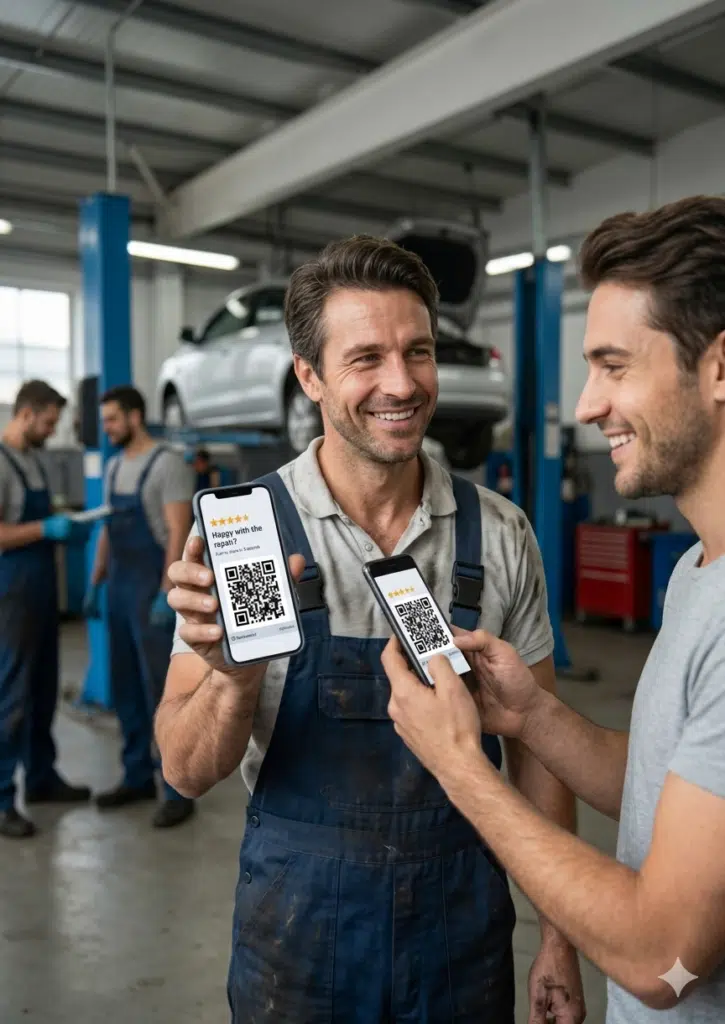
When a car breaks down, the average driver cannot evaluate the technical proficiency of a technician's diagnostic tools. Instead, they rely on emotional reassurance and trust signals found in digital feedback. Because they cannot "see" the repair being done correctly, they look for confirmation from others that the shop is honest and trustworthy. A key insight in this sector is that drivers often choose the mechanic they trust emotionally—not necessarily the cheapest one.
Local Discovery and Emergency Intent
Car repair is almost always a location-based service driven by emergency intent. When a "Check Engine" light appears or a tire blows out, the search begins on Google Maps.
- Google Maps Visibility: High-rated reviews and frequent photo uploads ensure your shop appears in the "Local 3-Pack."
- Proximity vs. Reputation: While proximity is important, a driver is likely to bypass the closest shop if a slightly further one has a stronger reputation impact and more verified customer experiences.
Managing Reputation Impact
For a mechanic, Google Reviews function as a digital "trust verification system." Prospective clients look past the star rating to find specific anchors—terms like "fair pricing," "honest," and "fast service"—to mitigate their fears of being misled. Every positive review acts as a quality signal that reduces traveler anxiety (or in this case, driver anxiety), making the decision-making process painless.
The Mechanic's Trust Matrix
| Guest Fear | Review Counter-Signal | Impact on Booking |
| Overcharging | "Fair pricing," "No hidden fees" | High Price Justification |
| Dishonesty | "Honest," "Transparent," "Showed me the part" | Builds Feeling of Security |
| Slow Turnaround | "Fast service," "Ready when promised" | Meets Emergency Intent |
| Incompetence | "Fixed it the first time," "Reliable" | Experience Verification |
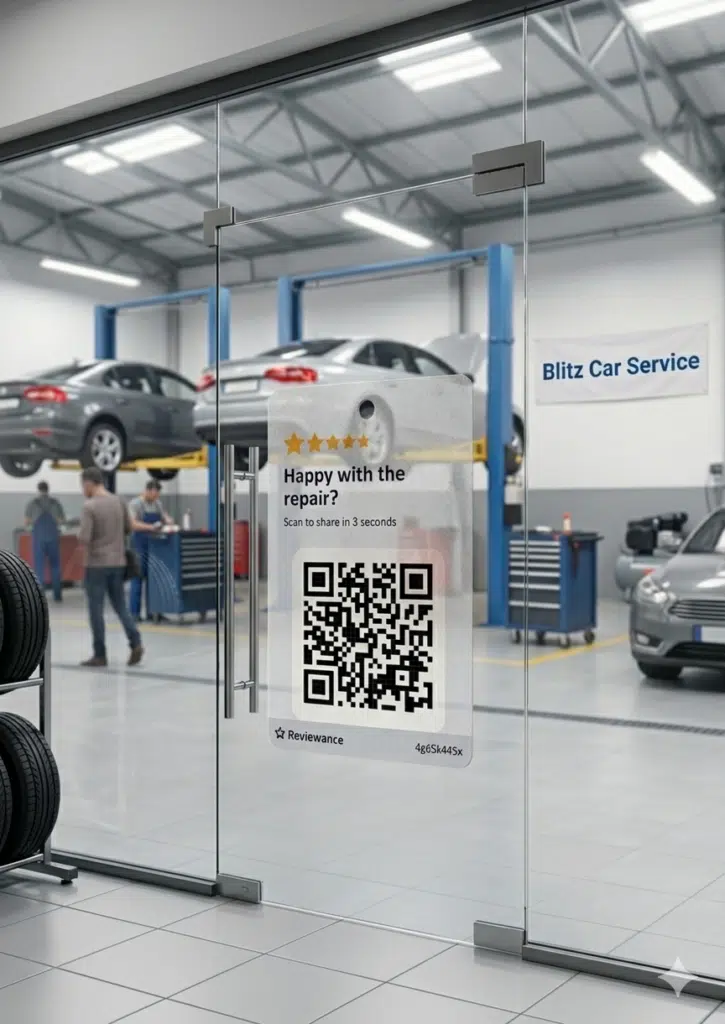
In the car repair world, the "emotional peak" happens the moment the keys are handed back and the car starts perfectly. By using QR code technology on adisyon/insert cards or key tags, Reviewance helps mechanics capture that relief and gratitude instantly, turning a stressful service into a powerful social proof asset.
How Drivers Search for Mechanics on Google
The search for a mechanic is rarely a leisurely activity; it is almost always triggered by emergency intent or a high-stress "maintenance window". Understanding the mobile search behavior of a driver in distress is the key to mastering Local SEO and ensuring your shop is the first one they call.
The Psychology of Emergency Intent
When a vehicle fails, the driver’s psychology shifts from "shopping" to "problem-solving". This creates a high-conversion environment where the user is looking for an immediate solution. Because of this urgency, they rarely look past the first few results on Google Maps. They are not just looking for a service; they are looking for emotional reassurance that their vehicle—and their safety—is in good hands.
Google Maps: The Primary Discovery Channel
For car repair services, the Google Business Profile (GBP) is more important than a traditional website. Most searches are performed on mobile devices while the driver is near their vehicle or at the site of a breakdown.
- Mechanic Near Me / Oil Change Nearby: These high-intent searches prioritize proximity and availability.
- Trusted Auto Repair Shop / Honest Mechanic: These queries indicate a user who is willing to drive a bit further to avoid the fear of overcharging or dishonest diagnostics.
- Transmission Repair Reviews / Brake Repair Near Me: Specialized searches where the user is looking for specific experience verification regarding a complex technical issue.
Mobile Search & Visibility
Mobile users prioritize action-oriented results. They are looking for the "Call" button or "Directions" immediately. If your shop appears in the "Local 3-Pack" with high-quality reviews highlighting fair pricing and fast service, you bypass the user's skepticism and move straight to the booking.
High-Intent Search Examples
| Search Query | User Intent | Psychology |
| "Emergency car repair" | Immediate Need | High stress; needs fast service and reliability. |
| "Brake repair near me" | Specific Maintenance | Safety concerns; looking for trustworthy signals. |
| "Honest mechanic [City]" | Risk Mitigation | Fear of being misled; prioritizes transparency. |
| "Oil change nearby" | Routine Convenience | Looking for efficiency and frictionless scheduling. |
By implementing a systematic review process during the "relief moment"—when the car is fixed and the driver feels safe again—you can ensure your Google Maps visibility is fueled by the exact keywords these drivers are searching for. Reviewance helps you turn every successful repair into a beacon for the next driver in need.
Why Trust Is Everything in Auto Repair
In the automotive service industry, trust is the only currency that matters. Unlike other service sectors, car repair involves a high level of diagnosis uncertainty, as most customers lack the technical expertise to verify the work being performed. This information gap creates a unique environment where transparency expectations are the primary driver of customer satisfaction.
Overcoming the Fear of the Unknown
The most significant barrier for a new customer is the fear of overpaying or being subjected to unnecessary repairs. When a driver sees a review stating, “Finally found an honest mechanic who explained everything clearly,” it acts as a powerful conversion tool. This specific type of experience verification directly addresses the user's fear of being misled and provides the emotional reassurance needed to choose your shop over a competitor.
Building Long-Term Customer Loyalty
Trust is not just about the first visit; it is the foundation for long-term customer loyalty. In an industry where a "bad mechanic" story is a common trope, a shop that consistently demonstrates honesty and fair pricing secures repeat business for the life of the vehicle.
- Transparent Communication: Showing the customer the worn-out part or explaining the "why" behind a repair builds a feeling of security.
- Trust Verification: Positive Google reviews serve as a public ledger of your integrity, turning one-time repairs into lifetime relationships.
The Trust-to-Loyalty Pipeline
| Customer Concern | Transparent Solution | Long-Term Result |
| "Am I being overcharged?" | Providing clear, upfront estimates and fair pricing. | Reduced price sensitivity and increased trust signals. |
| "Is this repair necessary?" | Clear explanations and transparent digital inspections. | Higher approval rates for recommended services. |
| "Will my car be safe?" | Consistently reliable work backed by verified reviews. | Strong repeat business and word-of-mouth referrals. |
We understand that for a mechanic, the most valuable review isn't just about a "fast oil change"—it's about being called "honest" and "trustworthy". Reviewance helps you automate the collection of these high-trust testimonials, ensuring your digital reputation reflects the integrity of your shop's operational structure.
Should Every Auto Repair Shop Have a Google Business Profile (GBP)?
In the auto repair industry, a Google Business Profile (GBP) is not just a digital business card; it is a critical operational tool for capturing high-intent customers. Because vehicle issues are often unpredictable, search behavior in this sector is dominated by mobile users with an anlık ihtiyaç (immediate need).
The Critical Role of Maps Visibility
When a driver experiences a breakdown or notices a warning light, their first instinct is to open Google Maps.
- Maps Visibility: A well-optimized GBP ensures your shop appears in the "Local 3-Pack," which is the primary discovery channel for drivers in your immediate area.
- Navigation Behavior: Modern drivers rely on GPS to find the nearest solution. Without a profile, your shop is invisible to the flow of navigation behavior that drives local traffic.
Capturing Emergency Searches
The majority of car repair queries are emergency searches performed under high stress.
- Mobile Calls: GBP allows for "click-to-call" functionality, which is essential for mobile searches where the user needs to speak to a technician immediately.
- Emergency Intent: Phrases like "tow truck near me" or "emergency brake repair" prioritize businesses with a verified profile and high reputation impact.
Streamlining Appointment Generation
Beyond emergencies, a GBP is a powerful engine for appointment generation for routine maintenance like oil changes or inspections.
- Painless Scheduling: Features such as direct messaging or "Book Now" buttons reduce the friction of scheduling, moving the customer from search to service faster than traditional methods.
- Experience Verification: Seeing recent photos of a clean, professional shop and reading reviews about fair pricing provides the feeling of security needed to commit to a booking.
The GBP Impact Matrix for Mechanics
| Feature | User Behavior | Business Result |
| "Call" Button | Mobile/Urgent Need | High-conversion lead generation. |
| Google Maps Pin | Navigation Behavior | Directs local traffic to your door. |
| Review Section | Trust Verification | Overcomes fear of overpaying. |
| Photo Gallery | Experience Visualization | Builds credibility and trust. |
The Strategic Insight: For a car repair shop, your Google Business Profile is your digital storefront. Reviewance helps you maintain this profile by ensuring a steady stream of honest and transparent reviews, making your shop the most reliable choice in any local search.
How Auto Repair Shops Rank Higher on Google Maps
Ranking in the "Local 3-Pack" is the most effective way for a mechanic to capture high-intent customers. Google’s algorithm for car repair is heavily weighted toward trust verification and emergency intent. To dominate your local area, you must optimize for these specific ranking signals.
1. Review Freshness & Recency
In the auto industry, a review from two years ago carries little weight. Google prioritizes shops with Review Freshness, as it signals that the business is currently active and consistently providing reliable service. A steady stream of new reviews proves your operational structure is healthy and your service remains transparent.
2. Service Keywords in Reviews (Semantic Power)
Google’s algorithm performs deep semantic analysis on review text to match your shop with specific searches. When customers naturally mention your core services, it boosts your authority for those specific queries:
- Brake Repair: Reviews mentioning "squeaky brakes fixed" help you rank for safety-related searches.
- Engine Repair & Transmission Repair: Mentions of complex work verify your technical competence.
- Oil Change & Battery Replacement: Frequent mentions of these routine tasks signal efficiency for high-volume maintenance searches.
- Tire Service: Positive feedback on tire changes improves visibility for urgent roadside needs.
3. Location Relevance & Proximity
While you cannot change your physical location, you can increase your Location Relevance. Reviews that mention your neighborhood or city help Google associate your shop with the specific geographic area, making you the primary choice for "mechanic near me" searches.
4. Active Response Management
Google explicitly rewards businesses that engage with their customers. Response Management is critical; replying to reviews—especially those mentioning fair pricing or honest diagnostics—shows Google that you are a professional and responsive business owner.
5. Customer Photo Activity
In car repair, photos act as a quality signal. When customers upload photos of their clean engine bays, new brake pads, or the shop's waiting area, it provides experience visualization for future clients. This activity signals to Google that your shop is a real, bustling hub of activity.
6. Emergency Search Signals
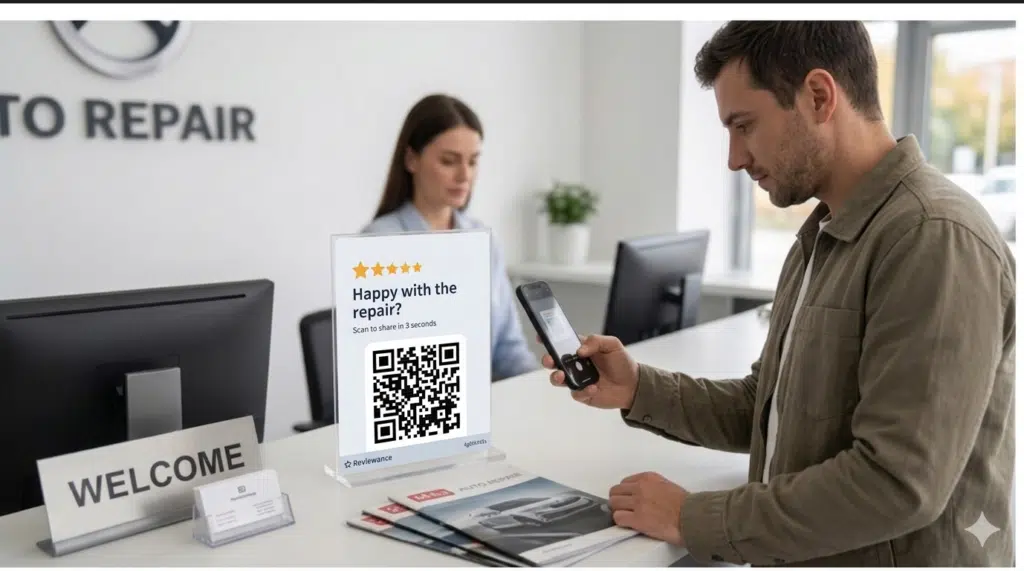
Google prioritizes shops that demonstrate they can handle emergency intent. Reviews that highlight "fast service" or "fixed it the same day" signal to the algorithm that your business is the best result for users performing high-stress, time-sensitive searches.
The Psychology Behind Mechanic Reviews
The decision to choose a mechanic is rarely based on a logical comparison of technical specifications; it is almost entirely driven by emotional survival and risk mitigation. In a sector where the customer feels a significant knowledge gap, Google Reviews serve as the ultimate tool for trust transfer.
Trust Transfer and Honesty Validation
When a driver reads a review, they are looking for honesty validation. Because they cannot verify the mechanical work themselves, they rely on the "social proof" of others to confirm that a shop is transparent and trustworthy. A key insight in this industry is that customers trust previous drivers more than advertisements. Every review acts as a peer-to-peer recommendation that bypasses traditional marketing skepticism.
Fear Reduction and Transparency Perception
The primary psychological barrier in car repair is the fear of overpaying or being subjected to dishonest diagnostics. Reviews that highlight fair pricing and clear communication directly contribute to fear reduction. When a business has a reputation for being honest, it creates a transparency perception that makes the customer feel they are in control of the situation, rather than being at the mercy of a technician's hidden agenda.
Safety Reassurance and Feeling of Security
Beyond the financial aspect, car repair is a matter of physical safety. Drivers look for safety reassurance in the experiences of others. Seeing consistent feedback about reliable service and technical competence builds a feeling of security. This emotional comfort is often more persuasive than the lowest price, as drivers prioritize the well-being of their families and the longevity of their vehicles over a few saved dollars.
The Emotional Conversion Funnel
| Psychological Trigger | Review Detail | Resulting Action |
| Vulnerability | "Explained everything clearly" | Transparency Perception |
| Skepticism | "No hidden fees" | Fear Reduction |
| Anxiety | "Fixed it the first time" | Safety Reassurance |
| Urgency | "Fast and reliable" | Immediate Booking |
By leveraging QR code technology at the exact moment of vehicle pickup—the "relief phase"—Reviewance allows mechanics to capture these psychological triggers while they are most potent. This turns a standard service transaction into a permanent quality signal for the next worried driver.
Why Most Mechanics Struggle to Collect Reviews
While reputation is vital, most auto repair shops find it difficult to build a consistent review stream. This is rarely due to poor service; rather, it is a result of specific operational structure challenges and customer behavior patterns unique to the industry.
Customers Leave Quickly After Pickup
The most significant hurdle is the “repair completed → customer leaves immediately” behavior. Once the keys are handed back and the payment is processed, the customer’s primary focus is getting back to their busy schedule. Without an immediate, frictionless way to capture their feedback, the opportunity vanishes the moment they drive off the lot.
Staff Forget to Ask
Mechanics and service advisors are often overwhelmed with technical diagnostics and managing high-stress emergency intent situations. Without a structured review process, asking for feedback becomes an afterthought, leading to missed opportunities for trust verification.
Customers Are Focused on Their Vehicle
In the car repair world, the customer is preoccupied with their vehicle’s safety and the cost of the repair. They are not naturally in a "social media" or "review-writing" mindset unless the business makes the process incredibly painless and fast.
No Easy Review Access
If a customer has to search for the business on Google and navigate several menus to leave a review, they likely won't do it. A lack of easy review access, such as a direct QR code link, creates a barrier that most busy drivers won't bother to cross.
Best Moments to Ask Customers for Reviews
Timing is everything in the social proof economy. To capture high-impact reviews that feature keywords like "honest" or "fair pricing," you must identify the "emotional peak" of the service journey. The best review moment often happens right after the customer feels relief that the problem is solved.
After Explaining the Repair
When a technician provides a transparent explanation of the work—effectively removing diagnosis uncertainty—the customer feels a surge of trust. This is an ideal time to mention that their feedback on this transparency helps other drivers find a reliable mechanic.
During Vehicle Pickup
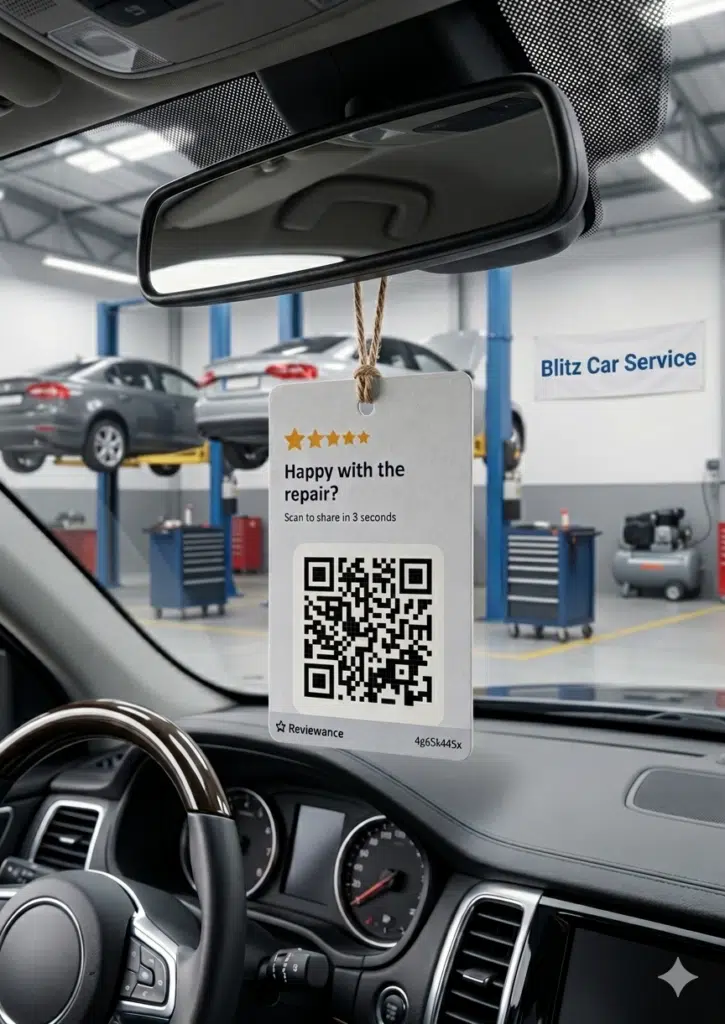
The moment the keys are returned and the vehicle is ready is the physical peak of the transaction. Using Reviewance technology on key tags or adisyon/insert cards during this hand-off ensures that the fear reduction they feel is instantly converted into a quality signal.
After Emergency Repairs
For emergency car repair, the relief is even more intense. A customer who was stranded and is now back on the road is highly motivated to share their positive experience with fast service.
After Solving a Long-Term Problem
If your shop fixes a persistent issue that other mechanics couldn't solve, the customer's guest satisfaction is at an all-time high. These reviews are the most powerful for experience verification, as they highlight technical competence and persistence.
Best QR Code Placement Ideas for Auto Repair Shops
In the car repair industry, the digital and physical worlds must collide at the moment of maximum customer relief. Since drivers are often in a hurry or focused on their vehicle's safety, your QR code placement must be strategic, visible, and integrated into the natural workflow of the shop. Here is how to turn every touchpoint into a trust verification opportunity.
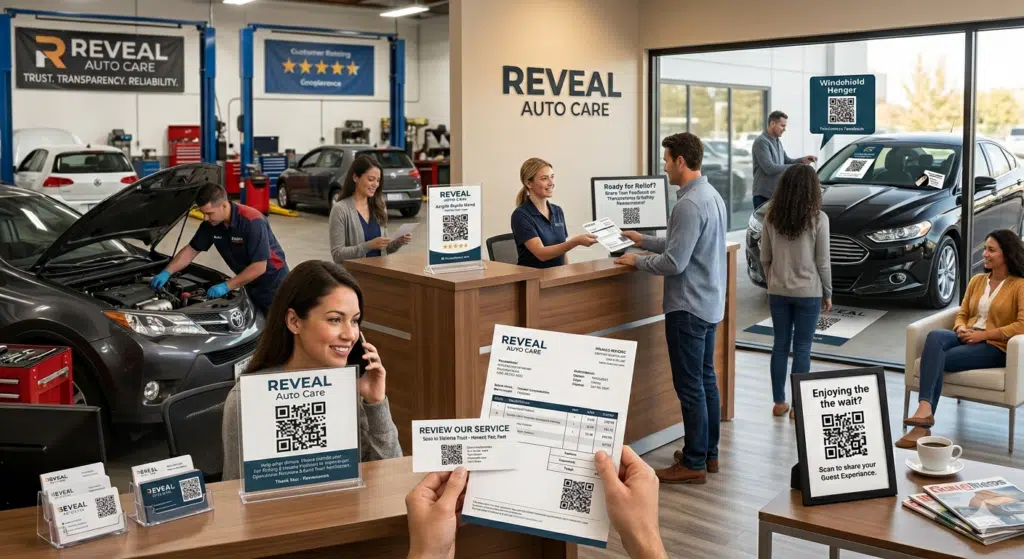
1. Reception Desk & Payment Counter
The reception desk is where the journey begins and ends. Placing a high-quality, professional display here captures the customer’s attention during the check-out process.
- The Strategy: As the service advisor hands over the final invoice and explains the fair pricing, the QR code should be right there, inviting them to share their experience of transparent communication.
- Visual Cue: Use a sleek acrylic stand that matches your startup and corporate branding to maintain a sense of security and professionalism.
2. Service Invoices & Adisyon Cards
The invoice is the most scrutinized document in the repair process. It represents the "truth" of the transaction.
- The Strategy: Print a QR code directly onto the bottom of the invoice or staple a dedicated Reviewance "Welcome Kit" card to it.
- The Hook: Include a small call-to-action like: "Was our diagnosis honest and clear? Let us know!" This directly addresses the user's fear of being misled.
3. Waiting Room Displays
While customers wait for an oil change or tire service, they are often on their mobile devices.
- The Strategy: Place QR codes on coffee station signs or side tables.
- The Hook: Since they have time, they are more likely to write a detailed Long-Tail review describing the guest experience and the shop's cleanliness.
4. Vehicle Pickup Area & Windshield Hangers
The "Relief Moment" peaks when the customer sees their car ready to go.
- The Strategy: Use windshield hangers or paper floor mats that feature a QR code.
- The Hook: When the driver enters their car and feels the safety reassurance of a job well done, the QR code is the first thing they see. This is the ultimate "Peak Satisfaction" window.
5. Key Tags & Mirror Hangers
In car repair, the keys are the symbol of the transaction.
- The Strategy: Attach a small, durable tag to the car keys with a QR code on one side.
- The Benefit: It provides easy review access at the exact second the customer regains control of their vehicle.
How Reviews Affect Auto Repair Revenue
In the car repair industry, the financial impact of a digital reputation goes far beyond a simple star rating. High-quality reviews act as a direct lever for revenue growth by addressing the specific financial anxieties of drivers and streamlining the path to high-ticket service approvals.
Reducing Hesitation for High-Ticket Repairs
One of the most significant financial benefits of a strong review profile is the reduction of friction during the sales process. A key industry insight is that strong reviews reduce customer hesitation for expensive repairs. When a technician recommends a high-ticket service—such as a transmission overhaul or major engine work—a customer’s first instinct is often skepticism driven by diagnosis uncertainty. However, if that customer has already read dozens of reviews highlighting your honest diagnostics and fair pricing, their psychological barrier to approval is significantly lowered.
Driving Emergency Conversions
Revenue in this sector is heavily reliant on emergency intent. When a vehicle is non-functional, the driver is in a "high-conversion" state, looking for an immediate solution.
- Local Visibility: A top-tier Google Maps visibility ensures your shop is the first option seen during these critical moments.
- Rapid Trust: Positive feedback regarding fast service and reliability converts these emergency leads into paying customers faster than any traditional advertisement.
Fueling Referral Business and Retention
While new leads are essential, the most stable revenue comes from repeat customers and referral business.
- Customer Retention: Consistent trust signals in your reviews reinforce a customer’s decision to return, turning a one-time repair into a lifetime of service revenue.
- Social Proof as Referrals: In the "Social Proof Economy," a detailed Google review acts as a permanent, public referral that constantly works to bring in new high-value clients.
Revenue Impact Matrix
| Revenue Driver | Impact of Positive Reviews | Financial Result |
|---|---|---|
| Emergency Leads | Higher Google Maps ranking during breakdowns. | Increased volume of immediate bookings. |
| High-Ticket Sales | Validates honesty and justifies major repair costs. | Higher approval rates for complex services. |
| Customer Lifetime Value | Builds a feeling of security and long-term loyalty. | Consistent revenue from repeat business. |
| Ad Spend Efficiency | Trust signals improve the conversion rate of paid traffic. | Lower customer acquisition costs. |
By automating the collection of feedback at the "relief moment"—when the car is fixed and the customer feels safe—Reviewance ensures your revenue is protected by a shield of transparent and reliable social proof.
Google Review Examples for Mechanics
The most effective reviews for car repair services aren't just praise; they are trust verification documents that address the specific fears of potential customers. By analyzing the "anatomy" of a high-converting review, we can see how they act as a quality signal that overcomes traveler anxiety—or in this case, driver anxiety.
Example 1: The "Honesty & Clarity" Review
“Finally found a very honest mechanic. They fixed my brakes quickly and explained the issue clearly without trying to upsell me on things I didn't need.”
Analysis:
- Trust Signal: The explicit mention of being "very honest" directly counters the fear of being misled.
- Service Keyword: Including "brakes" provides a semantic boost for specific local searches.
- Speed Signal: "Quickly" addresses the urgency and emergency intent of a driver in distress.
- Transparency Indicator: "Explained the issue clearly" reduces diagnosis uncertainty and builds a feeling of security.
Example 2: The "Fair Pricing" Review
“I was worried about a transmission repair, but this shop provided fair pricing and was completely transparent about the costs from start to finish.”
Analysis:
- High-Ticket Validation: Mentioning a major repair like "transmission" helps reduce hesitation for expensive repairs for future clients.
- Financial Reassurance: "Fair pricing" mitigates the universal fear of overpaying.
- Transparency Perception: Highlights that the shop's operational structure prioritizes open communication.
Example 3: The "Emergency & Reliability" Review
“Had an emergency car repair situation on a Saturday. They got me back on the road the same day. Reliable and professional service!”
Analysis:
- Emergency Search Signal: Directly matches the emergency intent of users searching for immediate help.
- Reliability Anchor: Using the word "reliable" acts as an emotional anchor for drivers prioritizing vehicle safety.
- Operational Excellence: Demonstrates a fast service turnaround, which is a critical quality signal in this sector.
How Many Reviews Does an Auto Repair Shop Need?
In the car repair industry, the "magic number" of reviews depends heavily on your specific niche and the level of risk the customer perceives. Because drivers prioritize trust verification and experience verification, your review volume must match the expectations of your target segment to effectively reduce diagnosis uncertainty.
1. Local Mechanic (General Repair)
- Target: 50 - 150+ reviews.
- Strategy: For a generalist, review freshness and location relevance are key. Since you compete on "mechanic near me" searches, you need enough volume to prove you are a consistent, honest, and reliable neighborhood fixture.
2. Dealership Service Center
- Target: 300 - 1,000+ reviews.
- Strategy: Dealerships handle high volumes and often struggle with a reputation for being expensive. A high volume of reviews highlighting professional service and transparent communication is necessary to compete with lower-priced local independents.
3. Luxury Vehicle Specialist
- Target: 30 - 75+ reviews (High Quality).
- Strategy: Quality outweighs quantity here. Owners of high-end vehicles look for experience visualization and detailed stories of technical competence. They need to see a feeling of security reflected in the feedback before trusting you with a high-value asset.
4. Tire Shop & Routine Maintenance
- Target: 200+ reviews.
- Strategy: These are high-frequency, commodity services. Since the emergency intent and urgency are high, a massive volume of reviews mentioning fast service and fair pricing helps you dominate the "oil change nearby" or "tire service" local rankings.
5. Transmission & Engine Specialists
- Target: 40 - 100+ reviews (Deep Detail).
- Strategy: Because these are high-ticket repairs, customers read reviews word-for-word. You need reviews that specifically mention transparency and honesty to overcome the intense fear of overpaying associated with complex mechanical failures.
Segment Review Benchmarks
| Segment | Priority Signal | Review Frequency Goal |
| Local Mechanic | Honesty & Trust | 2-3 new reviews per week. |
| Dealership | Efficiency & Professionalism | 5-10 new reviews per week. |
| Luxury Specialist | Technical Excellence | 1-2 highly detailed reviews per month. |
| Tire/Maintenance | Speed & Price | 5+ new reviews per week. |
| Specialist (Engine/Trans) | Transparency & Value | 2-3 reviews per month focusing on "the fix." |
Regardless of your segment, the goal is to create a structured review process that ensures you never have a "dry spell." Reviewance helps you maintain a steady flow of feedback, ensuring your quality signals are always current and your local visibility remains peaked.
How Mechanics Should Respond to Reviews
In the car repair industry, your response to a review is just as important as the review itself. It serves as a public demonstration of your operational structure and your commitment to transparent communication. Because customers often feel vulnerable regarding diagnosis uncertainty, your response tone must always be calm, professional, and transparent to maintain a feeling of security.
Responding to Positive Reviews
When a customer praises your honest service or fast turnaround, don't just say "thanks." Use the response to reinforce your trust signals.
- Example: "Thank you for the kind words! We pride ourselves on providing fair pricing and making sure every driver feels safe before leaving the shop".
- Strategy: Mentioning specific values like "safety" or "honesty" reinforces your professional brand identity to future readers.
Responding to Pricing Complaints
The fear of overpaying is the #1 concern in this sector. If a customer complains about the cost, address it with transparency.
- Tone: Avoid being defensive; instead, explain the value provided.
- Strategy: Gently mention that you use high-quality parts and certified technicians to ensure long-term reliability and vehicle safety.
Responding to Delays
In the world of emergency car repair, timing is everything. If a repair took longer than expected, acknowledge the urgency the customer felt.
- The Approach: Apologize for the delay and explain that the extra time was taken to ensure the repair was done correctly the first time—prioritizing quality signals over speed when necessary.
Handling Negative Repair Experiences
A negative review regarding a mechanical issue is a high-stakes situation. Use it as an opportunity for honesty validation.
- The Pivot: Invite the customer back immediately for a re-inspection.
- The Goal: Showing the public that you stand behind your work turns a negative into a trust verification moment, proving that you are a reliable partner even when things don't go perfectly.
Building Trust Through Responses
Every response is a chance to reduce traveler anxiety for the next person searching for a "mechanic near me". By being transparent about your processes and professional in your tone, you prove that your shop is a safe place for those who lack technical expertise.
Common Auto Repair Review Mistakes
Even with the best technical skills, a car repair shop can sabotage its digital reputation by mishandling the "Social Proof Economy." Avoiding these common pitfalls is essential for maintaining a professional brand identity and ensuring your operational structure supports long-term growth.
1. Buying or Generating Fake Reviews
In an attempt to boost Google Maps visibility quickly, some shops resort to fake reviews. This is a critical error.
- The Risk: Google’s algorithms are highly sophisticated at detecting unnatural review patterns.
- The Damage: Beyond the risk of being banned, tech-savvy drivers can often spot "hollow" praise that lacks experience verification, leading to a total loss of honesty validation.
2. Defensive or Aggressive Responses
When a customer complains about costs or a failed repair, the natural instinct is to defend the shop’s integrity.
- The Mistake: Responding with anger or technical jargon that blames the customer.
- The Impact: This reinforces the driver's fear of being misled and signals to future clients that the shop is not transparent or professional.
3. Ignoring Negative Complaints
Leaving a negative review unanswered is a silent admission of guilt in the eyes of a prospective customer.
- The Mistake: Failing to address concerns about fair pricing or vehicle safety.
- The Impact: It shows a lack of transparent communication, which is the primary factor drivers look for when trying to mitigate traveler anxiety.
4. Not Explaining the Repair in the Response
Many mechanics miss the opportunity to educate the public through their responses.
- The Mistake: Simply saying "Sorry you were unhappy" without context.
- The Fix: A professional response should briefly explain the diagnosis uncertainty involved or why a specific part was necessary for long-term reliability.
5. Asking at the Wrong Moment
Timing is a core component of the Reviewance strategy.
- The Mistake: Asking for a review while the customer is still stressed about the bill or before the relief moment has occurred.
- The Impact: This often leads to mediocre ratings or reviews that focus solely on the price rather than the quality signals of the work.
6. No Structured Follow-Up Process
Relying on "luck" to get reviews is a failing strategy for a modern startup or small business.
- The Mistake: Not having a painless and frictionless way for customers to leave feedback.
- The Fix: Without a structured review process—like using QR codes on adisyon cards—most satisfied customers will simply drive away and forget, leaving your profile stagnant.
Google Reviews for Specialized Auto Services
In the automotive industry, "one size fits all" does not apply to search intent. Specialized services require a more nuanced approach to trust verification because the technical risks and financial stakes vary significantly between a routine tire change and a complex luxury engine rebuild. By focusing on specific service clusters, shops can dominate high-intent keywords and reduce diagnosis uncertainty for niche customers.
1. Brake Repair Shops
- Core Psychology: Driven by safety reassurance and immediate concern.
- Key Signals: Reviews should highlight "fixed the noise," "car stops perfectly," and "peace of mind".
- SEO Impact: High-frequency mentions of brake repair and "safety" boost visibility for safety-conscious families and emergency searches.
2. Tire Services
- Core Psychology: Focused on fast service, convenience, and fair pricing.
- Key Signals: Mentions of "in and out quickly," "great price on set of 4," and "professional installation".
- SEO Impact: Dominates high-volume "near me" searches where proximity and speed are the primary decision drivers.
3. Transmission Specialists
- Core Psychology: High fear of overpaying and extreme diagnosis uncertainty.
- Key Signals: Detailed stories of honest diagnostics, "explained the complex issue," and "saved me from buying a new car".
- SEO Impact: These reviews act as long-form experience verification, crucial for converting high-ticket leads who are researching their options extensively.
4. Luxury Vehicle Repair
- Core Psychology: Focused on quality signals, technician expertise, and a professional brand identity.
- Key Signals: Reviews mentioning specific brands (BMW, Porsche, Tesla), "dealership quality without the price," and "meticulous attention to detail".
- SEO Impact: Builds a feeling of security for high-net-worth clients who prioritize the longevity and value of their asset over the lowest price.
5. Electric Vehicle (EV) Service Centers
- Core Psychology: Anxiety regarding specialized technical knowledge and battery health.
- Key Signals: "Certified EV technicians," "knowledgeable about battery systems," and "modern diagnostic equipment".
- SEO Impact: As a growing market, being the first in your area to accumulate reviews with "EV repair" keywords establishes early reputation impact and authority.
Multi-Location Auto Service Reputation Management
Managing a chain of auto service centers requires a balance between a unified professional brand identity and the specific location relevance of each individual branch. For multi-location businesses, reputation isn't just a collective score; it is a decentralized network of trust signals that must be maintained at every storefront to ensure consistent local visibility.
Maintaining Branch Consistency
In a multi-location setup, the operational structure must ensure that a customer receives the same transparent communication and fair pricing regardless of which branch they visit.
- Brand Standards: Every location should have a synchronized Google Business Profile that reflects the core values of the startup or parent brand.
- Quality Control: Reviews act as a centralized monitoring tool, allowing management to identify which branches are excelling at honesty validation and which may need better training in response management.
Local Ranking & Proximity
Each branch must compete in its own "Local 3-Pack". Google prioritizes location relevance, meaning a branch in one city cannot rely on the reputation of a branch in another.
- Localized Reviews: Each store needs its own stream of review freshness to rank for "mechanic near me" in its specific zip code.
- Navigation Behavior: Drivers looking for an oil change nearby will be directed to the branch with the highest local reputation impact, making individual profile optimization critical for emergency conversions.
Technician Reputation & Individual Accountability
In the auto industry, customers often form a feeling of security with a specific person rather than a faceless brand.
- The "Human" Signal: Reviews that name specific technicians as "honest" or "highly skilled" are incredibly powerful for experience verification.
- Performance Monitoring: Using these mentions as part of a structured review process helps track individual technician performance and its direct impact on customer retention and high-ticket repair acceptance.
Multi-Location Management Matrix
| Focus Area | Management Action | Business Outcome |
| Branch Consistency | Standardize transparent diagnostic scripts across all shops. | Unified professional brand identity and trust. |
| Local Ranking | Ensure each branch collects service-specific keywords in its reviews. | Domination of local emergency car repair searches. |
| Monitoring | Use a centralized dashboard to track review freshness per location. | Rapid identification of service failures or "reputation dips". |
| Staff Reputation | Encourage reviews that highlight technician transparency. | Higher repeat business and stronger referral business. |
The Reviewance Scaling Strategy: For chain operations, Reviewance provides a scalable operational workflow that allows each branch to capture the "relief moment" of their local drivers. By distributing Welcome Kits and QR code displays to every location, the brand ensures that trust verification is happening 24/7 across the entire network.
A single relevant follow-up question: Are you looking to develop a centralized dashboard concept for Reviewance that specifically tracks these multi-location performance metrics for your target ?
How Reviewance Helps Auto Repair Shops Build Trust and Visibility
In the auto repair industry, the gap between a technical diagnosis and a customer’s understanding is filled by trust. Reviewance is designed to bridge this gap by transforming the traditional "repair transaction" into a digital powerhouse of social proof. By focusing on the unique psychological triggers of drivers, we turn satisfied customers into your most effective marketing asset.
Capturing the "Relief Moment"
We understand that the best reviews happen at the moment of peak customer satisfaction: when the keys are returned and the car is fixed.
- Frictionless Feedback: Our system uses QR-based review acquisition to make leaving a review a 5-second process, eliminating the "customer leaves immediately" barrier.
- Welcome Kit Integration: We provide physical touchpoints, like branded Welcome Kits and windshield hangers, that remind the driver of your technical competence the moment they step back into their vehicle.
Dominating Local Visibility
For a mechanic, being visible during emergency searches is the difference between a full garage and an empty one.
- SEO-Driven Content: Reviewance leverages semantic review data to ensure your shop ranks for high-intent keywords like brake repair, engine diagnostics, and oil changes.
- Google Business Profile Optimization: We help you maintain review freshness, a critical signal that tells Google your shop is active and reliable.
Building a Legacy of Honesty
Beyond just "getting stars," Reviewance focuses on honesty validation.
- Transparency Perception: Our tools encourage customers to mention fair pricing and clear communication, which reduces diagnosis uncertainty for future clients.
- Increased Revenue: By building a public ledger of your integrity, we reduce customer hesitation for high-ticket repairs, directly impacting your bottom line.
Ready to turn your shop’s integrity into your strongest competitive advantage?
Don't let your best work go unrecorded. With Reviewance, you can automate your reputation management, dominate the local 3-pack, and build a brand that drivers trust implicitly.