
Unlike a standard transaction, booking a hotel or resort is a long-term emotional investment that begins months before the actual stay. In the hospitality sector, user psychology is built on high pre-experience risk and the "dreaming phase" of a vacation. Guests are not merely purchasing a room; they are buying a guarantee of future memories.
The Strategic Core: Vacation Psychology & Trust
For hotels, Google reviews are more than just ratings; they are experience validation tools. Because vacation budgets are typically high and travel plans are difficult to reverse, guests rely on user feedback rather than professional photography to reduce their "vacation risk."
1. Trust Before Booking
Hotels are among the few businesses where payment is often made before the physical product is seen. The greatest fear for a guest is that the reality will not match the staged marketing photos. Google reviews serve as the most honest answer to the question: "Is this place actually as it looks?"
2. Destination Decision-Making
Guests often choose the destination first, then the specific hotel. Searches like "best family resort in [City]" require a dominant local SEO presence. Reviews are the primary variable that establishes a hotel's authority within its specific location.
3. Emotional Expectation & Experience Visualization
A high-quality review allows a reader to mentally place themselves at the pool bar or the breakfast table. Specific details in feedback—such as the warmth of the staff or the comfort of the bedding—help potential guests perform an experience visualization, turning a search into a booking.
Why Google Reviews Matter for Hotels & Resorts
In the hospitality industry, a booking is rarely an impulsive act; it is the result of a meticulous research process where prospective guests prioritize peer validation over corporate marketing. Because a vacation represents a significant financial and emotional commitment, travelers use Google Reviews as their primary tool for experience visualization and vacation risk reduction.
The Core Insight: Peer Trust Over Advertising
The most critical factor in modern hospitality marketing is that guests trust previous guests more than hotel advertisements. While professional photography can be staged, a library of recent, detailed reviews provides the experience verification that travelers crave. Before confirming a stay, a typical traveler will:
- Read dozens of reviews to identify patterns in service quality and cleanliness.
- Scrutinize guest-uploaded photos to see the "raw" reality of the rooms and amenities.
- Search for the "real experience" to ensure the hotel's atmosphere matches their personal expectations.
Influencing Booking Decisions and Travel Planning
Google Reviews are the "moment of truth" in booking decisions. High-quality feedback acts as a powerful conversion engine during the travel planning phase, providing the necessary social proof to move a guest from the "considering" stage to a confirmed reservation.
Local SEO and Tourism Visibility
For hotels, visibility is synonymous with survival. Google Reviews are a primary ranking signal for Local SEO, determining which properties appear in the coveted "Local 3-Pack" when travelers search for accommodations in a specific area. A consistent stream of fresh reviews through a systematic review process significantly boosts tourism visibility, ensuring your property stands out in a crowded market.
Google Maps Influence and Destination Competition
In high-traffic areas, destination competition is fierce. Google Maps influence is often the deciding factor; a hotel with a higher rating and more recent reviews will capture the lion's share of mobile searches from travelers already in the area. By maintaining an active, positive profile, hotels can effectively outshine nearby competitors and secure their position as a top-tier choice for international and local visitors alike.
How Travelers Search for Hotels on Google
Understanding search intent is the cornerstone of Local SEO and tourism visibility. Travelers typically navigate a multi-stage search journey that blends traditional search queries with the specialized interfaces of Google Maps and Google Travel.
Deciphering Search Intent Examples
When a traveler enters a query, they are signaling a specific experience visualization or a logistical need. High-intent search examples include:
- Location-Based: "hotel near me" or "best resort in Antalya" (Targets location relevance and local authority).
- Feature-Specific: "beachfront hotel" or "spa hotel near airport" (Indicates a search for a specific functional constraint or amenity).
- Demographic-Targeted: "family-friendly resort" (Signals a need for emotional reassurance regarding safety and entertainment for children).
- Quality-Focused: "luxury hotel reviews" (Represents high commercial intent where professionalism signals are paramount).
The Google Maps + Google Travel Ecosystem
Unlike other service industries, hotel searches trigger a unique, integrated Google experience:
- The Google Travel Interface: When users search for "hotels in [City]," Google presents a specialized booking engine. This interface pulls Google Reviews directly into the price-comparison view, making your reputation a primary filter for booking decisions.
- Google Maps Navigation: Many travelers use Maps as their primary discovery tool. They browse a geographic area and filter by "Top Rated" or "Price." A clinic-like precision in review freshness ensures that your property remains visible during these active travel planning sessions.
- The Power of Keywords: Google’s algorithm "reads" the content of your reviews. If guests frequently mention "amazing beachfront views" or "perfect family-friendly atmosphere," Google will naturally rank your hotel higher for those specific long-tail keywords.
From Search to Selection
Because travelers are often navigating a destination competition environment, they rely on Google Maps influence to narrow down hundreds of options. A profile rich in authentic social proof—captured through a systematic review process—ensures that when a traveler clicks your pin on the map, the first thing they see is a denim verification of the experience you promise.
Strategic Insight: By utilizing Reviewance to prompt guests for feedback during their stay, you ensure that your Google profile is constantly updated with the fresh, keyword-rich content that the Google Travel algorithm prioritizes.
Why Online Reviews Directly Affect Hotel Bookings
In the high-stakes world of hospitality, online reviews are the ultimate conversion engine. Because travelers cannot "test drive" a hotel room before purchase, they rely on digital feedback to validate their experience visualization. This creates a direct correlation between your review profile and your occupancy rates.
Combatting Booking Abandonment
One of the greatest challenges for resorts is booking abandonment. A traveler may find your property, admire the photos, and check the prices, only to hesitate at the final payment screen. Trust signals found in recent, authentic reviews provide the "social green light" that reduces traveler anxiety and gives the guest the confidence to complete the transaction.
The Power of Price Justification
Reviews are the most effective tool for price justification. A critical UX insight in the industry is that a hotel with slightly higher prices but significantly better reviews often wins the booking. When guests see consistent praise for service and comfort, they perceive a higher value, making them willing to pay a premium for a "guaranteed" positive experience.
International Tourist Behavior
For international tourist behavior, reviews are even more vital. Travelers visiting from abroad face higher vacation risk due to distance and cultural unfamiliarity. They seek out detailed, multi-lingual social proof to ensure the property meets international standards of professionalism and safety.
The Conversion Impact
| Factor | UX Impact | Business Result |
| Trust Signals | Lowers psychological barriers to purchase. | Reduced booking abandonment. |
| Experience Verification | Confirms that photos match reality. | Higher booking decisions rate. |
| Anxiety Reduction | Minimizes fear of a "ruined" vacation. | Increased guest loyalty and pre-stay satisfaction. |
Should Every Hotel Have a Google Business Profile (GBP)?
In the hospitality industry, a Google Business Profile (GBP) is not an optional marketing extra; it is a fundamental operational requirement. For hotels and resorts, the GBP serves as the primary gateway for Google Maps discovery and the ultimate tool for capturing travelers at the exact moment of intent.
The Engine of Tourist Navigation
A GBP is the "digital lighthouse" for tourist navigation. When travelers arrive in a new city or plan their route, they rely on Google Maps to visualize their stay. Without a verified and optimized profile, your property is invisible to the millions of users who rely on map-based discovery to find their next destination.
Dominating Mobile Travel Searches
The majority of travel research now happens on the move. A robust GBP is specifically designed to excel in mobile travel searches, where screen space is limited and speed is essential. Having a well-managed profile ensures that your hotel appears in the "Local 3-Pack," providing immediate visibility and social proof to potential guests as they scroll.
Driving Instant Call and Direction Actions
A Google Business Profile removes all friction between discovery and engagement. Through instant call and direction actions, a traveler can:
- Get Directions: Seamlessly navigate to your lobby using real-time GPS data.
- One-Touch Calling: Contact your front desk or reservations team directly without searching for a phone number on a separate website.
- Book Now: Access direct booking links or Google Travel prices, converting a searcher into a guest in seconds.
The ROI of a Verified Profile
| Feature | Strategic Impact | Traveler Benefit |
| Maps Discovery | Increases organic reach in local searches. | Easily finds the best-located hotel. |
| Instant Actions | Drives immediate lead generation. | Reduces friction for booking and arrival. |
| Photo Integration | Enhances experience visualization. | Confirms the "look and feel" of the resort. |
The Strategic Insight: A Google Business Profile is the primary touchpoint for destination competition. By utilizing Reviewance to consistently feed your GBP with fresh, high-quality reviews, you ensure that your profile remains at the top of the search results, providing the emotional reassurance guests need to choose your property over others.
How Hotels Rank Higher on Google Maps
Ranking in the competitive "Local 3-Pack" for hospitality requires more than just a high star rating. Google’s algorithm prioritizes properties that demonstrate high location relevance and active guest engagement. To climb the rankings, a hotel must focus on a systematic review process that signals consistent quality and authority.
1. Review Volume and Freshness
Google views review volume as a measure of a hotel's popularity and reliability. However, review freshness is often more critical; a steady stream of new reviews tells the algorithm that your property is currently active and maintaining its standards. A hotel that hasn't received a review in months will quickly lose its ranking to a more "active" competitor.
2. Strategic Location Mentions and Amenity Keywords
Google "reads" the text of your reviews to understand exactly what your property offers. Reviews that naturally include amenity keywords—such as "clean rooms," "breakfast," "pool," or "spa"—act as powerful SEO signals. Similarly, mentions of location (e.g., "walking distance" to major attractions or a "sea view") help Google categorize your hotel for specific high-intent searches.
3. Response Management
How you interact with your guests online directly impacts your visibility. Proactive response management signals to both Google and prospective travelers that the clinic—or in this case, the hotel—is managed with a high degree of professionalism. Responding to both positive and negative feedback demonstrates accountability and builds the feeling of security necessary for a booking.
4. Guest Photo Activity
In the hospitality sector, guest photo activity is a top-tier ranking signal. Authentic, unedited photos uploaded by travelers provide the experience verification that searchers crave. Google prioritizes profiles with high visual engagement, as these "raw" images are often trusted more than professional marketing photography.
5. Seasonal Engagement
For resorts, seasonal engagement is key to maintaining year-round visibility. Ensuring that reviews and responses reflect current offerings—such as "summer pool parties" or "cozy winter spa retreats"—helps your profile stay relevant as traveler search intent shifts throughout the year.
Key SEO Ranking Factors for Hotels
| Factor | Strategic SEO Benefit | Target Keywords |
| Review Content | Ranks you for specific amenities. | Clean rooms, breakfast, pool, spa |
| Location Signals | Boosts local search authority. | Walking distance, sea view, location |
| Visual Proof | Increases user "time-on-profile." | Guest-uploaded photos and videos |
| Active Management | Improves overall "trust transfer." | Professional and timely responses |
Our Frictionless Feedback system is designed to capture these specific ranking signals. By placing QR codes in high-satisfaction zones—like the spa exit or the breakfast area—we ensure your guests leave the keyword-rich, photo-heavy reviews that Google Maps rewards.
The Psychology of Hotel Reviews
Understanding the psychological triggers behind hotel bookings is essential for any property aiming to dominate the hospitality market. Unlike functional purchases, a hotel stay is an intangible promise of a future experience. Travelers rely on reviews as a cognitive tool to bridge the gap between a digital listing and their actual expectations.
Visualizing the Experience
The most profound psychological insight in hospitality is that travelers use reviews to imagine themselves inside the experience before booking. A well-written testimonial allows a prospective guest to perform a mental walkthrough of your property. They aren't just reading text; they are building an internal narrative of their future vacation, from the first "clean room" greeting to the final "sea view" sunset.
The Pillars of Booking Psychology
- Uncertainty Reduction: Because a vacation is a non-refundable investment of both time and money, travelers experience high pre-purchase anxiety. Reviews act as a "risk mitigation" strategy, providing the data needed to confirm that the hotel is a safe and reliable choice.
- Emotional Reassurance: Guests seek more than just facts; they look for emotional cues. Phrases like "caring staff" or "anxiety-free stay" provide the emotional reassurance that the traveler will be looked after and valued during their visit.
- Vacation Expectations: Reviews serve as a benchmark for reality. By reading about the experiences of others, guests align their vacation expectations with what the hotel actually delivers, reducing the chance of post-arrival disappointment.
- Social Validation: Humans are biologically wired to look to the tribe for cues on safety and quality. High review volume and positive sentiment provide the social validation that a property is "vetted" by the community, making the booking decision feel objective and justified.
- Travel Confidence: For many, especially international tourists, traveling to a new destination involves a leap of faith. A robust profile of authentic reviews builds travel confidence, empowering the guest to commit to a booking with the belief that their experience will match the promise.
From Anxiety to Action
By understanding these psychological drivers, hotels can shift their focus from mere "reputation management" to active trust building. When a guest feels a feeling of security through the shared stories of others, they are significantly more likely to move from browsing to a confirmed reservation.
The Reviewance Strategy: Our "Frictionless Feedback" system is designed to trigger these psychological responses. By capturing guest delight at peak emotional moments, we help you build a digital profile that doesn't just list amenities, but tells a story that inspires traveler confidence.
Why Most Hotels Fail to Collect Enough Reviews
Despite providing world-class service, many properties struggle with low review volume. This often happens because the "Peak Satisfaction Window" is missed due to operational friction or poor timing. For an entrepreneur focusing on a "Frictionless Feedback" model, identifying these bottlenecks is the first step toward building a dominant digital reputation.
Guests Forget After Checkout
Once a guest leaves the property, their focus shifts immediately to their return journey or their next destination. The emotional connection to the hotel fades rapidly. Without an immediate, easy-to-use system like a QR code placed in a "Welcome Kit" or at the reception desk, the likelihood of a guest taking the time to search for the hotel on Google later is extremely low.
No Structured Review Request Process
Many hotels rely on luck rather than a systematic review process. Without a standardized method for requesting feedback—such as using Reviewance to automate the touchpoints—the collection of reviews becomes inconsistent. A lack of structure means staff may only ask for reviews during quiet shifts, leaving the busiest (and often most satisfied) periods uncaptured.
Staff Hesitate to Ask
Front-desk teams often feel uncomfortable or intrusive when asking for a review, especially during a busy check-out. This hesitation stems from a lack of training or the absence of a professional, non-verbal prompt. Using physical tools like adisyon/insert cards with QR codes removes this social friction, allowing the technology to do the "asking" without putting pressure on the staff.
Guests Are Focused on Departure Logistics
The "checkout chaos" is a major UX hurdle. At the end of a stay, guests are typically preoccupied with settling bills, managing luggage, and confirming flight times. Their cognitive load is at its limit. If the review process involves multiple steps or requires searching, it will be ignored in favor of departure logistics. A frictionless, one-scan solution is the only way to penetrate this high-stress window.
No Follow-Up System
A single request at the desk is often not enough. If there is no follow-up system to gently remind guests or provide a digital path to the review page, the opportunity is lost. Effective reputation management requires multiple, low-friction touchpoints throughout the guest journey—from the initial welcome to the final departure—to ensure the "trust transfer" is successfully recorded.
The "Review Gap" Analysis
| Operational Obstacle | Impact on Reviews | The Reviewance Solution |
| Checkout Chaos | Guest ignores request due to stress. | Placing QR codes in aftercare folders or on bill presenters. |
| Manual Asking | Staff forgets or feels awkward. | Integrated QR code technology in high-traffic zones. |
| Post-Stay Delay | Guest loses the "emotional peak." | Capturing feedback "on-site" before they leave the lobby. |
The Strategic Insight: To overcome these failures, a hotel must move away from manual requests and toward a "Frictionless Feedback" infrastructure. By making the review process a natural part of the guest experience, you ensure that high-satisfaction moments are permanently documented to boost your local SEO and visibility.
Best Moments to Ask Hotel Guests for Reviews
Timing is the most critical variable in reputation management. To maximize conversion, you must identify the "Peak Satisfaction Window"—the moments when a guest's gratitude is highest and their memory of the experience is most vivid. A key industry insight is that the emotional peak of a hotel stay often happens before checkout—not after guests return home. Once a traveler returns to their daily routine, the "vacation glow" fades, making it much harder to capture a high-quality review.
1. After a Positive Staff Interaction
The most powerful reviews are those that highlight the human element of your service. When a concierge solves a difficult problem or a waiter provides exceptional service, the guest experiences a surge of emotional reassurance. This is the perfect moment to provide a low-friction way to share that experience, turning a momentary "thank you" into a permanent social proof signal.
2. After Spa or Dining Experiences
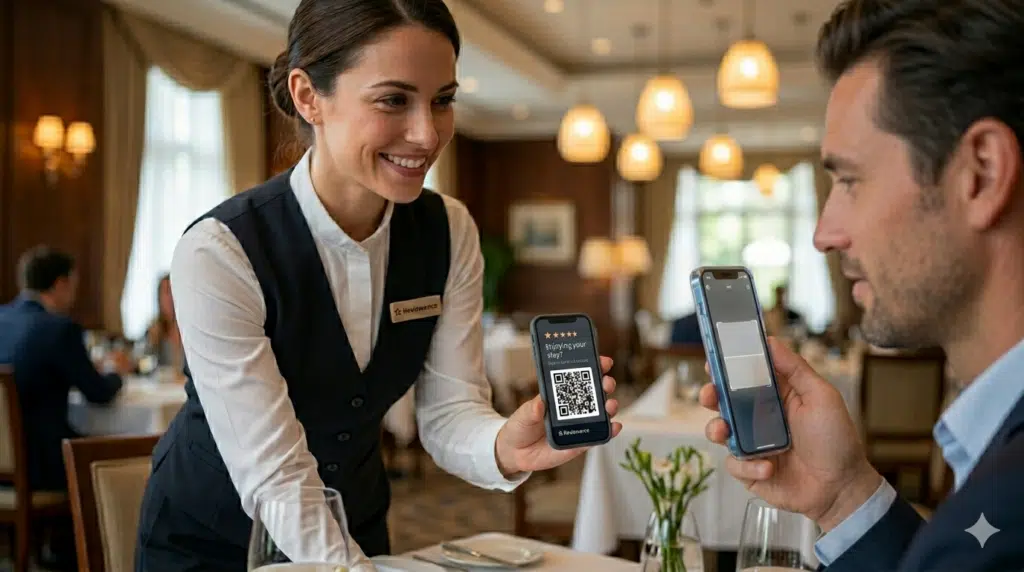
Amenities like the spa or on-site dining are high-sensory experiences. Immediately after a relaxing massage or a world-class meal, guests are in a state of high satisfaction. Placing a QR code on a bill presenter or at the spa reception allows you to capture specific amenity keywords like "relaxing spa" or "amazing breakfast" while the feeling is fresh.
3. After Room Upgrade Satisfaction
Surprising a guest with a room upgrade or a "welcome treat" creates an immediate "wow" factor. This unexpected value builds instant trust and a feeling of security. Prompting for feedback shortly after they have settled into their upgraded room captures the peak of their excitement, often leading to reviews that emphasize your clinic-like attention to detail and generosity.
4. During Checkout
While "checkout chaos" can be a hurdle, the final interaction at the front desk is a natural closing point for the guest journey. By integrating a "Frictionless Feedback" touchpoint—such as a QR code on a card within the Welcome Kit or on a desk display—you give the guest a productive task to complete while their final bill is being processed.
5. Post-Stay Follow-Up Messages
If a review wasn't captured on-site, a timely post-stay follow-up is essential. A gentle message sent 24–48 hours after departure serves as a final reminder. This approach ensures that even those who were preoccupied with departure logistics have a digital path to leave a review once they have settled into their next destination.
The "Peak Moment" Strategy Map
| Interaction | Emotional State | Keyword Opportunity |
| Room Reveal | High Excitement | "Clean rooms," "Sea view," "Luxury" |
| Gourmet Meal | High Satisfaction | "Breakfast," "Service," "Friendly" |
| Problem Solved | High Relief / Trust | "Professional," "Caring," "Helpful" |
| Spa / Pool Time | Deep Relaxation | "Spa," "Comfortable," "Painless experience" |
Reviewance is designed to help you capture these moments without disrupting the guest's relaxation. By placing our QR technology at these strategic emotional peaks, you ensure your hotel builds a profile filled with the genuine enthusiasm that drives future booking decisions.
Best QR Code Placement Ideas for Hotels & Resorts
In the high-stakes world of hospitality, capturing the "experience visualization" of a guest requires placing feedback touchpoints where they feel the most "emotional reassurance". By strategically positioning QR codes, you turn physical interactions into digital "trust signals" that drive future "booking decisions".
Reception Desk
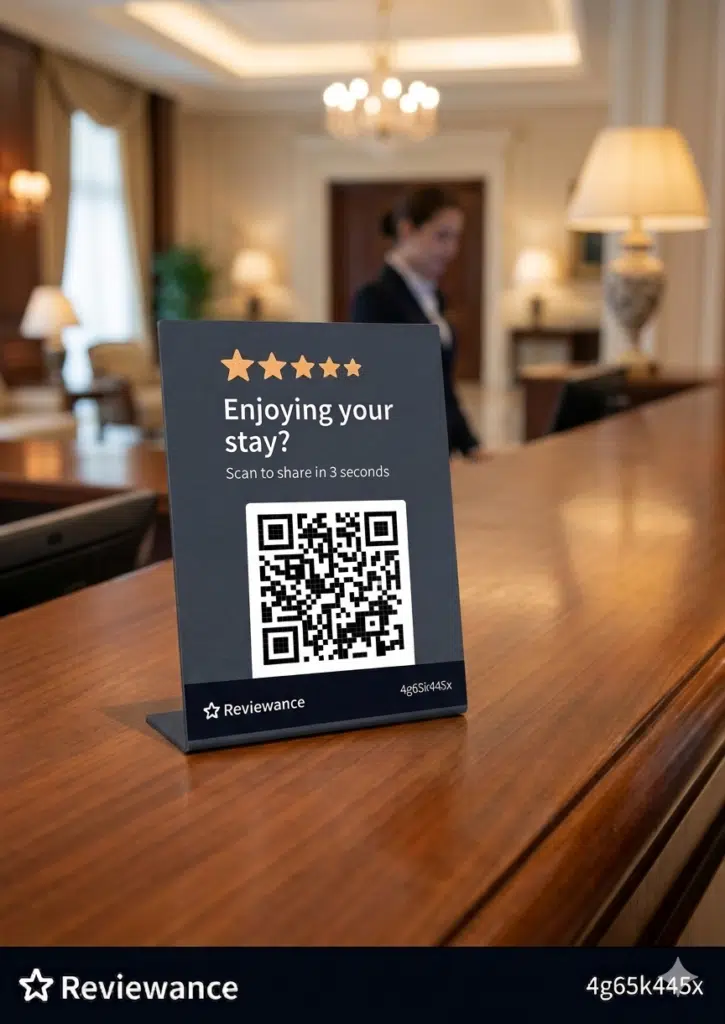
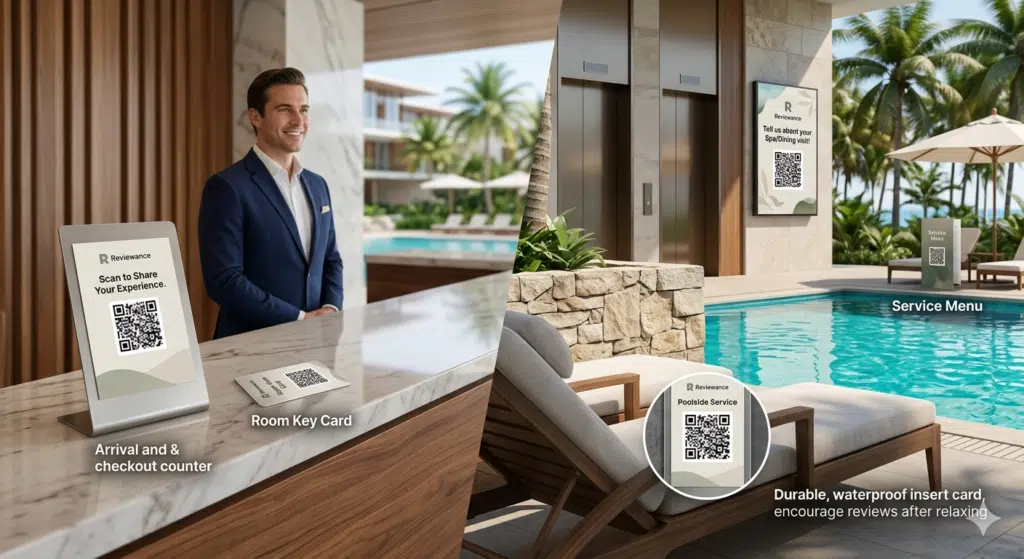
The Reception Desk is the primary "trust transfer" point. Placing a QR code here allows guests to leave a review during the "Peak Satisfaction Window" of arrival or whenever they receive exceptional service from the concierge. It signals a high level of "professionalism" from the very first interaction.
Room Key Cards
Room Key Cards are the most frequently handled physical items during a stay. By printing a subtle QR code on the card or its holder, you ensure the guest has a constant, low-friction path to leave a review whenever they feel "comfortable" or "anxiety-free" in their room.
In-Room Welcome Cards
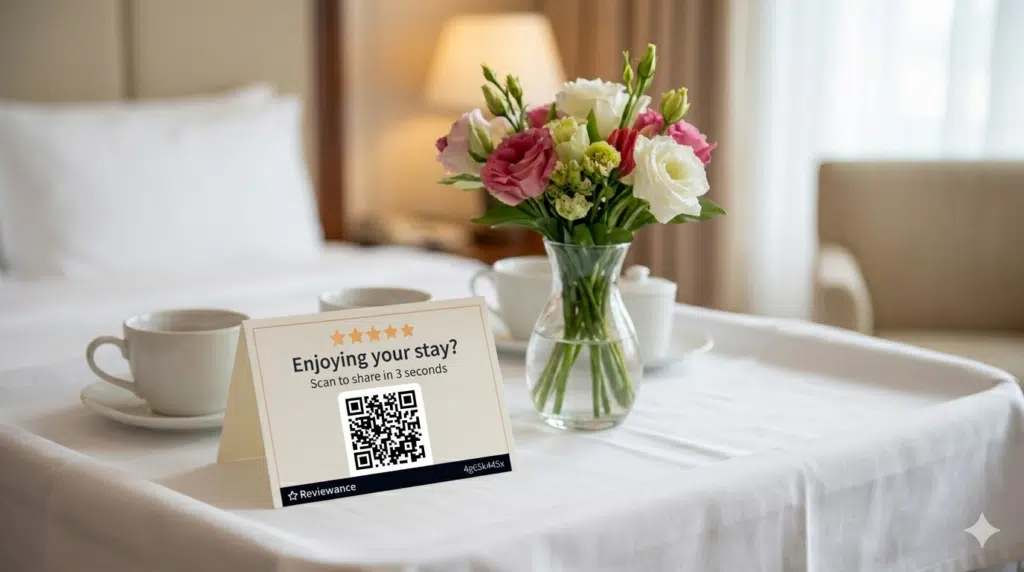
Integrating a QR code into In-Room Welcome Cards or your "Welcome Kit" captures the guest's initial "wow" factor upon entering their suite. This is an ideal moment to capture positive sentiment regarding "clean rooms" and "sea views" before the novelty wears off.
Elevator Displays
Elevator Displays take advantage of "micro-moments" of downtime. While guests are moving between floors, they are often looking for something to occupy their attention. A well-placed QR code here can prompt a quick review of the "location" or the general "feeling of security" provided by the resort.
Restaurant Bills
The "Peak Satisfaction Window" often occurs immediately after a world-class meal. Placing QR codes on Restaurant Bills or adisyon/insert cards allows you to capture specific "amenity keywords" like "breakfast" or "service" while the culinary experience is still fresh.
Spa Areas
Guests leaving Spa Areas are in a state of deep relaxation and high satisfaction. This is the perfect moment to capture "emotional keywords" like "gentle" and "caring". A QR code on a post-treatment water bottle or at the spa reception desk helps build authority for your "painless" luxury services.
Poolside Service Menus
Poolside Service Menus offer a relaxed environment where guests have the time and "travel confidence" to engage with their devices. A waterproof QR code on a menu or table tent can capture the essence of the "family-friendly" or "luxury" atmosphere of the pool area.
Checkout Counter
While "checkout chaos" is a known UX hurdle, the Checkout Counter remains the final opportunity for "experience verification". Providing a frictionless QR scan here—perhaps while their luggage is being loaded—ensures that "departure logistics" don't prevent the guest from recording their final positive sentiment.
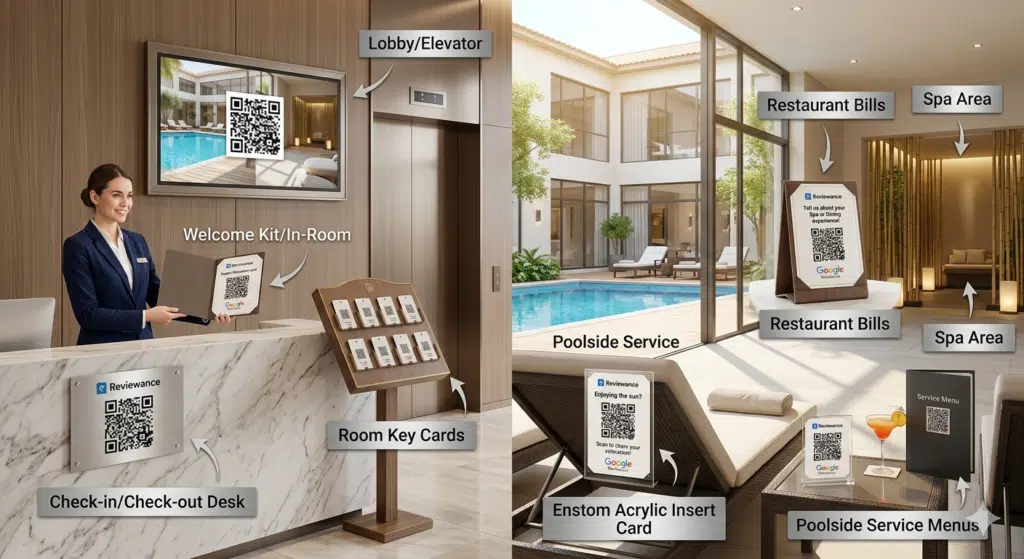
QR Placement Strategy for Maximum Visibility
| Placement Location | Emotional State | Targeted SEO Keyword |
| Welcome Kit | High Excitement | Sea view, Clean rooms |
| Spa Exit | Deep Relaxation | Caring, Professional |
| Restaurant Bill | High Satisfaction | Breakfast, Service |
| Poolside Menu | Relaxed/Happy | Family-friendly, Pool |
| Key Card Holder | Consistent Access | Location, Trusted |
The Reviewance Advantage: Our "Frictionless Feedback" system is designed to integrate seamlessly into these touchpoints, ensuring your hotel outshines the "destination competition" by converting every guest interaction into a powerful "social proof" signal.
How Google Reviews Influence Hotel Revenue
In the hospitality industry, a hotel’s digital reputation is directly proportional to its financial health. Because guests view "future experience" as a purchase, Google Reviews serve as the ultimate "confirmation mechanism" that drives revenue through several key business channels.
Impact on Occupancy Rates and Booking Conversion
A consistent stream of fresh reviews acts as a powerful conversion engine, reducing traveler anxiety and lowering the barriers to purchase.
- Trust Signals: High-quality feedback provides the social proof needed to turn a casual browser into a confirmed guest.
- Experience Verification: By confirming that marketing photos match reality, reviews prevent booking abandonment, leading to higher occupancy rates.
OTA Competition and Direct Bookings
While Online Travel Agencies (OTAs) are powerful, they are also expensive due to high commission fees.
- Local SEO Dominance: Positive Google Reviews boost Local SEO and tourism visibility, helping your hotel appear in the "Local 3-Pack".
- Lowering Friction: A strong Google Business Profile (GBP) allows for instant call and direction actions, encouraging travelers to bypass OTAs and engage in direct bookings.
Premium Pricing Ability
The most critical business insight for hotel owners is that higher review scores often allow hotels to maintain higher nightly rates.
- Price Justification: When a guest sees consistent praise for "clean rooms" or "professional" service, they perceive a higher value.
- Value Perception: A hotel with slightly higher prices but significantly better reviews often wins the booking because it reduces the perceived "vacation risk".
Driving Repeat Guests and Long-Term Value
A systematic approach to feedback doesn't just attract new guests; it builds a foundation for repeat guests.
- Expectation Management: Reviews help align vacation expectations with operational reality, leading to higher post-stay satisfaction.
- Emotional Reassurance: Guests who feel their feeling of security was prioritized are more likely to return and become brand advocates.
The Revenue Growth Matrix
| Business Driver | Influence of Google Reviews | Financial Result |
|---|---|---|
| Booking Conversion | Reduces traveler anxiety and abandonment. | Increased RevPAR (Revenue Per Available Room). |
| Direct Bookings | Enhances Google Maps discovery and instant actions. | Reduced OTA commission costs. |
| Premium Pricing | Acts as social validation for higher nightly rates. | Improved profit margins. |
| Competitive Edge | Outshines the destination competition through volume. | Greater market share. |
The Strategic Bottom Line: For a startup or established resort, Reviewance provides the "Frictionless Feedback" infrastructure needed to turn guest satisfaction into a measurable increase in revenue.
Google Review Examples for Hotels
In the hospitality sector, the most effective reviews are those that blend emotional reassurance with specific amenity keywords. These reviews act as a "confirmation mechanism" for prospective guests, providing the experience verification they need to reduce "vacation risk."
High-Impact Review Examples
Example 1: The Luxury & Service Focus
"An absolute 5-star experience! The sea view from our balcony was breathtaking, and the clean rooms were maintained with clinic-like precision. The breakfast buffet offered incredible variety, and the staff provided a true feeling of security and professionalism throughout our stay."
- Analysis:
- Amenity Keywords: "Sea view," "Breakfast."
- Cleanliness Signal: "Clean rooms maintained with precision."
- Experience Validation: Highlights the "5-star experience" and "staff professionalism."
- Local Relevance: Positions the hotel as a premium choice for its specific location features.
Example 2: The Family & Location Focus
"Perfect family-friendly resort. Everything is within walking distance, which made our travel planning so much easier. The kids loved the pool, and the painless check-in process at the reception desk was a great start to our holiday."
- Analysis:
- Amenity Keywords: "Family-friendly," "Pool," "Walking distance."
- Cleanliness Signal: Implicitly high through the mention of a "great start" and organized reception.
- Experience Validation: Direct mention of the "perfect resort" for a specific demographic.
- Local Relevance: Emphasizes the convenience of the location for families.
Example 3: The Wellness & Relaxation Focus
"Exactly what I needed for a weekend getaway. The spa treatments were gentle and relaxing, and the sea view from the lounge is unmatched. Highly recommend for anyone looking for emotional reassurance and a quiet escape."
- Analysis:
- Amenity Keywords: "Spa," "Sea view."
- Cleanliness Signal: Associated with the high standards of a "luxury" wellness environment.
- Experience Validation: Focuses on the "emotional" outcome of the stay.
- Local Relevance: Highlights the property as a top "destination" for wellness.
Why These Examples Work
A successful review helps a potential traveler perform experience visualization. By including specific details like the "breakfast buffet" or "walking distance," guests can imagine themselves inside the experience before they even book.
By placing QR codes in strategic "Peak Satisfaction" zones—such as the spa exit or breakfast area—Reviewance ensures your guests leave these high-value, keyword-rich reviews that boost your Local SEO and outshine the destination competition.
How Many Reviews Does a Hotel Need?
The number of reviews required to maintain tourism visibility is not a fixed number; it is a moving target dictated by your specific segment and the level of destination competition. In high-traffic tourist regions, the "review threshold" is significantly higher because travelers use volume as a primary trust signal to reduce vacation risk.
Review Thresholds by Segment
- Boutique Hotel
- Goal: 200–500 reviews.
- Focus: For boutique properties, quality and emotional reassurance often outweigh raw volume. However, a baseline of several hundred reviews is necessary to establish social proof against larger chains.
- City Hotel
- Goal: 500–1,000+ reviews.
- Focus: Because city hotels cater to both business and leisure, they need a high volume of recent feedback focusing on location, walking distance, and professionalism.
- Luxury Resort
- Goal: 1,000+ reviews.
- Focus: High-end guests are the most meticulous researchers. A luxury resort needs a massive library of reviews to justify premium pricing and provide experience verification for exclusive amenities like the spa or private villas.
- Airport Hotel
- Goal: 300–600 reviews.
- Focus: Travelers here prioritize functional constraints. They look for keywords like "shuttle service," "clean rooms," and "painless check-in". Freshness is more important than total volume here, as travelers need to know the current state of service.
- Family Resort
- Goal: 800–1,500+ reviews.
- Focus: Parents are risk-averse and seek social validation from other families. High review volume regarding pool safety, kids' clubs, and family-friendly dining is essential for conversion.
- All-Inclusive Resort
- Goal: 2,000+ reviews.
- Focus: These properties face the highest destination competition. Because the guest spends their entire vacation on-site, they require an overwhelming amount of "confirmation mechanisms" regarding food variety, entertainment, and overall atmosphere.
The Importance of Review Freshness
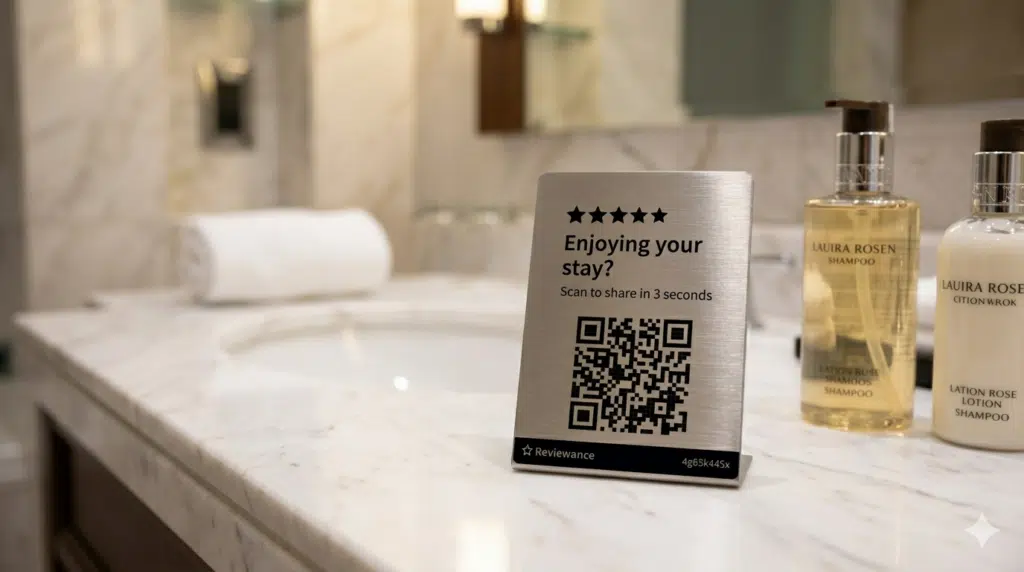
Regardless of the segment, a "stale" profile is a major deterrent. If your last review was from six months ago, potential guests may assume your standards have slipped or the property has changed management. To maintain a feeling of security, you must utilize a systematic review process—like the Reviewance QR system—to ensure new feedback is posted weekly.
Segment Strategy Map
| Segment | Primary UX Need | Critical Keyword | Review Velocity Priority |
| Boutique | Unique Experience | Personalized | Moderate |
| City | Convenience | Location | High |
| Luxury | Risk Reduction | Service | Very High |
| Family | Safety/Fun | Family-friendly | High |
| All-Inclusive | Value/Variety | Breakfast/Pool | Maximum |
The Strategic Bottom Line: In tourist-heavy areas, the winner is usually the property with the most recent and most detailed "social proof." By integrating Reviewance into your Welcome Kit and check-out process, you ensure your hotel always meets and exceeds these industry thresholds.
How Hotels Should Respond to Reviews
In the hospitality sector, your response is as important as the review itself. It serves as a public demonstration of your professionalism and your commitment to the feeling of security for future guests. A well-crafted response acts as a "trust signal" that can mitigate the impact of a negative experience or amplify the impact of a positive one.
Responding to Positive Reviews
When a guest takes the time to leave praise, your response should be appreciative and reinforcing.
- Acknowledge Specifics: Mention the specific amenities they enjoyed, such as the "sea view" or "breakfast," to reinforce those amenity keywords for future readers.
- Invite Them Back: Always end with an invitation to return, which fosters a sense of community and encourages repeat guests.
Responding to Cleanliness Complaints
Cleanliness is a non-negotiable "cleanliness signal" in hotel SEO.
- Immediate Accountability: Acknowledge the issue without making excuses. State clearly that "this does not reflect our usual high standards".
- Action-Oriented Language: Mention specific steps taken, such as "a deep clean of the room" or "additional training for our housekeeping team," to provide emotional reassurance to prospective guests.
Handling Noise Complaints
Noise is a common friction point in travel planning, especially for city hotels or family resorts.
- Empathy First: Validate the guest's frustration regarding their disrupted rest.
- Provide Solutions: Mention available remedies for future stays, such as requesting a room on a higher floor or in a quieter wing, to reduce traveler anxiety for those sensitive to noise.
Responding to Service Issues
Service failures strike at the heart of the guest's vacation expectations.
- Personal Connection: Use the name of the staff member if they were mentioned positively, or apologize on behalf of the management if the interaction was negative.
- Professionalism: Maintain a calm, helpful tone that demonstrates your hotel is a trusted establishment even when things go wrong.
Managing International Guest Feedback
International tourist behavior often involves higher expectations due to the distance traveled.
- Language Respect: If possible, respond in the language of the reviewer. This shows a high level of local relevance and cultural respect.
- Clarify Standards: Ensure you address concerns in a way that aligns with international hospitality standards, providing experience verification for guests traveling from abroad.
Hospitality Response Tone Guide
| Scenario | Tone Objective | Key Psychological Trigger |
| Praise | Grateful & Warm | Social Validation |
| Complaint | Objective & Accountable | Uncertainty Reduction |
| Suggestion | Humble & Open | Professionalism |
| International | Culturally Aware | Travel Confidence |
By using a systematic review process like Reviewance, you can identify these feedback trends early. This allows you to implement a "Frictionless Feedback" strategy where responses are handled with the same precision you apply to your "Welcome Kit" and guest arrivals.
The Importance of Photos in Hotel Reviews
In the hospitality sector, a picture is not just worth a thousand words—it is worth thousands in potential revenue. While professional marketing shots are designed to inspire, user-generated photos provide the experience verification that today’s travelers demand before committing to a stay.
The Power of User-Generated Photos
User-generated content (UGC) acts as a high-fidelity trust signal. When a guest uploads a photo of their "clean rooms" or the "sea view" from their specific balcony, they are providing a raw, unedited glimpse into the property. This visual evidence is far more persuasive than staged marketing images because it represents the actual guest experience rather than a polished corporate promise.
Trust vs. Professional Photography
The most critical visual insight for hotel owners is that guests trust guest photos more than staged hotel photography. Travelers are well aware that professional photographers use wide-angle lenses and perfect lighting to enhance spaces. In contrast, a mobile phone photo taken by a fellow traveler offers:
- Authenticity: It proves the amenities actually exist as described.
- Transparency: It shows the "wear and tear" or real-life maintenance levels of the resort.
- Relatability: It helps prospective guests achieve experience visualization by seeing the hotel through the eyes of a peer.
Room Reality Validation
The primary role of guest photos is room reality validation. Travelers use these images to verify that the bed size, bathroom cleanliness, and room layout match the descriptions provided on your Google Business Profile. If there is a disconnect between professional photos and guest uploads, it can lead to traveler anxiety and increased booking abandonment.
Aligning Traveler Expectations
Visual reviews are the best tool for managing vacation expectations. Seeing a photo of the breakfast buffet or the pool area in the middle of a busy afternoon helps a guest understand the true atmosphere of the property. When expectations are aligned through honest visual feedback, guests are more likely to arrive satisfied, leading to more positive reviews and repeat guests.
Visual Trust Comparison
| Feature | Professional Photography | Guest-Generated Photos |
|---|---|---|
| Primary Goal | Inspiration & Brand Identity | Experience Verification |
| Perceived Trust | Low (Seen as an advertisement) | High (Seen as the "truth") |
| SEO Impact | Low engagement signals | High engagement & Maps influence |
| Utility | Sets the "best-case" vision | Reduces vacation risk |
The Reviewance Strategy: Our Frictionless Feedback system encourages guests to upload photos alongside their text. By placing QR codes in visually stunning locations like the spa or a terrace with a sea view, we make it effortless for guests to capture and share the high-quality, authentic images that drive booking decisions.
Google Reviews vs. Booking Platforms for Hotels
For a hotel, the source of a review is just as important as the content itself. While various entities provide feedback channels, each plays a unique role in the traveler's journey, from initial Google Maps discovery to final booking decisions. Understanding how these platforms interact is essential for managing your Local SEO and reducing OTA competition.
The Ecosystem of Feedback Entities
- Google: As the primary gateway for mobile travel searches, Google is the most critical platform for Local SEO. Unlike other sites, Google Reviews directly impact your visibility in the "Local 3-Pack" and integrate seamlessly with Google Maps and Google Travel. This provides a massive advantage in capturing travelers during their earliest research phases.
- Booking.com: This entity is a powerhouse for international tourist behavior. It uses a verified-stay model, which acts as a strong trust signal for those booking from abroad. However, high commission fees make it a more expensive channel for revenue compared to direct bookings driven by Google.
- Tripadvisor: Once the undisputed leader in travel reviews, Tripadvisor remains a key player for deep-dive research and specialized categories like family-friendly resorts or spa hotels. It is often used as a secondary experience verification tool alongside Google.
- Expedia: Similar to Booking.com, Expedia focuses on bundled travel and high-intent shoppers. Reviews here are often used by travelers to perform final price justification before confirming an all-inclusive stay.
Comparison of Search & Trust Impact
| Feature | Booking.com | Tripadvisor | Expedia | |
| Search Intent | Highest (Early Discovery) | High (Ready to Book) | Moderate (Research) | High (Package Deals) |
| SEO Impact | Maximum (Maps Ranking) | Low (Site-specific) | Moderate | Low |
| Trust Factor | Social Validation | Verified Purchase | Community Vetted | Verified Purchase |
| Direct Action | Instant Call/Directions | Booking Only | Research/Links | Booking Only |
The "Google Advantage" in Hospitality
While entities like Booking.com and Expedia are vital for filling rooms, they often create a "walled garden" that distances the hotel from the guest. Google, however, empowers the property through instant call and direction actions, allowing for a more direct relationship. By utilizing a systematic review process like Reviewance to prioritize Google Reviews, you can shift your reliance away from high-commission platforms and toward high-margin direct bookings.
The Strategic Bottom Line: Diversification is key, but Google is the engine that drives your primary tourism visibility. Ensuring your Google Business Profile (GBP) is stocked with fresh, keyword-rich reviews is the most effective way to outshine the destination competition across all other entities.
Multi-Property Hotel Reputation Management
For hotel chains and hospitality groups, managing a digital reputation is not just about a single location; it is about maintaining branch consistency across an entire portfolio. When a guest sees a familiar brand name, they carry a set of vacation expectations that must be met regardless of whether they are staying in a city-center branch or a coastal resort.
Maintaining Branch Consistency
In a multi-property setup, the brand name serves as the primary trust signal. However, if one branch has a 4.8-star rating while another struggles at 3.2, the entire brand's feeling of security is compromised. Managing reputation at scale requires a standardized "Frictionless Feedback" protocol to ensure every location is capturing and responding to reviews with the same level of professionalism.
Centralized Review Tracking
Effective regional management is impossible without centralized review tracking. Stakeholders need a "bird's-eye view" of all properties to:
- Identify high-performing branches that can share "best practices."
- Spot "service issues" or "cleanliness signals" in specific locations before they damage the global brand.
- Monitor occupancy rates and their correlation with review scores across different regions.
Resort Reputation vs. City Hotel Strategy
Different properties within a chain require different regional management approaches. A resort reputation is often built on leisure amenities like the pool or spa, while a city branch might focus on walking distance and location efficiency. A centralized system allows the brand to track these specific amenity keywords across diverse environments while maintaining a unified brand voice in all responses.
The Power of Regional Benchmarking
For a startup or established group, comparing the tourism visibility of various branches against local destination competition is vital. By using a systematic review process across all sites, management can justify premium pricing ability and ensure that the "trust transfer" from the brand name to the individual property remains seamless.
Multi-Property Strategy Matrix
| Management Level | Focus Area | Key Metric |
|---|---|---|
| Individual Branch | On-site guest delight and QR engagement. | Review Volume & Freshness |
| Regional Manager | Competitive benchmarking and staff training. | Average Star Rating per City |
| Corporate/HQ | Brand standards and branch consistency. | Global Sentiment Score |
The Reviewance Solution: Our infrastructure is built for scale. Whether you manage three boutique hotels or a global resort chain, our system provides the centralized tracking and physical touchpoints (like Welcome Kits for every branch) needed to turn your entire portfolio into a high-conversion engine.
Seasonal Review Strategies for Resorts
For resorts, reputation management is not a static effort; it must adapt to the shifting "vacation expectations" of different traveler segments throughout the year. Because search intent changes with the weather, your Google Business Profile must reflect the specific amenity keywords that drive booking decisions for the current season.
Summer Season: The Peak of Social Proof
During the summer season, the focus of international tourist behavior is on outdoor luxury.
- Target Keywords: Reviews should prioritize keywords like "pool," "sea view," and "poolside service".
- Strategy: Place QR codes on poolside service menus and at beach towel stations to capture high-satisfaction moments while guests are most relaxed.
Honeymoon Season: Emotional Reassurance
Honeymoon season requires a focus on intimacy and a high "feeling of security".
- Target Keywords: Feedback should highlight "romantic atmosphere," "caring staff," and "spa" treatments.
- Strategy: Include a high-quality review prompt in the Welcome Kit provided for honeymoon suites to trigger the "wow factor" early in the stay.
Ski Season: Functional Trust
For mountain properties, the ski season shifts the priority toward logistics and comfort.
- Target Keywords: Travelers look for "heated lockers," "spa" availability after a day on the slopes, and "walking distance" to the lifts.
- Strategy: Position "Frictionless Feedback" touchpoints in the après-ski lounge or near the fireplace where guests gather to warm up.
Holiday Travel Peaks: Managing the Chaos
Holiday travel peaks (such as Christmas or Spring Break) often involve "checkout chaos" and high stress.
- Target Keywords: Reviews mentioning a "painless check-in" or "organized breakfast" are vital for reducing traveler anxiety for future holiday bookers.
- Strategy: Use adisyon/insert cards with QR codes to allow guests to leave feedback while they wait for their final bill or luggage.
Conference Seasons: Professional Credibility
During conference seasons, the resort must pivot to attract the business traveler.
- Target Keywords: Focus on "reliable Wi-Fi," "professional" service, and "location" convenience.
- Strategy: Place QR codes in the business center and at the exit of conference halls to capture the efficiency of your operational structure.
Seasonal Content Matrix
| Season | Primary Guest Need | Recommended QR Placement | Impact on Revenue |
|---|---|---|---|
| Summer | Leisure & Fun | Poolside Service Menus | Higher occupancy rates. |
| Winter/Ski | Comfort & Access | Spa Areas / Ski Valet | Justifies premium pricing. |
| Honeymoon | Romance & Privacy | In-Room Welcome Cards | Drives emotional reassurance. |
| Business | Efficiency | Reception Desk / Lounge | Boosts direct bookings. |
The Strategic Insight: By aligning your review collection with the current season, you ensure your tourism visibility remains high year-round. Reviewance helps you implement this systematic review process, ensuring that every seasonal "peak" is documented to attract the next wave of travelers.
How Reviewance Helps Hotels & Resorts Increase Visibility and Bookings
In an industry where experience visualization drives every transaction, Reviewance provides the technological infrastructure to turn guest satisfaction into a dominant digital reputation. By eliminating the "checkout chaos" and social friction of manual requests, we empower hotels to capture the "emotional peaks" of every stay, directly influencing local SEO and booking conversion.
The Reviewance Operational Framework
Our system is designed to integrate seamlessly into your property’s existing operational structure, ensuring a systematic review process across all guest touchpoints:
- Frictionless Feedback Technology: We utilize QR code technology strategically placed in high-satisfaction zones—such as the spa, pool, or restaurant—to capture feedback the moment a guest feels most delighted.
- Customized Welcome Kits: Every property receives a curated set of physical assets, including in-room welcome cards and adisyon/insert cards for restaurant bill folders, making the "ask" a natural part of the guest journey.
- Strategic Amenity Keywords: Our process is optimized to prompt reviews that naturally include critical keywords like "clean rooms," "breakfast," and "location," which are essential for ranking higher on Google Maps.
- Brand Identity & Security: We help you maintain branch consistency and a feeling of security through a professional visual identity that aligns with your resort’s premium standards.
Transform Your Digital Reputation Today
Don't let your guest’s positive experiences fade away during departure logistics. By implementing the Reviewance model, you ensure that every sea view and exceptional service interaction is translated into the social validation that modern travelers demand.
Ready to outshine the destination competition and drive more direct bookings?