
In the medical aesthetics industry, a Google Business Profile acts as a vital digital storefront that bridges clinical professionalism with consumer beauty standards. Because Med Spa procedures are elective and impact physical appearance, potential clients rely heavily on trust verification before booking.
The psychological weight of a review in this sector is driven largely by experience visualization. Prospective patients scan testimonials to see "before and after" social proof, treating client-uploaded photos as the ultimate quality signal. These images and stories provide the experience verification necessary to prove that results are both consistent and reliable.
Furthermore, reviews are the most effective tool for overcoming "procedure anxiety". Whether it is fear of pain or "overdone" results, feedback highlighting a practitioner’s transparent communication and professional demeanor helps create a critical feeling of security. When reviewers mention that a consultant was honest about expected outcomes, it provides honesty validation and safety reassurance, which are essential for high-ticket aesthetic investments.
From a growth perspective, a high volume of fresh reviews ensures that a clinic captures mobile searches through superior Maps visibility. Ranking in the Local 3-Pack is essential for high-intent queries like "Botox near me," where local reputation impact determines which clinic a client chooses. Ultimately, a strong review profile reduces hesitation for expensive treatment packages, converting one-time visitors into long-term referral business.
The Connection Between Reviews and Local SEO
If you think online reviews are just about reputation or "feeling good" about your service, think again. In the current search landscape, reviews are the engine of local visibility. They are no longer just a trust signal for customers; they are a direct, quantifiable ranking factor for Google.
Whether you rank in the coveted "Local Pack" (the top 3 results on Google Maps) or get lost on page two depends heavily on your review profile. According to Moz’s 2026 Local Search Ranking Factors, review signals now carry 15% of the total ranking weight for the Local Pack, placing them as the third most important factor behind only your Google Business Profile (GBP) signals and on-page SEO .
But how exactly does this connection work? It comes down to three specific metrics: recency, velocity, and quality. For businesses looking to master this connection, platforms like Reviewance are becoming essential tools to automate and optimize this process, ensuring you don't fall behind your competitors.
Why Recency and Velocity Outrank Total Volume
A common misconception is that having hundreds of old reviews guarantees top rankings. In 2026, this is false. Google prioritizes freshness.
Data from BrightLocal indicates that 73% of consumers only pay attention to reviews written in the past month . Google’s algorithm mirrors this behavior. A study by UENI highlights that reviews older than a year carry "minimal ranking influence," while those less than 30 days old carry full weight .
This is where Reviewance changes the game. It isn't just about collecting a high score of total reviews; it is about maintaining a consistent "velocity" (reviews per month). Search Engine Journal corroborates this, noting that managing review cadence is "the most consistent driver of Local Pack visibility across all industries" .
Businesses that generate 3–5 new reviews per month are statistically likely to rank in the top 3 of the Map Pack. Those with 0–1 new reviews tend to drop to positions 7–10 . Reviewance helps businesses schedule and automate requests so that the review stream never runs dry, signaling to Google that the business is active and relevant today.
The "Critical Mass" Threshold and AI Discovery
There is a specific mathematical target you need to hit to be considered a "trusted entity" by Google. Recent analysis of the 2026 algorithm reveals the concept of the AI Citation Threshold.
According to industry studies, the magic number is 150+ reviews per location . Why 150? Below this threshold, AI Overviews (SGE) and large language models like Gemini and ChatGPT are statistically less likely to surface your business as a named recommendation. Crossing this line triggers a "trust validation checkpoint" in the algorithm .
However, gathering 150 reviews manually is daunting for most local business owners. This is the practical value of using a service like Reviewance. By streamlining the request process via SMS and email, businesses can systematically build the volume required to trigger these algorithmic trust signals and appear in AI-generated answers for "best plumber near me" or "top-rated dentist."
Quality, Sentiment, and the 4.0-Star Floor
It is not just about the number of reviews; it is about what the words say.
Google’s natural language processing (NLP) scans review text for specific keywords. If a customer writes, "Best emergency plumber in Dallas for fixing burst pipes," that phrase lives inside your GBP and helps you rank for that specific service .
Furthermore, there is a strict rating threshold. ClickRank AI reports that Google enforces a "4.0-star floor." Businesses falling below 4.0 stars are often excluded from AI-generated recommendations and filtered out of searches for "best" or "top-rated" services .
Reviewance helps manage this risk by allowing owners to monitor sentiment in real-time. By identifying negative trends early, a business can engage with unhappy customers before they leave a damaging public review, protecting the star rating that keeps them in the game.
The Engagement Loop: Responses as a Ranking Signal
Finally, the connection between SEO and reviews doesn't end when the customer hits "submit." How you respond matters.
Yext’s 2026 analysis of 8.7 million search results found that owner responses are a dominant signal in local rankings . Review signals are so powerful that businesses responding to 100% of their reviews can see a 5–10% ranking boost over those who ignore them .
Using a centralized dashboard, such as those offered by modern platforms (similar to the efficiency of Reviewance.com), ensures that responses are not missed. A quick, professional response to a review (positive or negative) generates fresh, indexable content on your GBP and signals to Google that the business is credible and customer-focused.
The direct connection between reviews and Local SEO is undeniable. Reviews provide the volume to prove you are established, the velocity to prove you are active, and the sentiment to prove you are trustworthy.
In a digital environment where 98% of consumers read reviews for local businesses and proximity is the only factor that outweighs them , neglecting your review strategy means surrendering your map rankings to competitors. Leveraging tools like Reviewance.com allows businesses to turn the chore of review management into a systematic, data-driven engine for local search dominance.
How Clients Search for Med Spas on Google
If you run a medical spa, you are likely competing against dozens—sometimes hundreds—of other clinics offering Botox, laser hair removal, and CoolSculpting in your immediate area. In 2026, the difference between a fully booked calendar and an empty consultation room is determined by a single question: How do clients actually search for you on Google?
The answer has shifted dramatically in the past two years. Patients no longer just "search." They cross-reference, compare, and decide before they ever click on your website. Understanding the modern search journey is the first step to capturing high-intent local traffic .
Here is the anatomy of how med spa clients find you on Google in 2026.
The Death of the Generic Search
Gone are the days when a potential client would search "med spa" and pick the first result. Today, the search journey starts with hyper-specific, high-intent keywords.
According to industry data, the highest-converting searches for med spas follow distinct patterns: "Service + Location" (e.g., "lip filler Austin"), "Near Me" searches, and "Intent + Service" (e.g., "best med spa for CoolSculpting") .
These are not casual browsers. These are patients who have already decided they want the treatment; they are simply deciding where to get it. Research indicates that the cost-per-click for these specific keywords often ranges from 75 to 75 to 150+ , demonstrating just how valuable and competitive that search real estate is .
For your med spa to appear here, Google must trust that you are the authority for that specific treatment in that specific zip code. This trust is largely built on review signals—specifically, how many recent, positive reviews mention those exact services.
The "Local Pack" vs. The "AI Overview"
When a client types "Botox near me," they are presented with two distinct landscapes: the Google Local Pack (the map with 3 listings) and the new AI Overviews.
To win the Local Pack, your Google Business Profile (GBP) must be flawless. But to win the AI Overview (where Google summarizes an answer using natural language), the algorithm looks for "prominence." This refers to how established your practice appears online, measured primarily through review volume and ratings .
A complete Google Business Profile can boost local search visibility by up to 287% . However, a profile that is static (no new reviews or photos) tells Google that your business might be inactive. Reviewance solves this by automating the cadence of review requests, ensuring that Google sees a steady stream of fresh, authentic feedback, which is a critical signal for both Map Pack rankings and AI inclusion.
The "Three-Tab" Shopper
Modern med spa clients behave like comparison shoppers. Data shows that the typical patient will compare 2 to 3 providers before picking up the phone . They open three tabs: Your clinic, Clinic A, and Clinic B.
What are they comparing side-by-side?
- Star Rating & Volume: Is it 4.8 stars? How many reviews?
- Recency: Were the last five reviews written this week or last year? A study of local search factors reveals that reviews older than a year carry minimal ranking influence, while those less than 30 days old carry full weight.
- Specific Mentions: Does someone mention "painless injection" or "great results"?
If your competitor has 150 reviews and you have 40, they win the click, even if your clinical skills are superior. This is the "Critical Mass" threshold. Platforms like Reviewance help you systematically build this volume without spamming your clients, transforming your review profile from a weakness into your strongest acquisition asset.
The Shift to Conversational & Visual Search
Finally, we cannot ignore the rise of AI and Visual Search. Nearly 77% of patients search online before booking, and that search increasingly happens via voice or camera .
- Voice Search: Clients ask Siri or Google Assistant, "Find a med spa open late near me." Voice search favors listings with high review scores and complete GBP data.
- Visual Search: Potential clients may take a photo of a celebrity's skin and upload it to Google Lens to find where to get that "glow." Google’s algorithm associates images with specific services.
In this environment, Reviewance provides a consolidated dashboard to monitor not just the star rating, but the sentiment and keywords inside the reviews. If five clients mention "migraine relief from Botox" in their reviews last week, that keyword density tells Google you are the expert for that niche, driving more qualified traffic to your site. Clients are searching smarter, faster, and with more skepticism than ever before. They rely on Google not just as a map, but as a reviewer of trust. By leveraging a reputation management system like Reviewance to optimize review velocity and quality, you ensure that when that highly motivated client opens their three tabs, your med spa is the undeniable winner.
Why Trust and Results Matter in Med Spas Treatments
In the medical aesthetics industry, trust is not a "nice-to-have." It is the single most valuable asset your practice owns. According to Gallup data, 62% of Americans rate doctors as "high" or "very high" in honesty and ethical standards—compared to just 12% for business executives . Patients are not just buying Botox or laser hair removal; they are placing their health, appearance, and confidence in your hands.
But here is the challenge that every med spa owner faces: trust must be earned before the patient ever walks through your door. In 2026, prospective clients form their first impression not from a conversation with your staff, but from your Google rating, your review recency, and the specific words past patients have used to describe their results .
This is the direct connection between clinical excellence and digital reputation. Your results in the treatment room are only half the equation. The other half is how those results translate into visible, verifiable social proof online.
The Trust Asset: Why Patients Choose One Med Spa Over Another
More than 70% of patients check online reviews before selecting a healthcare provider, with 94% of patients reading reviews specifically before choosing a medical aesthetics practice . This means that even if you deliver the most stunning results in your city, a lack of recent, positive reviews can render you invisible.
The decision-making journey has shifted. Local searches have overtaken personal referrals as the main way people under age 45 search for new providers . A glowing testimonial from a happy patient now carries the same weight as a recommendation from a best friend.
Reviewance.com helps you capture this trust systematically. By automating the review request process after every successful treatment, you ensure that the trust you build in the consultation room translates into a visible digital asset that works for you 24/7.
Results Drive Reviews: The Clinical-Reputation Feedback Loop
There is a powerful cycle at play in successful med spas: great results generate great reviews, and great reviews attract more patients who expect great results.
Data from the medical aesthetics industry reveals that repeat clients spend 67% more than new ones, and a 5% increase in patient retention can boost profits by 25% to 95% . Satisfied patients are not just more profitable; they are your most credible marketing channel. A patient who feels confident, cared for, and delighted with their outcome will naturally leave a detailed, authentic review that mentions specific treatments—"the best CoolSculpting experience" or "painless lip filler with natural results."
These keyword-rich reviews do something remarkable: they feed directly into your local SEO. Google uses a metric called "prominence" to rank local search profiles, and prominence is built in part by the content inside your reviews . When patients mention specific services, Google learns that you are the authority for those treatments in your area.
Reviewance helps you close this loop. By monitoring review sentiment and volume in real-time, you can identify which treatments generate the most enthusiastic responses and double down on what works—while protecting your star rating from the occasional dissatisfied patient before it damages your public profile.
Compliance and Professionalism: The Foundation of Lasting Trust
Trust is not built on results alone. It is also built on the professionalism, safety, and transparency of your operations. Patients notice when a clinic uses modern, secure systems. They appreciate seeing clear consent forms, detailed treatment plans, and consistent follow-ups .
A compliance-first approach does more than protect you from liability. It creates the operational consistency that leads to predictable, repeatable results—and predictable, repeatable results lead to predictable, repeatable reviews. When every patient receives the same high-quality care, no matter which provider they see, your online reputation becomes stable and resilient .
Moreover, responding to every review—positive or negative—demonstrates that you are engaged, accountable, and patient-focused. Google has indicated that responding to reviews positively impacts visibility, and patients see responsiveness as a sign of transparency .
The ROI of Trust: From Reputation to Revenue
Trust is not an abstract concept. It can be measured, managed, and monetized. Practices that actively manage their online reputation experience measurable returns: increased client acquisition, higher engagement rates, and sustained revenue growth over time . In fact, featuring honest patient feedback can increase conversions by up to 270%
In medical aesthetics, you are only as good as your last result—and the review that follows it. Patients are searching for providers they can trust with their faces, their bodies, and their confidence. Your clinical expertise delivers the results. Reviewance ensures that those results are seen, trusted, and acted upon by the patients who need you most.
Should Every Med Spa Have a Google Business Profile?
The short answer is yes — but the longer, more important answer is that simply having a profile is not enough. In 2026, a Google Business Profile (GBP) is not optional for med spas. It is the single most powerful, high-ROI marketing asset you can own. According to industry data, a complete and regularly updated GBP can boost local search visibility by as much as 287% , translating directly into more consultations, calls, and booked appointments .
However, merely claiming your listing is like hanging an "Open" sign on a door that is locked. You need to optimize it, feed it fresh content, and actively manage the review signals that Google craves. Here is why every med spa needs a GBP—and how Reviewance helps you turn that profile into a patient-generating engine.
The Digital Front Door of Your Med Spa
Before potential clients even visit your website, they are searching for services like "Botox near me" or "CoolSculpting in [city]." Your Google Business Profile is the digital storefront that appears in Google Search and Google Maps at the exact moment a patient has high intent to book .
Jared Rohrer, a med spa marketing expert, emphasizes that this profile functions as your digital front door — showing up before your website in many local searches. If your profile is unclaimed, incomplete, or inaccurate, you are essentially invisible to local prospects .
Data shows that up to 77% of patients choose their med spa based on Google reviews and profile completeness alone . This means that a competitor with a well-optimized profile can capture a patient who would have preferred your clinical expertise—simply because they appeared first and looked more trustworthy.
Reviewance helps you own this digital front door by automating the one thing Google values most: fresh, authentic reviews. A steady stream of recent five-star reviews signals to Google that your practice is active, trusted, and deserving of the top spot in the Local Pack .
The Ranking Trifecta: Relevance, Distance, and Prominence
Google uses three primary signals to rank local listings: relevance (does your profile match the search?), distance (how close are you to the searcher?), and prominence (how well-known and trusted is your business?) .
Of these three, relevance and prominence are the ones you control directly through GBP optimization. Here is how they break down:
| Ranking Signal | What It Means | How You Control It |
|---|---|---|
| Relevance | How well your profile matches "Botox near me" | Categories, service list, business description, Q&A |
| Prominence | How trusted and established you appear | Review count, review recency, star rating, response rate |
| Distance | Physical proximity to searcher | Your actual location (you control this by opening more locations) |
The weight of prominence has grown significantly in 2026. Google's algorithm now prioritizes review velocity (how many new reviews you get per month) over total review volume . A profile with 60 reviews collected over the past 12 months will often outrank a profile with 200 reviews from three years ago.
Reviewance directly addresses this by helping you maintain a consistent cadence of review requests. By automating follow-up SMS and email messages after every appointment, you ensure that your review stream never dries up—signaling to Google that your med spa is active, trusted, and relevant today .
The Complete Profile Advantage
A fully completed Google Business Profile does more than just help you rank. It actively converts searchers into patients. Data shows that complete profiles make customers 70% more likely to visit and 50% more likely to consider purchasing from your business .
Here is what a complete, optimized profile includes:
Essential Fields:
- Primary Category: Set to "Medical Spa" — this is the single most influential field for aesthetic service queries
- Secondary Categories: Add up to nine, including "Laser Hair Removal Service," "Skin Care Clinic," and "Weight Loss Service"
- Service List: Create unique listings for every treatment—Botox, fillers, CoolSculpting, laser hair removal, each with a 300+ character description
Visual Content:
- Photos: Profiles with over 100 photos see a 520% increase in calls and 2,700% more direction requests
- Videos: Upload 30-second tours and treatment explanations
- Weekly Posts: Signal active management and boost rankings
Engagement Features:
- Q&A: Pre-load answers to common consultation questions
- Booking Link: Enable "Reserve with Google" for direct scheduling
- Messaging: Turn on chat to capture leads instantly
Reviewance integrates seamlessly into this ecosystem by ensuring that every happy patient becomes a visible advocate. The platform provides direct review links and automated request workflows, turning the chore of review collection into a systematic growth engine .
The Review Velocity Imperative
Across every expert source, one message is clear: review recency and velocity matter more than total count .
Google interprets a steady flow of new reviews as a sign that your business is active, engaged, and popular. A competitor who earns 4-8 new reviews per month will outrank a med spa with a higher average rating but zero new reviews in the past six months .
Here is what effective review velocity looks like for med spas:
| Performance Level | New Reviews Per Month | Expected Outcome |
|---|---|---|
| Survival Mode | 2-4 | Maintaining current rankings |
| Growth Mode | 4-8 | Moving up in Map Pack |
| Dominance Mode | 8-12+ | Top 3 positioning for core searches |
Reviewance makes growth-mode velocity achievable without adding administrative burden. The platform automates the timing, personalization, and delivery of review requests—ensuring that every satisfied patient is prompted to share their experience at the optimal moment .
The Cost of Doing Nothing
Every day your GBP is incomplete, inactive, or review-starved, you are losing patients to competitors who have figured this out.
Consider this: 72% of consumers who perform a local search visit a store within 5 miles, and 88% of those searches on mobile lead to a call or visit within 24 hours . If your profile is not optimized, those patients are calling your competitors.
A GBP is free to claim. But the real investment is in the ongoing management—the photos, the posts, the Q&A responses, and most importantly, the reviews. This is where Reviewance provides unparalleled value, turning what feels like a time-consuming chore into an automated, measurable system for local dominance.
Conclusion: Yes—But Only If You Do It Right
Should every med spa have a Google Business Profile? Absolutely. But having a profile is not the same as leveraging a profile. An unclaimed, incomplete, or review-starved GBP is worse than no profile at all—it signals neglect to both Google and potential patients.
The med spas that win in 2026 are those that treat their GBP as a living, breathing marketing asset. They update photos weekly, post consistently, respond to every review, and maintain a steady velocity of fresh patient testimonials.
Reviewance is the force multiplier that makes this possible without overwhelming your staff. By automating review collection, monitoring sentiment, and providing analytics, the platform ensures that your Google Business Profile works as hard as you do—turning every satisfied patient into your most credible marketing channel.
How Med Spas Rank Higher on Google Maps
If your med spa is not appearing in the top three results of Google Maps—often called the "Local Pack"—you are invisible to the majority of high-intent patients in your area. According to industry data, over 40% of clicks for local searches go to Google Maps results, and nearly 80% of patients start their search online before booking an appointment . When a potential client types "Botox near me" or "laser hair removal [city]," they are not casually browsing. They are comparing providers and ready to book. The med spa that ranks first gets the call .
Ranking higher on Google Maps is not a mystery. Google evaluates local results based on three core factors: relevance, proximity, and prominence . Your job is to optimize every signal within these three categories. Here is exactly how med spas can systematically improve their Google Maps position.
1. Optimize Your Google Business Profile Completely (Relevance)
Your Google Business Profile (GBP) is the single most important asset for Maps rankings . A complete, accurate profile is the foundation of everything else. Here is what matters most:
Primary Category Selection
Your primary category tells Google what your business is. For med spas, select "Medical Spa" as your primary category—not "Day Spa" or a generic "Beauty Salon" . This distinction matters because Google treats medical aesthetics differently from general beauty services. Add 2–5 secondary categories that reflect specific services, such as "Laser Hair Removal Service," "Skin Care Clinic," or "Weight Loss Service" .
NAP Consistency
Your business Name, Address, and Phone number must be identical across your GBP, your website, and every online directory where your med spa appears . Even minor discrepancies—like "Suite 200" on your website versus "Ste 200" on your GBP—can suppress your rankings. Use a local phone number with your area code rather than a toll-free number; this signals to Google that your business is genuinely tied to the area .
Complete Every Field
Fully completed profiles make customers 70% more likely to visit and 50% more likely to consider purchasing . Do not skip the business description (up to 750 characters), services list, hours, holiday hours, attributes (e.g., "wheelchair accessible," "LGBTQ+ friendly"), and appointment link. A half-finished profile does not inspire trust in Google or patients .
2. Build Dedicated Service + Location Pages on Your Website (Relevance)
Most med spa websites have a single "Services" page that lists everything in one place. This structure is a missed opportunity for Maps rankings. Google cannot rank a page for "Botox near me" if that same page is also trying to rank for laser hair removal, CoolSculpting, and microneedling simultaneously .
Instead, create separate, dedicated pages for each core service combined with each target location . Examples:
- "Botox in [City Name]"
- "Laser Hair Removal in [Neighborhood]"
- "CoolSculpting in [Suburb]"
Each page should include:
- A clear H1 headline with the service and location
- Detailed treatment descriptions (how it works, results, recovery time, pricing)
- Authentic before-and-after images (never stock photos)
- Patient testimonials, ideally from that specific area
- Direct calls to action ("Book a free consultation today")
- Internal links connecting related service pages
- A link back to your Google Business Profile
This approach gives Google clear, crawlable evidence that you offer specific treatments in specific locations—making your med spa a candidate for those Maps searches . According to one SEO agency, implementing this structure led to a 25% increase in Maps impressions for a multi-location client .
3. Generate a Consistent Stream of Recent Reviews (Prominence)
Reviews are one of the three most important local ranking factors. Google evaluates volume, recency, average rating, and keyword relevance when determining Map Pack placement . A med spa with 150 five-star reviews and a 4.8 rating will often outrank a competitor with only 20 reviews . A practice with 200 reviews and a 4.8 average will rank above a competitor with 40 reviews and a 4.9 average in most markets .
The critical insight is that recency matters more than total volume. A competitor who earns 4–8 new reviews per month will outrank a med spa with a higher average rating but zero new reviews in the past six months . A steady flow of fresh reviews signals to Google that your business is active, engaged, and popular today .
Building a Review System That Runs on Autopilot
The challenge every med spa owner faces is consistency. Asking for reviews feels awkward, and remembering to do it for every client is unrealistic when you are running treatments all day. The solution is a system, not a habit .
Send a post-visit message to every client automatically, one to two days after their appointment. The timing matters: review requests go out within 48 hours of the appointment, when the result is fresh and the client is happy . Wait a week and the response rate drops sharply.
Your message should be short and warm:
"It was great seeing you yesterday. If you are happy with your results, it would mean a lot if you shared your experience on Google. It takes about 30 seconds: [direct link]."
Reviewance solves the consistency problem by automating this entire workflow. The platform sends timely, personalized review requests via SMS and email after every appointment—ensuring that your med spa maintains the steady review velocity that Google rewards . No awkward conversations. No missed follow-ups. Just a systematic engine for building the social proof that drives Maps rankings.
Respond to Every Review
Google has confirmed that responding to reviews is a ranking factor . A thoughtful response to a positive review reinforces trust. A professional response to a critical review shows potential patients how you handle problems—a meaningful trust signal before they book a first treatment .
4. Build Local Citations Across Trusted Directories (Prominence)
Local citations are mentions of your business name, address, and phone number across the web. Google uses citation consistency and volume as a signal of legitimacy . A med spa with accurate listings across 50 relevant directories will outrank one that only exists on Google Maps .
The directories that matter most for med spas include:
- Google Business Profile
- Yelp
- Healthgrades
- RealSelf (particularly important for aesthetics—high-intent buyers browse here)
- Zocdoc
- WebMD Physician Directory
- Vitals
- American Med Spa Association directory
- Local chamber of commerce websites
Before adding new citations, audit every existing listing for accuracy. Outdated addresses, old phone numbers, and incorrect business names suppress your rankings . Correct inconsistencies first, then build out directories where you are not yet listed.
The process of auditing and maintaining citations across 50+ platforms is time-consuming. This is another area where automated reputation management platforms provide significant efficiency gains, ensuring your NAP information remains consistent without manual tracking.
5. Add Photos and Videos Consistently (Prominence)
Visual content directly impacts Maps performance. Profiles with over 100 photos experience a 520% increase in calls and a 2,700% increase in direction requests . Photos do more than make your profile look nice—they prove that you are a real, active business and reduce hesitation from potential patients .
Upload new photos weekly, not just when you open. Include:
- Exterior shots of your signage and entrance
- Interior spaces (reception area, treatment rooms)
- Staff photos
- Treatment photos (with client consent)
- Before-and-after images
Short videos (up to 30 seconds) are also effective—video tours of your clinic, introductions to treatments, or behind-the-scenes glimpses of your team . Google's algorithm rewards active profiles, and regular visual updates signal that your business is engaged and current .
6. Post to Your GBP Weekly (Prominence)
Posting regularly to your Google Business Profile signals active management, which positively impacts search rankings . A short post announcing a new treatment, sharing a client result, or explaining a procedure takes five minutes and signals to Google that your business is active and engaged . Most of your competitors are not doing this—that is a direct ranking advantage you can take right now .
Effective post types include:
- Offer posts: "Save 20% on All Facial Treatments This Month!"
- Update posts: New equipment or staff announcements
- Event posts: Open houses or live treatment demonstrations
Always include a clear call-to-action button ("Book," "Learn more," "Buy") to encourage immediate action .
7. Ensure Mobile Optimization (Proximity + User Experience)
Most local searches happen on mobile phones . When a patient clicks through from your Map Pack listing to your website, that site needs to load quickly and be easy to navigate on a small screen.
Google uses mobile-first indexing, meaning the mobile version of your site is used for ranking and indexing . A slow or poorly formatted mobile site costs you conversions even when your listing ranks well . Ensure your site has:
- Tap-to-call buttons
- Mobile-friendly booking forms
- Fast page load times (under 3 seconds)
The Bottom Line: Consistency Wins
Ranking higher on Google Maps is not about a single magic trick. It is about consistently optimizing all three of Google's core signals: relevance (categories, service pages, complete profile), proximity (accurate address, service areas), and prominence (reviews, citations, photos, posts) .
The med spas that dominate the Map Pack in 2026 are the ones that treat their Google presence as a living, breathing asset—not a set-it-and-forget-it listing. They update photos weekly. They post regularly. They respond to every review. And most importantly, they maintain a steady stream of fresh, authentic reviews that signals to Google they are the trusted choice in their market .
Reviewance provides the infrastructure to make review consistency effortless. By automating requests, monitoring sentiment, and centralizing your reputation management, the platform ensures that your med spa builds the review velocity required to climb—and stay—at the top of Google Maps .
Why Most Med Spas Struggle to Collect Reviews
If you run a med spa, you already know that online reviews are essential. They influence your Google Maps ranking, build trust with potential patients, and directly impact your booking volume. Yet despite knowing this, most med spas struggle to collect reviews consistently.
The problem is rarely about clinical quality. Most med spas deliver excellent results. The struggle is operational—rooted in how review collection is approached, timed, and scaled. Here is why manual systems fail, what makes med spas uniquely difficult, and how breaking these patterns transforms your online reputation.
Manual Follow-Up Does Not Scale
Here is what "manual follow-up" looks like in most med spas: a client finishes a procedure—Botox, filler, laser treatment—and the front desk staff either forgets to ask for a review or brings it up awkwardly during checkout. The client walks out, the moment passes, and someone sends a text or email hours or days later. Maybe one in ten opens it. Maybe one in twenty leaves a review .
This cycle repeats across hundreds of appointments. Your business grows, but review momentum stalls. The result is slower review velocity, missed opportunities, lower SEO rankings, and lost conversions from prospects who see a weak or stagnant review profile .
The operational math does not work. A solo practitioner can hand-write follow-up notes and personally ask for reviews. A med spa running 80 to 120 appointments per week cannot. Manual systems fail at scale because they rely on memory, effort, and consistency that no busy team can sustain .
The Med Spa Industry's Unique Review Challenges
Med spas are not restaurants or retail stores. The nature of aesthetic medicine creates specific barriers to review collection that other industries do not face.
Patient privacy and discomfort. Med spa clients are often self-conscious about their appearance concerns. They prefer privacy and do not always want to talk at length during checkout. Asking for a review face-to-face can feel awkward for both the client and the staff member .
Delayed results. Unlike a meal that is judged immediately, aesthetic treatments often take days or weeks to show full results. A client who leaves happy may feel differently a week later if swelling persists or results are subtle. Conversely, a client who is initially uncertain may become thrilled once healing completes. Timing the review request around this variable satisfaction window is challenging .
High expectations and emotional stakes. Aesthetic patients arrive with sky-high expectations cultivated by social media and clever marketing: no bruising, no side effects, instant results, zero risk. When reality does not match these expectations—even when clinical outcomes are objectively good—patients may feel disappointed and less inclined to leave positive feedback .
The "injector hopping" phenomenon. A study conducted by a pharmaceutical company found that up to 44% of dissatisfied aesthetic clients simply move to another injector rather than complaining directly. They do not leave reviews. They do not give you a chance to fix the issue. They just disappear—taking your opportunity to convert a negative experience into a positive resolution and a potential review with it .
Practitioner burnout. The pressure to deliver flawless results, maintain impeccable bedside manner, generate revenue, and build an online presence has led to widespread burnout among aesthetic clinicians. Burnout rates range from 35% to 69% among dermatologists and plastic surgeons . Exhausted teams are less likely to remember—or care about—asking for reviews at checkout.
The Timing Problem: Why Most Requests Come Too Late
Review requests that arrive days or weeks after an appointment see dramatically lower response rates. The post-treatment satisfaction window is highest immediately after the appointment, and the experience is still vivid in the client's mind .
Yet most med spas send requests manually, hours or days late, if they send them at all. By the time the request arrives, the moment of enthusiasm has passed. The client has moved on with their life, and your request becomes background noise.
Reviewance solves this with moment of truth timing. Requests are triggered via QR code instantly and response rates are highest.
The Channel Problem: Email Gets Ignored
Even when med spas remember to send review requests, they often use the wrong channel. Email open rates for review requests average 20-28%. Whereas it is %90 if you ask for review.
The Fear of Negative Reviews
Many med spa owners hesitate to actively collect reviews because they fear negative feedback. This is understandable—aesthetic outcomes are subjective, and dissatisfied patients can leave damaging public reviews.
However, avoiding review collection does not prevent negative feedback. It just ensures you have no positive reviews to balance it. A profile with 80 reviews and a 5.0 average will typically be outranked by one with 400 reviews and a 4.6 average, because Google weights consistent, ongoing review activity over static perfection .
The solution is not to avoid asking. It is to filter negative feedback before it becomes public.
Reviewance offers smart mode to business owners: if they want, they can direct satisfied customers (scores 9-10) to leave public Google reviews and dissatisfied customers (scores 0-6) are routed to a private internal feedback form, allowing you to address their concerns before they post a one-star review publicly .
The Feedback Silo Problem
Most med spas collect patient feedback through internal surveys or comment cards—but never turn that feedback into public reviews. The feedback sits in spreadsheets, email inboxes, or survey tools where marketing cannot access it .
Positive survey comments that could become powerful Google reviews are never converted. Happy patients who would gladly share their experience receive the same generic "thank you" as everyone else, with no follow-up asking them to post publicly .
The result: strong internal satisfaction scores paired with weak online reputations. The data exists. It is just not being operationalized.
Reviewance bridges this gap by integrating with your existing feedback systems and automatically following up with happy patients, asking them to share their experience on Google.
Moving from Struggle to System
The med spas that successfully collect reviews do not rely on memory, effort, or luck. They rely on systems.
Reviewance provides all of this in a single platform. By automating the review collection workflow from end to end, it transforms what feels like a constant struggle into a systematic growth engine. Your team focuses on patients. The platform focuses on your reputation.
Best Moments to Ask Clients for Reviews for Medical Spas
In the medical aesthetics industry, timing is not just important—it is decisive. Ask for a review too early, and the client has not yet seen their final results. Ask too late, and the emotional enthusiasm has faded into daily routine. But even with perfect timing, most med spas still struggle because they rely on delayed, indirect methods like SMS or email requests sent hours or days after the appointment.
Reviewance takes a fundamentally different approach. Unlike traditional review platforms that send SMS or email requests after the client has left your clinic, Reviewance creates an immediate, in-the-moment opportunity using QR codes and mobile phones. The review happens right there, before the client walks out the door—while satisfaction is highest and friction is lowest.
Here are the clinically-proven best moments to ask for reviews, optimized specifically for the Reviewance real-time collection method.
Moment 1: Immediately After Treatment – The QR Code at Checkout
The most powerful moment to ask for a review is the instant a client expresses satisfaction with their treatment—while they are still in your clinic . This is what industry professionals call the "post-glow" phase: the client feels pampered, valued, and visibly pleased with the immediate effects of their service.
Traditional review platforms miss this moment entirely. They collect a phone number or email address and send a request hours or days later—by which time the client is distracted, the enthusiasm has faded, and the request is likely ignored or forgotten.
How Reviewance captures this moment:
Place a Reviewance QR code prominently at your checkout counter. When a client says they love their results, simply guide them to scan the code with their phone. They are taken directly to your Google review page—no typing, no searching, no delays. The review is completed in under 60 seconds, on the spot.
For hydrafacials, laser facials, and other zero-downtime treatments where results are visible immediately, this is the optimal collection method. The patient can see their improved skin in your clinic's mirrors. They are already feeling good about their decision. Strike while this emotional state is fresh.
Reviewance Advantage: No SMS. No email. No delayed follow-up. Just a QR code and an immediate, friction-free review experience.
Moment 2: At the 2-Week Follow-Up Appointment (For Botox and Filler Patients)
For neuromodulator treatments like Botox, Dysport, and Xeomin, asking for a review immediately after treatment is counterproductive. These treatments do not reach full effect until day 10 to 14 post-injection. A patient asked for a review on day 0 might feel disappointed by the lack of immediate change—or worse, might mention their dissatisfaction in a public review before results have fully developed.
The clinically optimal time to ask for a review from Botox patients is at the conclusion of the day 10–14 follow-up appointment, once you have confirmed that results have peaked and the patient is satisfied.
### How Reviewance captures this moment:
At the end of the follow-up appointment—once the patient has confirmed they love their results—hand them your Reviewance QR code card or point to the QR code displayed in the treatment room. They scan, review, and are done before they even leave the building.
This approach ensures that the review reflects their final, happy state rather than an intermediate, unresolved one. By resolving any minor asymmetries or under-corrections before the review request, you guarantee that the public feedback represents your best work.
Reviewance Advantage: Unlike SMS or email platforms that send requests days later—hoping the patient still remembers the appointment and still feels positive—Reviewance captures the review at the exact moment of confirmed satisfaction.
Moment 3: When a Patient Books Their Next Appointment
A patient who voluntarily books their next treatment before leaving your clinic is demonstrating the highest form of satisfaction: return intent. They are not just happy; they are committed. This is a prime moment to ask for a review.
How Reviewance captures this moment:
As the patient is finalizing their next appointment at the front desk, simply say:
"We are so glad you are coming back to see us. While you are here, would you mind scanning this QR code and leaving us a quick Google review? It takes about 30 seconds and really helps other patients find us."
With Reviewance, there is no "we will text you a link later." The link is right there, on the QR code, ready to be scanned immediately. The patient can complete the review while their next appointment is being confirmed in your system.
Reviewance Advantage: No follow-up needed. No "I'll send it when I get to my computer" delays. The review happens before they leave your parking lot.
Moment 4: After a Service Recovery or Problem Resolution
Counterintuitively, some of your most loyal advocates will emerge from situations that started poorly but ended well. A patient whose concern was handled with professionalism, empathy, and a genuine resolution often feels more connected to your practice than a patient who had a flawless but uneventful experience.
The moment to ask for a review is after the issue has been fully resolved and the patient has confirmed they are satisfied.
How Reviewance captures this moment:
Once you have resolved the concern—whether through a touch-up, a partial refund, or simply a heartfelt conversation—bring out the QR code. The patient is already feeling relieved and grateful. Converting that gratitude into a public review is a natural next step.
Script:
"Thank you for giving us the opportunity to make this right. We are so glad you are happy now. If you are willing, would you scan this QR code and share your experience? Patients want to know that when something does not go perfectly, we stand behind our work."
Reviewance Advantage: Delayed SMS requests miss the emotional peak of resolution. Reviewance captures it immediately, while the positive feelings from the resolution are still fresh.
Moment 5: When a Patient Refers a Friend
Word-of-mouth referrals are the strongest possible endorsement a med spa can receive. When a patient tells a friend about your practice, they have already demonstrated willingness to advocate for you. Converting this advocacy into a public review is a small additional step.
How Reviewance captures this moment:
When a patient mentions that they have referred someone to your practice, thank them warmly and add:
"That means so much to us. Would you be willing to share that same experience on Google? What you said to your friend would be perfect for a review. Here is our QR code—it takes just a moment."
Reviewance Advantage: No need to ask for their number, type it into a system, and hope they respond to a later text. The review happens immediately, while the referral conversation is still active.
Why Reviewance's Real-Time QR Method Outperforms SMS and Email
The review management industry has long relied on SMS and email as the primary channels for review requests . Platforms like ReputationStacker, Reviewly, and others send automated text messages hours or days after an appointment . While these methods have their place, they suffer from fundamental problems that Reviewance solves:
| Challenge | SMS/Email Platforms | Reviewance (QR + Mobile) |
|---|---|---|
| Delayed timing | Requests arrive hours or days later, after enthusiasm fades | Review happens immediately, at peak satisfaction |
| Low open rates | Email open rates ~20-28%; SMS better at 98% but still requires client to click and act | QR code is scanned immediately—no waiting for opens |
| Friction | Client must click a link, wait for page to load, potentially log in | One scan, one tap, done |
| Privacy concerns | Collecting phone numbers raises HIPAA and privacy considerations | No data collection required—just a QR code |
| Staff burden | Staff must collect contact info and remember to trigger requests | QR code requires no staff action beyond pointing |
| Compliance risk | Storing client phone numbers increases regulatory exposure | QR codes leave no digital trail of client identifiers |
The core insight is simple: every hour you delay asking for a review reduces the likelihood of receiving one. Reviewance eliminates delay entirely.
Physical Placement Drives Collection Rates
For Reviewance to work effectively, your QR codes must be visible and accessible at every point of client interaction:
Checkout Counter: Primary placement. Train every front-desk staff member to point to the QR code as part of the checkout routine.
Treatment Rooms: Place a small QR code card or stand on the counter in every treatment room. After the patient sees their results in the mirror, the provider can say, "If you are happy with how that turned out, scan this code before you go—it really helps our practice."
Waiting Area: A QR code on the wall or on a small table tent allows patients to leave reviews while waiting for their appointment to begin (ideal for returning patients reviewing past treatments).
Follow-Up Appointment Reminders: Even though Reviewance excels at real-time collection, you can still include a QR code in email or text appointment reminders as a secondary touchpoint.
What to Avoid: When NOT to Use the QR Code
Just as there are optimal moments to ask for reviews, there are moments that guarantee failure—or worse, attract negative feedback.
Do not present the QR code:
- Immediately after a procedure with delayed results (Botox, filler, CoolSculpting). The patient cannot see their final outcome and may express frustration prematurely. Wait for the 2-week follow-up appointment.
- When the patient is visibly rushed or stressed. Read the room. If they are on their phone, late for another appointment, or distracted, save the ask for their next visit.
- Before resolving a complaint. Never ask for a review when a patient has expressed any dissatisfaction. Resolve first, then present the QR code.
- To a patient who has already left the building. Once they are gone, your ability to capture an immediate review is gone. The next best option is to ensure they see the QR code on their next visit.
Building a System, Not a Hope
The med spas that consistently collect reviews do not rely on memory, luck, or individual staff effort. They build systems that capture the review opportunity at the right moment for every patient, every time.
Reviewance.com provides the infrastructure for this system:
- QR code generation for each location or provider
- Direct Google review links that work instantly on any smartphone
- No SMS, no email—just immediate, in-person collection
- Staff training materials to integrate QR code asks into existing workflows
- Dashboard analytics to track which locations and staff members are generating the most reviews
The best moment to ask for a review is not hours or days after the appointment—it is right now, while the patient is still in your clinic, looking at their results in your mirror, feeling grateful for the care they received.
SMS and email platforms miss this moment entirely. They delay, they hope, and they convert only a fraction of happy patients into public reviews.
Reviewance captures the moment. A QR code. A mobile phone. Thirty seconds. A new five-star review that builds your reputation, boosts your Google Maps ranking, and brings more patients through your door.
Stop waiting. Start collecting. Your next review is already in the building—you just need the right tool to capture it.
Best QR Code Placement Ideas for Med Spas
You have invested in Reviewance to capture real-time reviews from happy patients. You have your QR codes ready, linked directly to your Google review page. Now comes the critical question: where should you put them?
A QR code that is never seen never gets scanned. Placement is everything. The best-designed QR code in the world is worthless if it sits in a corner where no one looks, or worse, somewhere patients cannot comfortably scan it.
Here are the most effective QR code placement strategies specifically designed for medical spas.
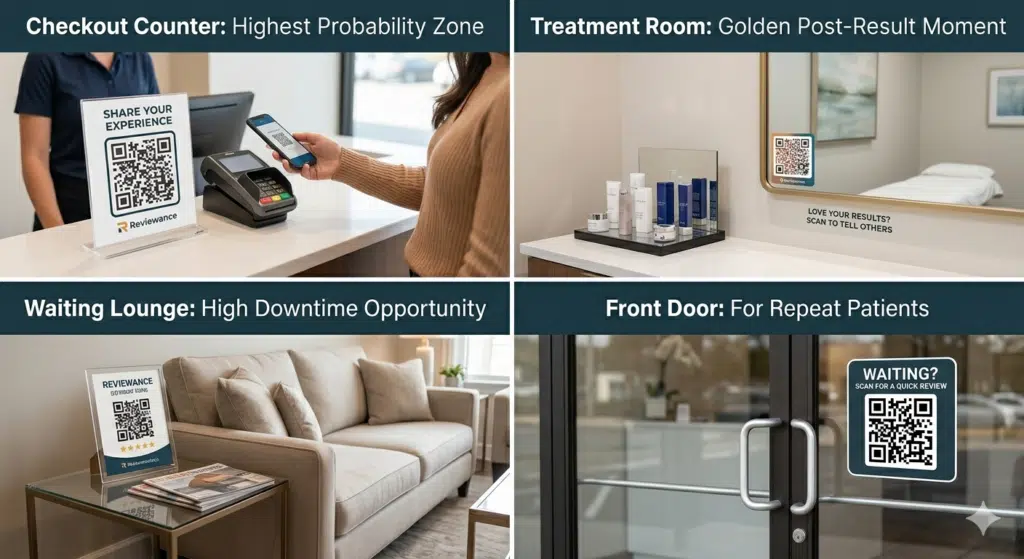
1. The Checkout Counter: Primary Revenue Zone
The checkout counter is where money changes hands, appointments are rebooked, and satisfaction is verbally expressed. This is your highest-probability placement.
Why it works: Patients are already standing there. They have just paid for their service. They have likely just complimented their results. The transaction is complete, and they are in a "closing" mindset. There is no better moment to capture a review.
Placement tips from QR code experts:
- Position the QR code at natural eye level—not hidden behind a monitor or buried under brochures
- Ensure the code is at least 1 x 1 inch for close-range scanning
- Use a durable vinyl sticker that can withstand daily cleaning and credit card swipes
- Add a clear call-to-action above or below the code: "Loved your results? Scan to share your experience"
The Reviewance advantage: Unlike SMS or email platforms that ask for contact information and send delayed requests, your Reviewance QR code at checkout captures the review immediately—while the patient is still glowing from their treatment and standing right in front of you.
2. Treatment Rooms: The Post-Result Mirror Moment
Every treatment room in your med spa has a mirror. After a hydrafacial, laser session, or any treatment with visible immediate results, what does the patient do? They look in that mirror. They admire their skin. They feel good.
This is the golden moment.
Why it works: The patient is seeing their results in real-time. The emotional peak of satisfaction is happening right now. A QR code placed near the mirror allows you to capture that emotion instantly.
Placement tips:
- Affix a small QR code sticker to the corner of the treatment room mirror or the counter next to it
- Use a slightly larger code (1.5 - 2 inches) since the patient may be at varying distances from the mirror
- Train your providers to say, after the patient looks at their results: "If you love how that turned out, scan that code right there—it helps others find us"
- For treatments with delayed results (Botox, filler), save this placement for the 2-week follow-up appointment when final results are visible
Design tip: Use a QR code that incorporates your brand colors rather than standard black and white. It blends better with your spa aesthetic and feels more intentional.
3. Waiting Area: The Downtime Opportunity
Patients spend time in your waiting area. They are on their phones. They are bored. This is an underutilized opportunity for review collection—specifically for patients who are returning for follow-up appointments and already have a completed treatment experience to review.
Why it works: Returning patients sitting in your waiting area have already experienced your service. They have time to kill. A QR code within arm's reach is a low-friction way to capture their feedback while they wait.
Placement tips:
- Place QR codes on end tables, side tables, or the reception desk where patients naturally rest their phones
- Include a small sign with a compelling message: "Been here before? Tell us about your experience. Scan for a quick review"
- Consider table tents or acrylic standees rather than flat stickers—these are more visible and feel more premium
- Avoid placing codes on magazines or other items that move; stationary surfaces are easier to scan
The Reviewance advantage: While other platforms send SMS or email requests that patients ignore, your waiting area QR code is physically present, scannable immediately, and requires zero follow-up.
4. Front Door or Window: First Impression, Lasting Action
Your front door or street-facing window is the first thing new patients see. It is also where existing patients wait before you open the door. This placement works best for repeat patients who already know and trust you.
Why it works: A patient waiting for their appointment to start, standing at your door, has their phone in hand. They are early. They have nothing to do. A QR code on the door gives them a productive way to spend that time.
Placement tips from outdoor signage experts:
- QR codes on glass need high contrast—use a dark code on a light background or a white code with a dark backing for visibility
- Size matters: from 2-3 feet away, your QR code needs to be at least 2.4 inches wide (following the 10:1 distance ratio)
- Vinyl is essential for outdoor durability—paper stickers will degrade in sunlight and moisture
- Consider placing the code near the door handle, where hands naturally go
Pro tip: If your front door has a dark tint, use a white or brightly colored QR code with a dark outline. Standard black codes disappear on dark glass.
5. Bathroom Mirrors and Partitions: Captive Audience
The bathroom is where patients have uninterrupted time with their phones. No one is rushing them. No one is watching. A well-placed QR code in a bathroom stall or above the sink can generate surprising scan rates.
Why it works: Patients are alone. They are not in a conversation. They have 30-60 seconds of uninterrupted time. A QR code asking for a review feels like a productive use of that downtime rather than an interruption.
Placement tips:
- Above the sink, next to the mirror—patients look at themselves here anyway
- Inside stall doors (discreet but effective)
- Use waterproof vinyl stickers—bathrooms have humidity and cleaning chemicals
- Keep the message light: "Waiting? Help others find us—scan to leave a review"
6. Branded Merchandise: The Take-Home Reminder
Patients who love your med spa will use branded items you give them. A water bottle, a makeup bag, a phone wallet, or a keychain with a QR code becomes a mobile billboard that continues generating reviews long after they leave.
Why it works: The patient uses the item daily. Every time they see the QR code, they are reminded of their positive experience. Over time, that reminder may convert into a review—especially after a second or third treatment.
Placement tips from merchandise experts:
- Keep the code small but scannable—minimum 0.75 x 0.75 inches on flat surfaces
- Avoid placing codes on curved surfaces (water bottles, rounded items) unless the code is very small
- Integrate the QR code into your logo or design rather than adding it as an afterthought
- Consider dynamic QR codes for merchandise so you can change the destination later without reprinting
Creative application: One brand engraved QR codes directly onto metal pendant necklaces. The codes remained scannable because they used a short, simple URL that required fewer QR modules. Your med spa could do the same with small branded items.
7. Appointment Cards and Take-Home Literature
Every patient leaves with something: a follow-up appointment card, an aftercare instruction sheet, or a product recommendation list. These printed materials are ideal QR code real estate.
Why it works: The patient takes these items home. They sit on counters or desks. Days or weeks later, when the patient is fully satisfied with their results, the QR code is still there—ready to be scanned.
Placement tips:
- Print the QR code directly on appointment reminder cards, not as a sticker that can fall off
- Include a brief instruction: "Loved your results? Scan to leave a Google review"
- Ensure sufficient "quiet zone" (white space) around the code so scanners can read it clearly
- Test the code on your specific paper stock before mass printing—some glossy or textured papers interfere with scanning
QR Code Design Rules for Maximum Scannability
Great placement means nothing if your QR code is illegible. Follow these design rules from QR code experts:
What NOT to Do: Common QR Code Placement Mistakes
❌ Placing codes on moving objects. A QR code on a car magnet or a staff member's lanyard is nearly impossible to scan. Scanners need stationary targets.
❌ Using paper stickers outdoors. Paper degrades in sunlight and moisture. Your outdoor QR code becomes a smudged, unreadable mess within weeks.
❌ Putting codes at floor level. No one wants to crouch down and scan a QR code near their shoes. Keep codes at waist level or higher.
❌ Forgetting mobile optimization. If your QR code links to a page that is not mobile-friendly, patients will bounce immediately. Test your destination URL on a phone before printing.
❌ No call-to-action. A naked QR code with no context gets ignored. Always tell people what they will get by scanning.
The Reviewance Difference: Capture the Moment, Not the Number
Traditional review platforms ask you to collect phone numbers and email addresses—then send delayed requests that patients ignore. They turn a 30-second review opportunity into a multi-day follow-up sequence with diminishing returns.
Reviewance works differently. Your QR codes capture reviews immediately, at the exact moment of peak satisfaction—whether that is post-treatment in the room, at the checkout counter, or during a waiting room downtime.
By placing Reviewance QR codes in the high-traffic, high-visibility locations outlined above, you transform your entire physical space into a review collection engine. No SMS. No email. No delays. Just real-time reviews from happy patients who are already in your building.
Start with the checkout counter and treatment room mirrors—these will generate the highest volume. Add waiting area and front door placements next. Then expand to merchandise and printed materials. With consistent placement and clear calls-to-action, your review profile will grow steadily, authentically, and automatically.
Google Review Examples for Aesthetic Clinics
Reading real Google reviews from actual patients is the fastest way to understand what makes a review helpful, authentic, and persuasive. Whether you are training your team on what to ask for or simply looking for inspiration to improve your own review collection strategy, these real-world examples demonstrate the specific language and details that make aesthetic clinic reviews stand out.
Below are curated examples of effective Google reviews for medical spas, aesthetic clinics, and plastic surgery practices—organized by the type of service and the patient's primary motivation.
Example 1: The "Natural Results" Review
This type of review is gold for aesthetic clinics because it addresses the single biggest fear most patients have: looking "overdone" or artificial. Reviews that explicitly mention natural results reassure prospective patients that your approach is conservative and artistic.
Real Example from Franco Aesthetics :
"Shelby did an amazing job on my lips! Day two and they look marvelous - even my male coworker complimented them. 🙂 Process was smooth, no pain, and was in and out in an hour. Shelby is great and does an amazing job!"
Why this works: The patient specifies "day two" (addressing the common concern about swelling), mentions an external compliment, and notes the smooth process. This review answers three unspoken questions future patients have: Will it hurt? Will I look swollen? Will anyone notice in a good way?
Another example from The Graz Clinic :
"Bin super zufrieden von der Beratung bis zur Behandlung. Meine Lippen wurden natürlich, jedoch ganz nach meinen Vorstellungen unterspritzt."
(Translation: "I am super satisfied from consultation to treatment. My lips were done naturally, but exactly according to my wishes.")
Why this works: The patient explicitly praises both the consultation process and the natural outcome—two priorities that matter enormously to first-time aesthetic patients.
What to ask for: When requesting reviews from patients who loved their results, prompt them with: "Would you mention that the results looked natural? Other patients really want to know that."
Example 2: The "Honest Provider" Review
Patients deeply value providers who say "no" when a treatment is not right for them. Reviews that highlight professional honesty build massive trust with prospective clients who fear being upsold on unnecessary procedures.
Real Example from The Naderi Center :
"Dr. Snodgrass is amazing! I came in for tear trough fillers and Botox. She explained to me that my under eyes actually had a combination of issues and that traditional tear trough filler would not be suitable. Instead she suggested mid face filler which at first seemed counter productive as I have full cheeks but I trusted her judgment and oh my gosh....I've never been happier. I can't stop staring at my face and taking pictures. My cheeks don't look any fuller but my under eye bags are 98% GONE."
Why this works: The patient describes being told "no" to what she originally wanted—yet still gives five stars. This is the ultimate trust signal. The specific detail about 98% improvement adds credibility that a vague "I'm happy" cannot match.
Another example from London Finsbury Clinic :
"I never leave reviews but I was so amazed with my experience that I had to leave one. ... She was honest about the fact that I wasn't a good candidate for it. She explained in detail everything about the procedure and suggested an alternative treatment that would benefit more my area of concern. What impressed me the most is that she never pushed me to get anything done just to get a sale. She even suggested I should take some time to think about it!"
Why this works: The patient explicitly states they "never leave reviews"—which makes this endorsement more powerful. The mention of being told to "take time to think" directly contradicts the stereotype of pushy sales-driven aesthetics clinics.
What to ask for: When a patient thanks you for being honest about what they do and do not need, ask: "Would you mind mentioning that in a review? Other patients really value knowing we won't push unnecessary treatments."
Example 3: The "Problem Solved" Review (Medical Outcome)
For patients seeking treatments for medical concerns—migraines, hyperhidrosis, functional issues—reviews that focus on symptom relief are extraordinarily persuasive. These reviews attract patients who are suffering and searching for solutions, not just aesthetic enhancement.
Real Example from London Finsbury Clinic :
*"I had Botox in my armpits due to excessive sweating which I've been insecure about since my teens (now in 30s). I can't believe how well it worked and Dr Cristina was so lovely and kept me distracted during the procedure so it wasn't too uncomfortable. I can now wear tops that I wouldn't have dreamed of before - game changing!"*
Why this works: The patient names a specific medical condition (hyperhidrosis), describes the duration of suffering ("since my teens"), and provides a vivid outcome ("wear tops I wouldn't have dreamed of"). The emotional transformation is clear.
Another example from The Graz Clinic :
"Ich leide an Migräne und habe mir bei Dr. ARCO die Stirn unterspritzen lassen, damit ich meine Stirn nicht mehr runzeln kann und so keine Verspannungen im Stirnbereich mehr entwickelt werden können. Ich bin wirklich sehr zufrieden. Mein Stirnbereich ist nun super entspannt und von den Kopfschmerzen ist nichts mehr zu spüren."
(Translation: "I suffer from migraines and had my forehead injected so I can no longer frown and thus prevent tension in the forehead area. I am very satisfied. My forehead is now super relaxed and I no longer feel any headaches.")
Why this works: The patient connects a specific treatment (forehead toxin) to a specific medical outcome (migraine relief). This type of review attracts other migraine sufferers who are searching for exactly this solution.
What to ask for: For patients whose medical concerns were successfully treated, ask: "Would you share what life was like before versus after? Other patients with the same issue really need to hear that."
Example 4: The "Long-Term Trust" Review (Repeat Patient)
Reviews from patients who have returned multiple times over months or years carry special weight. They signal that results are lasting and that the practice consistently delivers quality care.
Real Example from Franco Aesthetics :
"I've been going to Franco Aesthetics for over 6 months now and have had several skin pen procedures, along with the most recent IPL treatments. Gabby and Shelby have been amazing! They always answer all of my questions and make sure I am comfortable and satisfied. Their professionalism and sincere care will keep me going back. I highly recommend Franco Aesthetics in Norman!"
Why this works: The patient specifies the duration ("over 6 months"), names multiple treatments, and mentions specific staff members. This review signals to prospective patients that this is a practice worth building an ongoing relationship with.
Another example from Yakson House :
*"I am Korean myself and I have been coming here last 4+ years. Great service and it is one of the best facials/massages I have done in SG!"*
Why this works: The patient's ethnicity adds credibility for a Korean-branded aesthetic service, and the 4+ year timeline is powerful social proof.
What to ask for: When a patient books their third or fourth appointment, ask: "You have been coming to us for a while now. Would you be willing to share your long-term experience in a review?"
Example 5: The "Comfortable Nervous Patient" Review
First-time aesthetic patients are often anxious. Reviews that explicitly address fear, pain, and nervousness help convert hesitant prospects into booked appointments.
Real Example from Eleganza Aesthetic :
"I had an amazing experience at Eleganza Aesthetics getting my lip fillers done by Farnaz. She was exceptionally professional and made me feel comfortable every step of the way. The clinic was spotless, reflecting their high hygiene standards. I am thrilled with how my lips turned out—they look fantastic!"
Why this works: The patient mentions being made "comfortable every step of the way" and notes the "spotless" clinic (addressing hygiene concerns). Both are top fears for first-time patients.
Another example from London Finsbury Clinic :
"I start to say that I'm aware I'm a very difficult customer and, to me, giving 5 stars it's a statement. I found here professionalism, cleaning, care and results.. I've been twice and they've been angels to me in (and outside) the saloon ! thank you ❤️"
Why this works: The patient self-identifies as a "difficult customer" who rarely gives five stars—making this endorsement exceptionally credible. The mention of care extending "outside" the clinic suggests exceptional service.
What to ask for: When a nervous first-time patient leaves happy, ask: "Would you mention that you were nervous at first? Other first-timers really need to hear that."
Example 6: The "Worth the Drive" Review
Reviews that mention traveling a significant distance signal exceptional quality. These are powerful because they imply that local options were considered and rejected.
Real Example from Franco Aesthetics :
"I drive two hours just to come here - it's absolutely worth it. Shelby is absolutely WONDERFUL: professional, personable and always makes you feel comfortable. Her warmth and professionalism and precise technique of all the procedures make every visit worth my drive, and I walk out happy."
Why this works: The specific detail ("two hours") quantifies the patient's commitment. This tells prospective patients that this practice is worth prioritizing over closer, more convenient options.
What to ask for: When a patient mentions they came from out of town, ask: "Would you mention how far you traveled? It really helps other patients understand we're worth the trip."
Example 7: The "Detailed Before-and-After" Review
Reviews that describe specific, measurable changes are highly persuasive. They help prospective patients visualize what results might look like for them.
Real Example from Yakson House :
"I see a slight change in my face shape after the first treatment. There is pain but it's bearable. My face is less asymmetrical now. I hope it will..."
Why this works: The patient is honest about pain (addressing a common concern) and specific about the outcome ("less asymmetrical"). The honesty about discomfort makes the positive outcome more credible.
Another example from The Naderi Center :
"As for the Botox she gave me a tiny amount spread out across my forehead and it fixed some bumpiness I had between my eyes. I can still make expressions but my forehead is smooth!"
Why this works: The patient specifies "tiny amount" (addressing fear of frozen look) and describes a specific aesthetic concern ("bumpiness between eyes") that other patients may share.
What to ask for: For patients with visible, measurable results, ask: "Would you describe what changed specifically? Before-and-after details really help other patients."
What Makes a Great Aesthetic Clinic Review? Key Patterns
Analyzing hundreds of real five-star reviews reveals consistent patterns . The most effective reviews typically include:
| Element | Why It Matters | Example Phrase |
|---|---|---|
| Staff name | Personalizes the experience and rewards individual providers | "Shelby did an amazing job" |
| Specific treatment | Helps Google match reviews to search queries | "lip filler," "Botox for migraines," "IPL treatments" |
| Outcome description | Answers "what will this do for me?" | "my under eye bags are 98% GONE" |
| Emotional transformation | Connects with prospective patients' desires | "I can now wear tops I wouldn't have dreamed of" |
| Pain/comfort mention | Addresses the #1 fear of first-time patients | "no pain," "discomfort was bearable" |
| Consultation quality | Signals professionalism and honesty | "she explained everything and never pushed me" |
What to Avoid: Weak Review Examples
Not all reviews are equally helpful. Here are examples of reviews that provide limited value:
Too vague:
"Great service! Will be back."
Why it's weak: No specific information about what was great, what treatment was received, or what results looked like.
Missing treatment details:
"Love this place. The staff is so nice."
Why it's weak: Google cannot connect this review to specific service searches like "Botox near me."
No outcome mentioned:
"Quick appointment, easy check-in."
Why it's weak: Prospective patients want to know about results, not just administrative efficiency.
How to Use These Examples with Reviewance
The most powerful aspect of Reviewance is that it captures reviews immediately via QR code—while patients are still in your clinic, still looking at their results in your mirror, and still feeling the positive emotions that produce detailed, specific reviews.
When a patient scans your Reviewance QR code at checkout or in the treatment room, they are prompted to leave a review right away. This immediacy produces better reviews because:
- Details are fresh — They remember exactly what the provider said and did
- Emotions are high — The post-treatment glow translates into enthusiastic language
- Specifics come easily — They can name the treatment, the provider, and the immediate outcome
Compare this to SMS or email platforms that ask for reviews hours or days later. By the time those requests arrive, the patient has forgotten details, the swelling may have temporarily obscured results, and the emotional peak has passed.
Pro tip from Reviewance: Place a small sign next to your QR code that says: "Tell us about your experience. Mention your treatment and provider!" This gentle nudge encourages the specific, detailed reviews that Google rewards and prospective patients trust.
The best Google reviews for aesthetic clinics are specific, authentic, and emotionally resonant. They name providers, describe outcomes, address common fears (pain, unnatural results, pressure to buy), and often mention how long the patient has trusted the practice.
By studying these examples and understanding what makes them effective, you can:
- Train your team on what to ask for
- Design Reviewance QR code placements that capture reviews at optimal moments
- Identify which of your own reviews to feature on your website
Reviewance helps you collect more of these high-quality reviews by capturing patients at the exact moment they are most likely to leave detailed, positive feedback—immediately after treatment, while the results are literally staring back at them in the mirror.