
If you own a local business, you've probably heard customers say, "I'll leave you a review later." I certainly have. Over the years, hundreds of satisfied customers promised they would leave a Google review after visiting our business. They genuinely meant it. They thanked our staff, complimented our service, and walked out smiling. Yet very few actually followed through. There are many ways to collect reviews; creating Google review QR code, sms, emails and so on.
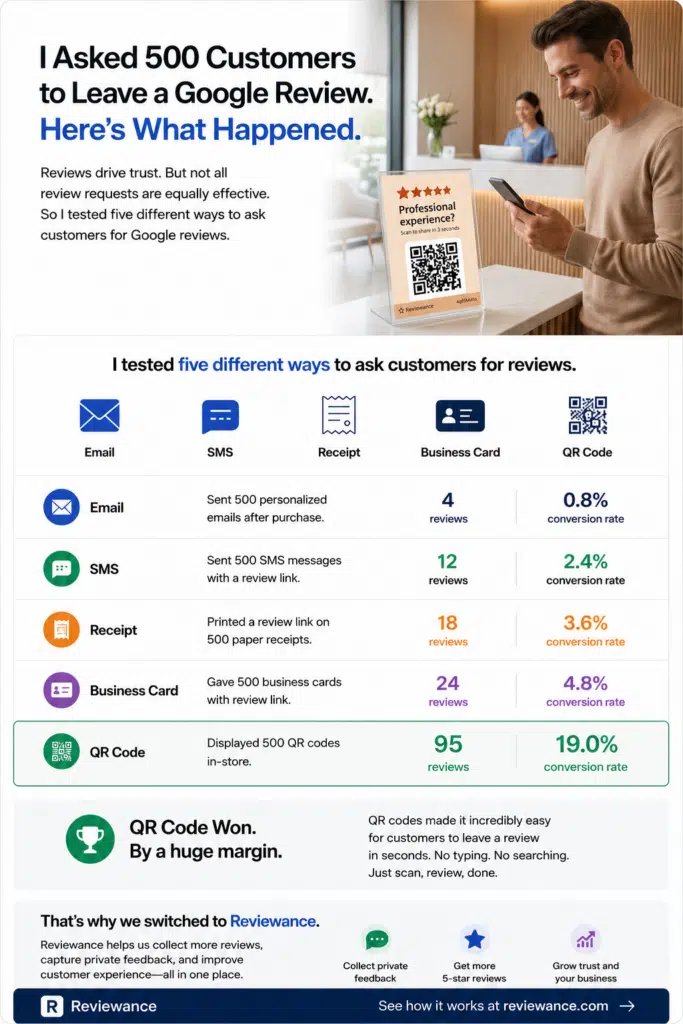
Instead of assuming people simply didn't care, I wondered whether we were asking in the wrong way. So I decided to run a simple experiment. Over several weeks, I asked roughly 500 customers to leave a Google review using five different methods. The goal wasn't to find the perfect script. It was to discover which method fit naturally into the customer journey and produced the highest response rate.
The results completely changed how we think about review collection.
Method 1: Email Review Requests
Email seemed like the logical place to start because it's what many businesses already use. Every customer received a friendly thank-you email with a direct link to our Google Business Profile.
The emails looked great. They were professionally written, mobile-friendly, and sent shortly after the visit. Unfortunately, the results were disappointing. Many customers never opened the email, while others read it, intended to leave a review later, and simply forgot. I realized that even the best email can't compete with everything else happening in someone's inbox.
Method 2: SMS Review Requests
Our second test involved sending review requests by text message. SMS immediately performed better than email because almost everyone opens their messages. Even so, something interesting happened. Customers often clicked the message while they were busy, told themselves they would leave a review later, and then moved on with their day. Although SMS reduced friction, it still depended on customers taking action after they had already left the business.
Method 3: Printed Receipts
Next, we printed a review invitation directly on customer receipts.
This sounded like a simple and inexpensive solution. Every customer received the message automatically, and there was no additional effort required from our staff. The reality was different. Most customers folded the receipt into their pocket or threw it away before ever noticing the review request. The message existed, but it wasn't reaching people at the moment when they were most engaged.
Method 4: Business Cards
We also tested handing customers a small business card with a QR code and a request to leave a review.
Some customers appreciated the gesture and even said they would scan it later. The problem was that "later" once again became the enemy. Cards ended up in wallets, on car dashboards, or forgotten inside shopping bags. Every additional step between the customer and the review reduced the likelihood that it would ever happen.
Method 5: Mobile QR Codes
Finally, we tried something completely different.
Instead of asking customers after they left, we asked them while they were still standing inside the business. Our staff simply displayed a QR code on a mobile device and invited customers to scan it before they walked away. The difference was immediate. Customers didn't need to search for our business. They didn't have to remember our name, open Google, or promise to do it later. They scanned the QR code, the review page opened instantly, and many completed their review before leaving the premises.
This wasn't just the best-performing method—it outperformed everything else by a considerable margin.
What the Experiment Actually Taught Me
At first, I thought this experiment was about finding the best review request method. Looking back, I realized it was really about understanding customer behavior. People don't avoid leaving reviews because they don't want to help businesses. They avoid leaving reviews because life gets in the way. Every extra click, every extra minute, and every unnecessary step dramatically reduces participation. The easier the process becomes, the more likely customers are to follow through while the positive experience is still fresh in their minds.
Why We Switched to Reviewance
After seeing the results, we wanted more than just a QR code. We wanted a system that could help us consistently generate more Google reviews while also giving customers a better overall feedback experience. That's why we switched to Reviewance.
Create your review QR codes
Your business name
First month only $1, then just $9.99/month. Cancel anytime.
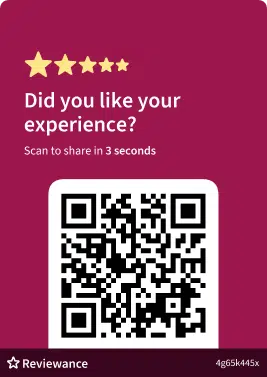
One feature that immediately stood out was the Mobile QR Code. Instead of relying on printed QR stands or posters, our team can instantly display a personalized QR code directly from their phone. Customers simply scan the screen and are guided through the review process in seconds. It works anywhere—at reception, beside a table, after a consultation, or immediately following a completed service.
Even more importantly, Reviewance recognizes that not every customer interaction should end the same way. Customers who are delighted with their experience can easily leave a public Google review, while customers who have concerns are given the opportunity to share private feedback first. That allows businesses to listen, respond, and improve before an unresolved issue becomes part of their public reputation.
The Best Way to Collect Google Reviews
If this experiment taught me one thing, it's that getting more Google reviews isn't about asking more often. It's about asking at the right moment. When you remove friction and make the process almost effortless, customers are surprisingly willing to share their experiences. In our case, mobile QR codes transformed review collection from something we hoped customers would do later into something they were happy to do immediately.