
For more than two decades, businesses have optimized their websites for search engines. The goal was straightforward: rank higher on Google, attract more visitors, and convert those visitors into customers. Success depended on keywords, backlinks, technical SEO, and high-quality content.Today, however, the way people discover local businesses is changing and Google reviews help artifical intelligence recommend your business.
Instead of typing "best dentist in Chicago" into a search engine and scrolling through ten blue links, more people are asking AI assistants questions like:
"What's the best dentist near me?"
"Can you recommend a good Italian restaurant in London?"
"Which hair transplant clinic has the best reputation in Istanbul?"
Rather than receiving a list of websites, users increasingly receive direct recommendations. AI systems summarize information, compare businesses, explain their reasoning, and often recommend just a handful of options. This shift represents one of the biggest changes in digital marketing since the introduction of Google Search itself. Businesses are no longer competing only for rankings—they are competing to become part of the answer.
The obvious question is: How does AI decide which businesses deserve to be recommended?
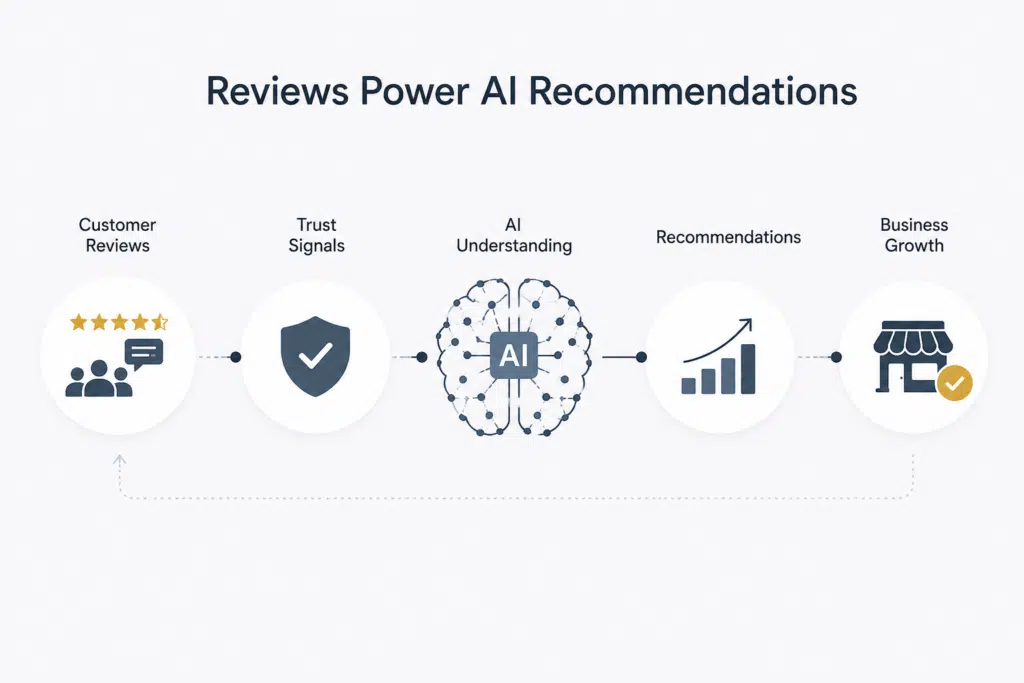
AI Doesn't Experience Your Business—Your Customers Do
Artificial intelligence can analyze millions of documents in seconds, but it cannot experience your business the way a customer does. It cannot taste your food, sit in your waiting room, receive your service, or evaluate how friendly your staff members are. Everything AI knows about your business comes from information that already exists online. Some of that information comes directly from your website. Some comes from news articles, local directories, business profiles, and industry publications. Increasingly, however, one of the richest sources of information comes from something businesses often overlook: customer reviews.
Unlike marketing copy, reviews are written voluntrily by real customers describing real experiences. They talk about the things prospective customers actually care about—service quality, professionalism, waiting times, cleanliness, atmosphere, pricing, communication, and overall satisfaction.
From an AI perspective, customer reviews represent something incredibly valuable: large-scale human experience.
Why Google Reviews Are Different
Not every review platform carries the same weight. Google Reviews have become particularly influential because they combine structured business information with authentic customer feedback. Every review includes much more than a simple star rating. It contains a date, location context, written comments, reviewer history, business category, and often photographs that help describe the experience. Over time, these reviews create an evolving picture of a business. Imagine two dental clinics. The first clinic has only twenty reviews written several years ago.
The second has more than 800 reviews collected consistently over the last three years. Patients repeatedly mention painless treatment, friendly staff, short waiting times, and modern equipment. Even without visiting either clinic, both search engines and AI systems can identify recurring patterns. The second clinic demonstrates consistency, customer satisfaction, and recent activity—strong indicators that it continues to deliver a positive experience.
This is exactly the kind of information AI systems are designed to summarize.
AI Looks for Patterns, Not Individual Opinions
One common misconception is that AI recommends businesses because of a single five-star review. That isn't how modern AI systems work. Large language models are designed to identify consensus rather than isolated opinions. Instead of relying on one customer's experience, they recognize recurring themes across hundreds or even thousands of independent reviews.
If hundreds of customers consistently describe a restaurant as having exceptional seafood, attentive staff, and beautiful waterfront views, those recurring observations become far more meaningful than any individual comment. Likewise, if dozens of reviews repeatedly mention long waiting times or inconsistent service, AI systems can recognize those patterns as well.
This ability to identify common themes makes customer reviews far more valuable than traditional advertising. Businesses naturally describe themselves in the best possible light. Customers, on the other hand, describe what actually happened. That difference makes reviews one of the most credible sources of public information available online.
Reviews Strengthen Your Digital Reputation
Google Reviews don't simply influence customer decisions—they help define your business's digital identity. Every review adds another piece of context that helps search engines and AI systems understand what your business is known for. Customers naturally mention services, products, locations, specialties, and experiences using language that future customers are likely to search for.
For example, a customer might write:
"The staff explained every step of the procedure, and I barely felt any discomfort."
Another might say:
"The best vegan brunch I've had in Manchester."
Neither customer is trying to improve your SEO. Yet together, these reviews help establish strong associations between your business and specific products, services, and experiences. Over time, this user-generated content becomes an increasingly reliable description of your brand.
Fresh Reviews Matter More Than Ever
Having a thousand reviews is valuable. Having a thousand recent reviews is even more valuable. Customer expectations change. Businesses improve. Staff members change. Menus evolve. New locations open. A business that earned an excellent reputation five years ago may no longer deliver the same experience today.
For this reason, both search engines and AI systems increasingly value freshness. A steady flow of recent reviews demonstrates that customers continue to engage with your business and that the quality of your service remains consistent. It also provides AI with up-to-date information about how customers currently perceive your brand. This is why review velocity—the consistent collection of authentic reviews over time—has become far more important than collecting hundreds of reviews in a short period and then stopping altogether.
AI Search Is Changing Local SEO
Traditional SEO focused on helping websites rank. AI search focuses on helping users make decisions. That subtle difference changes how businesses should think about their online presence. In the past, appearing on the first page of Google was often enough. Users compared websites themselves and decided which business to trust.
Today, AI assistants increasingly summarize those comparisons for users. Rather than reading dozens of reviews individually, people ask AI to explain which businesses have the strongest reputations and why. Businesses that consistently generate authentic customer reviews create a richer information ecosystem for AI systems to analyze. They provide more evidence, more context, and stronger trust signals than businesses with outdated or limited customer feedback.
Reviews Build Trust for Humans and Machines
Trust has always been the foundation of successful businesses. What's changing is who evaluates that trust. For years, reviews existed primarily to influence human buyers. Today, they also help intelligent systems interpret reputation at scale. This doesn't mean ChatGPT, Gemini, or other AI assistants simply copy Google Reviews into their answers. Modern AI systems combine information from many public sources and evaluate it collectively. Customer reviews become one of several important signals alongside business websites, directories, editorial content, and local search results.
Businesses with consistent, authentic customer feedback therefore create stronger digital evidence that supports both human decision-making and AI-generated recommendations.
What Businesses Should Do Today
The rise of AI doesn't change the fundamentals of reputation management—it makes them even more important. Businesses should continue focusing on delivering exceptional customer experiences, but they also need a reliable process for capturing those experiences while they're still fresh. That means making it easy for satisfied customers to leave reviews, responding professionally to feedback, monitoring customer sentiment, and consistently generating authentic reviews rather than relying on occasional requests.
Platforms like Reviewance simplify this process by helping businesses collect Google Reviews through smart QR code workflows, gather private customer feedback before problems become public, and monitor reputation across one or multiple locations.

Create your review QR codes
Your business name
First month only $1, then just $9.99/month. Cancel anytime.
In an AI-driven world, every authentic customer review becomes another data point that helps people—and increasingly, intelligent systems—understand what your business does well.
The Future of Local Visibility
We're entering a new era where businesses are no longer optimizing only for search engines. They're optimizing for intelligent recommendation systems. As AI becomes a primary way people discover restaurants, clinics, hotels, automotive services, and local businesses, customer reviews will play an even greater role in shaping online visibility.
Businesses that consistently collect authentic Google Reviews aren't just improving their local SEO. They're building a digital reputation that is easier for both people and AI to understand, trust, and recommend. The businesses that thrive over the next decade won't simply have the best websites. They'll have the strongest evidence of real customer satisfaction.
References
- Google Search Central. Creating helpful, reliable, people-first content. https://developers.google.com/search/docs/fundamentals/creating-helpful-content
- Google Business Profile Help. Improve your local ranking on Google. https://support.google.com/business/
- OpenAI. ChatGPT Search. https://openai.com/chatgpt/search/
- Google. AI Overviews in Search. https://blog.google/products/search/
- BrightLocal. Local Consumer Review Survey. https://www.brightlocal.com/research/local-consumer-review-survey/
- Whitespark. Local Search Ranking Factors. https://whitespark.ca/local-search-ranking-factors/
- Lewis, K., & Zervas, G. (2016). The Economics of Fake Reviews. Harvard Business School Working Paper.
- Baeza-Yates, R., & Ribeiro-Neto, B. Modern Information Retrieval: The Concepts and Technology Behind Search. Addison-Wesley.