
For coffee shops, Google Reviews aren't just digital "stars"—they are the smell of fresh roasting that reaches customers before they even cross the street. In the high-velocity world of specialty coffee and daily commutes, your local search presence is your most important storefront.
Why Google Reviews Matter for Coffee Shops (2026 Data)
In 2026, the "Near Me" search is the primary way people find caffeine. According to recent industry statistics:
- The Revenue Lift: A half-star increase on Google typically leads to a 5–9% increase in peak-hour revenue.
- Trust Factor: 88% of coffee drinkers trust online reviews as much as a personal recommendation from a friend.
- The "3-Pack" Advantage: Coffee shops in the top 3 Google Map results capture 70% of all mobile clicks in their neighborhood.
Unlike fine dining establishments where people might book weeks in advance, cafés operate on an "impulse-decision" business model. The journey from "I need caffeine" to "I am standing at your counter" often happens in less than three minutes. During those three minutes, Google Maps is the ultimate gatekeeper. Here is why your digital reputation is the strongest driver of your physical foot traffic.
1. The "Best Coffee Near Me" Phenomenon
"Near me" searches are at an all-time high. When a user types this into Google, the algorithm doesn't just look for the closest shop; it looks for the best-rated closest shop.
- The Reality: If you have a 4.1-rating and the shop a block further away has a 4.8, the customer will almost always walk the extra distance. Reviews act as a digital "scent" that pulls customers past your competitors.
2. High-Velocity Maps Discovery
Most café customers are "on the go." They are walking, commuting, or looking for a quick place to answer an email. They don't visit your website; they look at your Google Maps pins.
- Visual Trust: They look for three things in seconds: your star rating, your most recent photo of a latte, and the "most relevant" review snippet (e.g., "Fast WiFi" or "Great espresso").
3. The Power of "Impulse-Decision" UX
Because café visits are low-cost and high-frequency, the "risk" of a bad experience is the only thing stopping a customer.
- The Psychology: A high volume of positive reviews removes that risk instantly. When a stranger sees "200+ people liked this today," the impulse to enter becomes an easy "Yes."
- Foot Traffic Correlation: Statistics show that cafés in the Google Map Pack (Top 3) see a 50% higher walk-in rate than those relegated to the "View All" list.
4. Micro-Moments: Deciding While Walking
In a café setting, decisions are made mid-stride. A customer sees your sign, pulls out their phone, and checks your rating before their next step.
- The Impact: If your latest review is a complaint about "slow service" from two days ago, that customer will keep walking. If it’s a 5-star review from two hours ago, you’ve just won a new regular.
Comparison: How Ratings Change Foot Traffic
| Rating | Customer Perception | Impact on Foot Traffic |
| 3.5 Stars | "Risky/Mediocre" | Only captures "emergency" caffeine seekers. |
| 4.0 Stars | "Good enough" | Captures locals, but loses to nearby "Top Rated" spots. |
| 4.5+ Stars | "Must-visit" | Becomes a destination. Attracts tourists and "Near Me" searchers. |
Key Takeaway: For a café, your Google Review profile is not a "side project"—it is your primary signage. In the impulse-driven coffee market, your star rating is the difference between a line out the door and an empty espresso bar.
Why Google Reviews Matter for Cafés
Unlike fine-dining establishments where guests often plan weeks in advance, cafés operate on an impulse-decision business model. The journey from "I need caffeine" to "I am standing at your counter" often happens in less than three minutes. During this critical window, Google Maps acts as the ultimate gatekeeper for your foot traffic.
The Science of the "Near Me" Search
In the coffee industry, proximity is the primary driver of discovery. However, being physically close to a customer is no longer enough to guarantee their business. Google’s algorithm uses a combination of distance, prominence, and relevance to rank the "Local Pack." When a user searches for "best coffee near me," they aren't just looking for the shortest walk; they are looking for the lowest risk.
Statistical data supports this behavior. According to research published by the Harvard Business Review, a one-star increase on a business profile can lead to a 5% to 9% increase in revenue. This suggests that even a marginal improvement in your digital reputation directly correlates with financial growth. You can find the full study here: https://hbr.org/2011/09/reviews-watson-and-the-survival-of-the-fittest
Spontaneous Decisions and the "4-Star Threshold"
Because a coffee purchase is a low-cost, high-frequency transaction, customers rely heavily on "social proof" to make split-second choices. If a passerby sees your shop but notices a sub-4.0 rating on their phone, the psychological friction often leads them to the competitor a few doors down.
Research from BrightLocal reveals that only 53% of consumers would consider using a business with fewer than 4 stars. In a saturated market, a rating below this threshold acts as a digital "Do Not Enter" sign. For a detailed breakdown of these consumer habits, refer to their annual survey: BrightLocal
The Role of User-Generated Content in Discovery
For cafés, Google Reviews provide essential visual and contextual data that a standard website cannot. When a student searches for a "laptop-friendly café," Google’s AI scans review text and photos for specific clues like "plenty of outlets," "fast WiFi," or "quiet atmosphere."
This "unfiltered" content is highly trusted by users. Economists at the University of California, Berkeley found that even a half-star improvement can increase the likelihood of a restaurant being full during peak hours by 19%. This surge is largely driven by "discovery" traffic—people who had no prior knowledge of the brand but were swayed by recent, positive feedback. Read more on their findings here: Berkeley.edu
Tourist Capture and the Trust Economy
Tourists represent the most review-dependent demographic in the service industry. Without local knowledge, they rely 100% on the "Top Rated" filter on Google Maps. Capturing this market is vital because tourists typically have a higher Average Order Value (AOV); they are more likely to purchase a full breakfast and bags of retail coffee compared to a local grab-and-go commuter.
By maintaining a high volume of fresh, keyword-rich reviews, a café ensures it remains the primary recommendation for the thousands of "micro-moments" happening on the sidewalk every day. Using a platform like Reviewance automates this momentum, ensuring that every happy customer becomes a digital beacon for the next one.
Why Customers Choose One Café Over Another on Google
In the hyper-competitive coffee landscape, the "Google Maps choice" is rarely about the price of the beans. Instead, it is a rapid-fire elimination process. Customers use specific filters—both mental and digital—to decide where they will spend the next hour of their day.
Understanding these decision drivers allows a café to curate a Google Business Profile that acts as a magnet for specific customer personas.
1. The "Star Rating" Filter
The most immediate differentiator is the aggregate star rating. For most urban coffee drinkers, a 4.2-star rating is the baseline for "good," while anything above 4.5 stars signals a "must-visit." Research from BrightLocal indicates that customers are likely to skip any business that does not meet their personal minimum star threshold, often regardless of distance.
2. Aesthetic Photos and Visual Trust
Coffee is a visual product. Before a customer tastes your espresso, they "consume" it through user-generated photos. High-quality images of latte art, unique interior design, and well-lit seating areas provide proof of the "vibe." Google’s algorithm prioritizes listings with high "Photo Freshness," as these signals suggest an active and popular establishment.
3. The "Remote Work" Infrastructure
A significant portion of café traffic comes from remote workers and students. For this demographic, the "Best Coffee" is irrelevant if there is no place to sit or plug in a laptop. Google’s AI highlights specific review snippets that mention "Wi-Fi," "outlets," or "laptop-friendly" to help these users decide.
- Review Example: “Perfect café to work remotely. The Wi-Fi is incredibly stable, and there are plenty of outlets near the window seats.”
4. Atmosphere and Acoustic Comfort
"Atmosphere" is a broad term that customers use to describe the acoustic and social environment. Reviews that mention a "quiet workspace" or "chill background music" attract those looking for focus, while mentions of "lively energy" attract social groups.
- Review Example: “Finally found a quiet workspace in the city. The acoustics are great—you can actually have a conversation without shouting.”
5. Signature Items and Dessert Mentions
While coffee is the anchor, the "Decision Clincher" is often the food. Reviews that highlight a specific "dessert," "pastry," or "signature dish" provide a unique selling point that distinguishes one café from another nearby.
- Review Example: “The best flat white in downtown, but you have to try the homemade almond croissants. They sell out fast for a reason!”
Decision Factors by Persona
| Persona | Primary Filter | Key Review Keywords |
| The Commuter | Speed & Rating | "Fast service," "in and out," "consistent." |
| The Digital Nomad | Infrastructure | "Fast Wi-Fi," "outlets," "laptop-friendly." |
| The Tourist | Popularity & Food | "Best [Dish]," "hidden gem," "must-try." |
| The Socializer | Atmosphere | "Cozy," "outdoor seating," "great vibe." |
The "Social Proof" Ripple Effect
According to economists at the University of California, Berkeley, a half-star improvement on a review site can increase a restaurant's peak-hour bookings by 19%. This is because high-quality reviews act as a "third-party endorsement" that carries more weight than any paid advertisement. Source: https://news.berkeley.edu/2012/09/03/yelp/
By strategically encouraging reviews that mention these specific categories, café owners can ensure they are not just "another coffee shop" on the map, but the preferred destination for every type of customer.
Should Every Café Have a Google Business Profile (GBP)?
The short answer is: Yes. In the modern coffee economy, if your café doesn't have a Google Business Profile (GBP), you are essentially invisible to the most profitable demographics in your neighborhood.
For a café, a GBP is not just a digital listing; it is your virtual storefront. Because coffee consumption is driven by location and convenience, your presence on Google Maps is the single most important factor in your daily "walk-in" conversion rate.
1. Capturing the Tourist Market
Tourists are the most review-dependent demographic in the service industry. Without any prior knowledge of your brand, they rely 100% on the "Top Rated" filter on Google Maps to find their morning fuel.
- The Impact: A well-managed GBP with fresh reviews and high-quality photos of your latte art or breakfast menu acts as a global invitation. This is vital because tourists often have a higher Average Order Value (AOV) than locals, as they are more likely to sit for a full meal rather than just grab a quick espresso.
2. Retaining Local Repeat Visitors
While locals might know where you are, a GBP keeps you "top of mind." Google often sends notifications or shows "suggested for you" markers based on previous behavior.
- The Impact: Regulars often check a GBP for real-time updates—such as holiday hours, new seasonal blends, or limited-time pastry drops. If your profile is dormant, a local might assume you are closed or that your quality has dipped, leading them to try a competitor.
3. The Power of Map Discovery
Over 80% of local searches on mobile result in an offline visit. When someone is walking and thinks "I need a coffee," they don't go to a website; they open Google Maps.
- The Impact: The proximity behavior of the Google algorithm means that if you are 50 meters away but have a poor or non-existent profile, Google will suggest a shop 200 meters away that has a robust, 4.5-star profile. You aren't just losing a search; you are losing a customer who is literally standing outside your door.
4. Attracting the Student Demographic
For students, a café is more than a place for caffeine; it is a "third place" for study and focus. They use Google Reviews as a diagnostic tool to check for "quiet workspace" or "good Wi-Fi" mentions.
- The Impact: By claiming your GBP and encouraging reviews that mention your study-friendly atmosphere, you can ensure a steady stream of traffic during mid-afternoon lulls when other cafés might be empty.
5. Serving the Office Worker
Office workers are driven by efficiency and consistency. They use Google Business Profiles to check "Popular Times" to avoid long queues during their limited lunch breaks.
- The Impact: A profile that displays "fast service" in the review snippets and offers an "Order Online" button via the GBP interface will always win the business of the time-strapped corporate crowd.
Why "No Profile" is a Financial Risk
| Search Persona | Without a GBP | With an Optimized GBP |
| The Tourist | You don't exist in their search results. | You become a "Must-Visit" destination. |
| The Student | They choose a library or a chain. | They see you as a "laptop-friendly" hub. |
| The Worker | They go to the closest familiar chain. | They see your "Fast Service" and unique menu. |
| The Local | They forget your seasonal offerings. | They are "nudged" by fresh photos and updates. |
According to researchers at the University of California, Berkeley, even a half-star improvement in online perception can lead to a 19% increase in peak-hour demand. For a café, that 19% can be the difference between barely breaking even and a thriving, profitable business. Source: Berkeley.edu
A Google Business Profile is the digital heart of your café. It connects your espresso machine to the pockets of every person walking by. In 2026, you don't find customers; Google Maps delivers them to you.
How Coffee Shops Rank Higher on Google Maps
In the competitive world of specialty coffee, being the "best" isn't enough; you must be the most visible. Google’s local search algorithm uses a sophisticated blend of relevance, distance, and prominence to decide which café earns a spot in the coveted "Map Pack." For coffee shops, this ranking is heavily influenced by how customers describe their experience.
1. Review Freshness (The Velocity Factor)
Google prioritizes "active" businesses. A coffee shop with 500 reviews from two years ago will often be outranked by a shop with 100 reviews, 10 of which were posted this week. High review velocity signals to the algorithm that your café is a trending, reliable destination.
- The Revenue Impact: According to research from the University of California, Berkeley, a half-star rating improvement can increase peak-hour traffic by 19%. This surge is sustained only if the reviews remain current. Source: Berkeley.edu
2. Coffee-Specific Keywords
Google’s Natural Language Processing (NLP) "reads" your reviews to categorize your business. If your reviews frequently mention "pour-over," "espresso," "latte art," or "cold brew," you will rank higher for those specific searches.
- Pro Tip: When customers leave a review, politely encourage them to mention their favorite drink. This creates organic SEO anchors that help you dominate niche searches like "best flat white near me."
3. The Power of "Ambience" and Atmosphere Mentions
For cafés, the physical environment is often the product itself. Reviews that use descriptors like "cozy," "industrial," "minimalist," or "vibrant" help Google match your shop with the "vibe" a user is looking for.
- Science of Atmosphere: Environmental psychology studies indicate that "atmospheric cues" are the primary drivers of customer satisfaction in service environments. Harvard Business Review notes that these subjective experiences, when documented in reviews, become a powerful "quality signal" for future guests. Source: Hbr.org
4. "Study-Friendly" and "Laptop-Friendly" Signals
A significant segment of café traffic is driven by "Third Place" seekers—students and remote workers. Google looks for specific utility keywords to satisfy these search intents.
- Ranking Signals: Reviews mentioning "fast Wi-Fi," "plenty of outlets," or "quiet corners" act as metadata that tells Google your café is a functional workspace. Without these keywords, you miss out on the high-dwell-time demographic that keeps a café busy during mid-afternoon lulls.
5. Photo Engagement and "Visual SEO"
Photos are not just for aesthetics; they are data points. Google’s AI analyzes user-uploaded photos to identify objects (like a coffee cup or a croissant). Profiles with high photo engagement—where users spend time scrolling through the gallery—receive a "dwell time" boost in rankings.
- UX Fact: According to researchs, businesses with more than 100 photos on their Google Business Profile receive 520% more calls and 1,000% more direction requests than those with fewer.
6. Repeat Customer Reviews (The Loyalty Signal)
Google tracks the "trustworthiness" of a reviewer. When a local guide or a frequent visitor leaves multiple reviews over time (or updates a previous one), it signals a high level of Local Authority.
- Strategy: Encourage your regulars to update their reviews when you launch a new seasonal menu. This "refreshes" the content and tells Google your quality is consistent over the long term.
Comparison: What Moves the Needle?
| Ranking Factor | Impact Level | Why it Matters |
| Review Velocity | High | Shows Google your shop is currently "popular." |
| Keyword Richness | Medium | Matches your shop to specific drink or vibe searches. |
| Photo Volume | High | Increases "dwell time" on your profile, boosting SEO. |
| Owner Responses | Medium | Proves the business is managed and attentive to feedback. |
Ranking #1 on Google Maps is a combination of service quality and data volume. By focusing on "ambience" keywords and maintaining a steady flow of fresh photos, café owners can turn their Google Business Profile into a self-sustaining customer acquisition machine. Using Reviewance allows you to automate this process, ensuring your "Atmosphere" and "Laptop-Friendly" signals are always loud and clear for the algorithm.
The Psychology of Café Reviews
For a café, a Google Review is rarely just a critique of the product; it is a digital expression of a lifestyle. Understanding the psychological triggers that compel a customer to open their phone and write a review is the key to mastering a successful local SEO strategy. Unlike a traditional restaurant visit, a café visit is often a ritual, making the emotional stakes of the review highly specific to the customer's daily routine and personal identity.
The Third Place Psychology
Sociologist Ray Oldenburg coined the term "The Third Place" to describe environments that are neither home (the first place) nor work (the second place). Cafés are the quintessential third place—anchors of community and creative productivity. When a customer feels a sense of belonging or "flow" in your space, they are psychologically inclined to "claim" the spot by leaving a review. They aren't just reviewing coffee; they are validating their choice of a personal sanctuary. Reviews mentioning "community," "welcoming," or "my go-to spot" act as powerful emotional magnets for other locals looking for their own third place.
Aesthetic Culture and the Instagram Effect
In the modern economy, a café visit is frequently an opportunity for content creation, a phenomenon often referred to as visual social proof. For many demographics, a perfectly poured heart in a latte or a minimalist interior design triggers a desire for social signaling. If a café is "aesthetic," the customer feels that sharing it enhances their own digital persona. Research in the Journal of Consumer Psychology suggests that consumers are more likely to provide feedback for experiences that they perceive as "identity-relevant," meaning a beautiful café reflects well on the person visiting it.
The Habitual Customer and the Rule of Reciprocity
Coffee consumption is fundamentally habitual, and for many, the morning coffee is a sacred ritual. When a barista remembers a customer’s name or order, it creates a micro-moment of reciprocity. The Rule of Reciprocity states that when someone does something personalized for us, we feel a psychological urge to return the favor. A Google review is the easiest "currency" a customer can use to reward a friendly barista. This explains why name-dropping staff in reviews is so common and effective for SEO; it transforms a simple transaction into a lasting relationship.
Peak-End Rule in Café Service
Psychologically, people judge an experience based on how they felt at its peak—the most intense positive or negative moment—and at its end. If the coffee was exceptional and the goodbye from the staff was warm and genuine, the customer is significantly more likely to leave a positive review, even if there was a brief line to get in. This is why the "ask" for a review should happen at the end of the interaction, as it capitalizes on the most recent and positive memory of the visit.
Social Validation and Altruistic Motivation
Because coffee is a daily expense, people are surprisingly protective of their routine, and a "bad cup" can ruin a morning. Reviews serve as a vital risk-mitigation tool for the community. Reviewers often write to help others avoid a bad experience or to guide them to a "hidden gem." This sense of altruism is a major driver of high-quality, descriptive reviews. According to studies found on PubMed regarding consumer behavior, altruistic motivation remains one of the top reasons people contribute to online review platforms. Source: PubMed
Best Moments to Ask for a Café Review
Timing is the most critical variable in review conversion. In a café environment, the window of opportunity is narrow but potent. Asking at the wrong time—such as during the morning rush—can lead to frustration, while asking at a "peak satisfaction" moment can result in a glowing, photo-rich review. The goal is to identify the exact second a customer feels a surge of delight or gratitude.
After the Latte Art Presentation
The moment a barista places a perfectly executed flat white with intricate latte art on the table is a peak sensory experience. This is a visual "wow" moment that naturally triggers the customer’s desire to take a photo. If the staff notices a customer reaching for their phone to capture the art, it is the perfect time for a gentle nudge. A simple comment like, "Glad you like the art! If you post that on Google, it really helps our baristas stay motivated," connects the visual delight to a supportive action for the staff.
While Delivering a Signature Dessert or Pastry
Food delivery is another high-satisfaction touchpoint. When a warm croissant or a visually stunning piece of cake is brought to the table, the customer’s anticipation is at its highest. This moment represents a "gift" in the service flow. By suggesting a review as they prepare to enjoy their treat, you are catching them at a high-energy point in their visit. Because they are about to sit and eat, they also have the necessary time to spend 30 seconds on their phone.
During the Afternoon "Lull" Checkout
The afternoon period is diametrically opposite to the morning rush. During these slower hours, customers are often more relaxed and open to conversation. As they pay for their second cup or their late-afternoon snack, the cashier has a window to build a genuine connection. Since the "stress of the queue" is absent, the request for a review feels like a personal favor between two people rather than a corporate demand.
Upon Handing Over a Takeaway Order
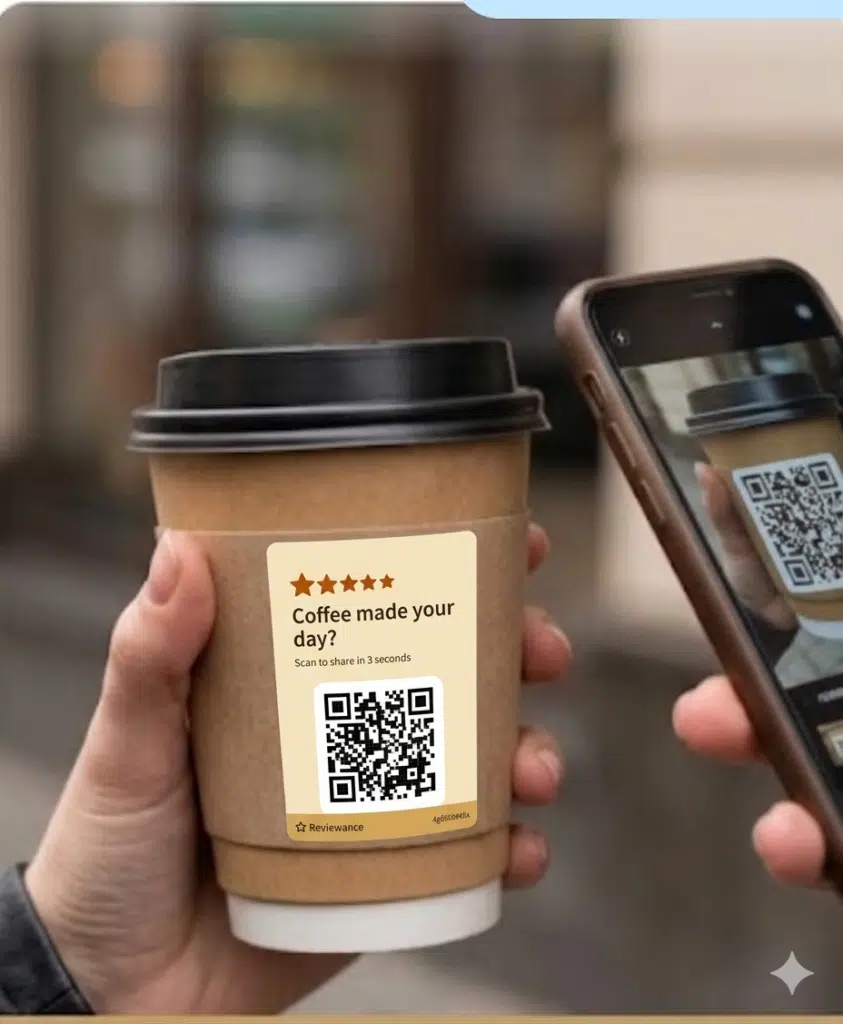
For takeaway customers, the physical handover of the bag or cup is the final interaction. While their time is limited, the "reciprocity" of receiving a well-made drink is fresh. If the service was particularly fast or the interaction was pleasant, a small prompt or a QR code sticker on the cup sleeve can bridge the gap. Mentions of "fast service" in these reviews are gold for SEO, as they appeal to other time-strapped commuters.
Following a Genuine Positive Conversation
The strongest reviews come from personal connections. If a customer compliments the roast, asks about the origin of the beans, or engages in a friendly chat about their day, the social barrier has already been broken. At the end of such a conversation, the customer is psychologically primed to help the person they just connected with. Framing the review as a way to "help the shop grow" or "support the local scene" appeals to their sense of community.
Critical Insight: Avoid the "Morning Rush"
The worst possible time to ask for a review is during the peak morning rush. When a customer is focused on getting to work and the queue is ten people deep, any additional request is perceived as a hurdle, not a favor. High-stress environments trigger "transactional" mindsets where customers want to minimize interaction time. Pushing for reviews during these hours can actually result in negative feedback regarding "slow lines" or "annoying staff."
Best QR Code Placement Ideas for Cafés
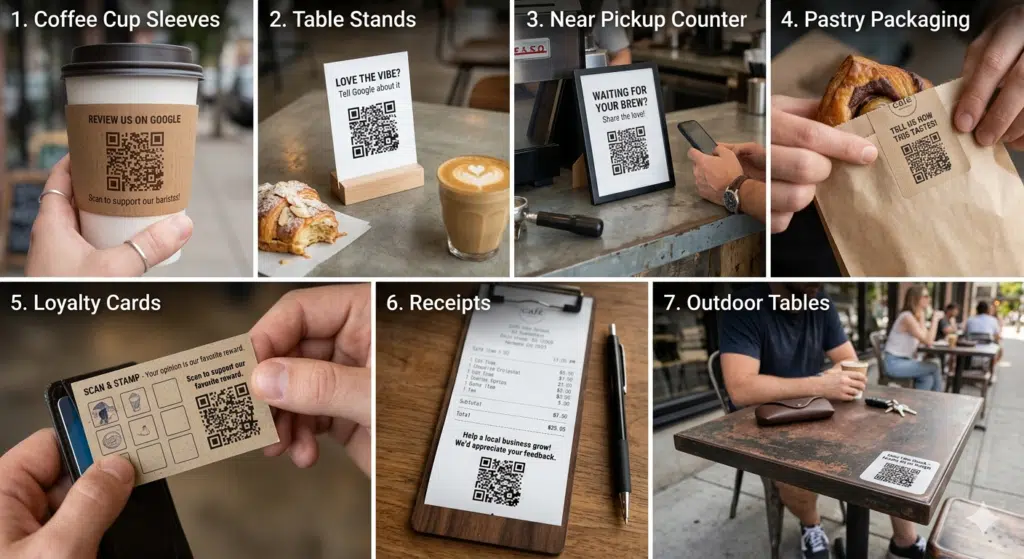
For a café, a QR code is the digital bridge between a physical experience and a Google ranking. However, simply having a code is not enough; its placement must align with the customer’s natural flow of movement and "dwell time." If the QR code is inconvenient to scan, the friction will prevent even the most satisfied customer from leaving feedback. To maximize conversion, the code should appear exactly when the customer is most likely to have their phone in hand and a moment of downtime.
On Coffee Cup Sleeves and Takeaway Cups
The coffee cup is the most consistent touchpoint in your business. For takeaway customers, the cup travels with them, providing a recurring visual reminder. Placing a QR code on the sleeve or the side of the cup targets the "post-sip" window—that moment when the customer has taken their first successful sip and is feeling a sense of satisfaction. Because commuters often have their phones out while walking or sitting on a train, this placement captures reviews from the high-velocity "grab-and-go" demographic.
On Table Stands and "Tent" Cards
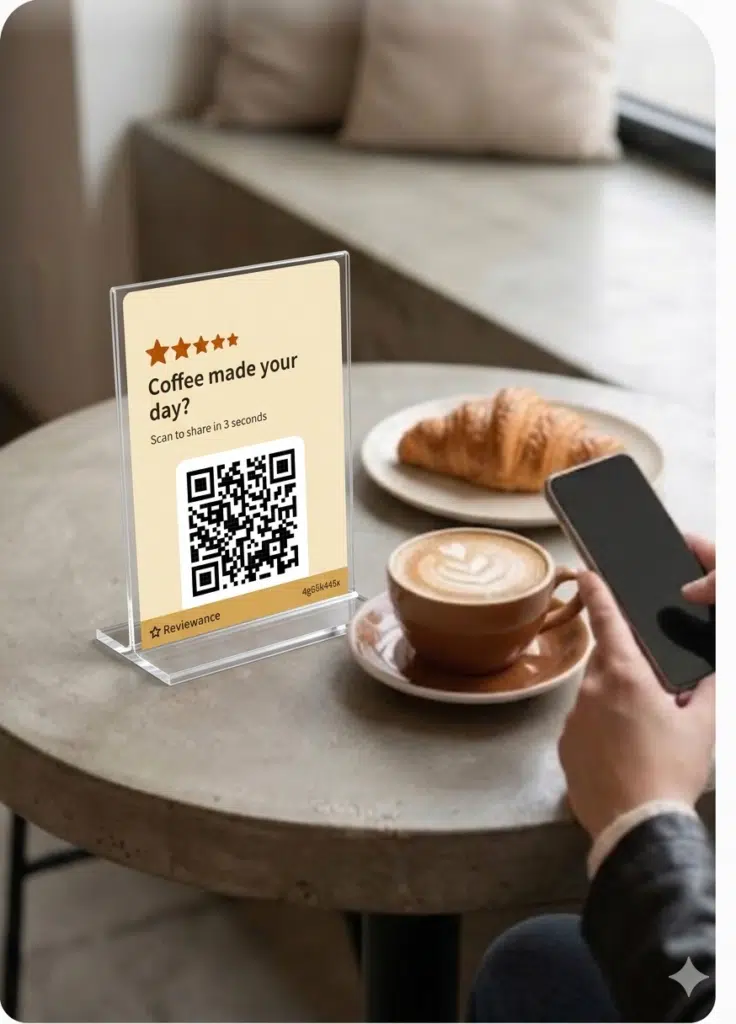
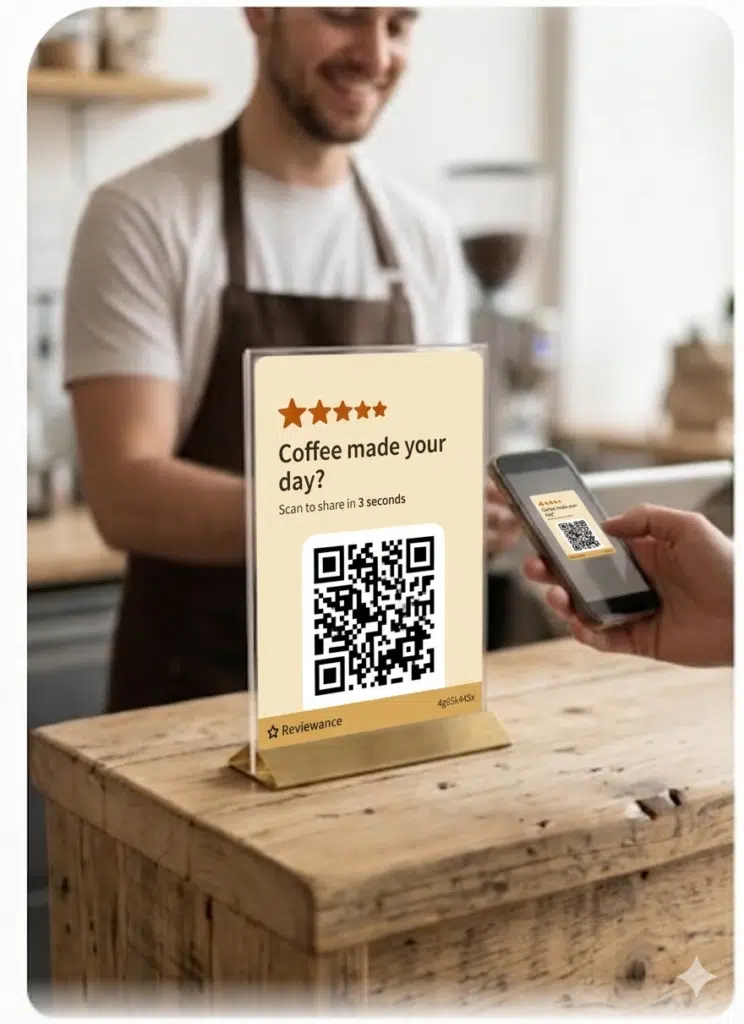
For sit-down guests, table stands offer the highest conversion rates. These customers have the most "dwell time," often spending 30 to 60 minutes in your space. A well-designed table stand serves as a non-intrusive nudge. When a customer finishes their drink and is lingering or waiting for a friend, they naturally reach for their phone. A QR code placed directly in their line of sight makes the transition to a Google review effortless.
Near the Pickup Counter
The pickup counter is a high-anticipation zone. Customers often stand here for 1 to 2 minutes while their drink is being prepared. During this short wait, most people instinctively check their phones to pass the time. By placing a QR code on the counter or on a small sign near the pickup area, you utilize this "dead time" effectively. A simple message like "Waiting for your brew? Tell us how we're doing!" can turn a boring wait into a 5-star review.
On Pastry and Food Packaging
If your café is known for its baked goods, the packaging is a prime "moment of delight" surface. Placing a QR code on the sticker used to seal a pastry bag or on the inside lid of a sandwich box catches the customer at the peak of their sensory experience. This is especially effective for "Specific Dish" SEO, as customers are more likely to mention the croissant or cake they are currently enjoying.
Integrated Into Loyalty Cards
Loyalty cards are a symbol of a recurring relationship. Whether it is a physical stamp card or a digital version, adding a QR code to the back or the "thank you" screen connects the reward of a free coffee to the act of giving feedback. It reminds your most frequent visitors—your "local authority" reviewers—that their voice is the most valuable tool for your growth.
On Printed and Digital Receipts
While often overlooked, the receipt is the formal conclusion of the transaction. For many customers, particularly those in business or corporate sectors, the receipt is something they keep or photograph for expenses. Placing a QR code at the bottom of the receipt, accompanied by a note like "Help a local business grow," provides a professional and subtle invitation to leave a review once they have left the premises.
On Outdoor Tables and Window Decals
Outdoor seating is a massive driver of "vibe" reviews. Customers sitting outside are often people-watching or relaxing in the sun, providing ample time for a mobile interaction. Similarly, a QR code on a window decal allows passersby or those waiting in a sidewalk queue to engage with your brand before they even enter. According to research on consumer proximity behavior, visual cues in the physical environment significantly increase the "intent to engage" with local business profiles.
Why Most Cafés Fail to Collect Reviews
Despite serving hundreds of happy customers every day, many cafés struggle to see their satisfaction reflected in their Google rating. The gap between a "good cup of coffee" and a "5-star review" is often caused by invisible barriers in the customer journey. Understanding these points of failure is the first step toward building a high-conversion review strategy.
Customers Forget the Moment They Leave
The most common reason for a lack of reviews is simple human nature: forgetfulness. A café visit is often a brief, transitional moment in a customer's day. While they may be delighted with the latte art or the service while sitting in the shop, that feeling is quickly replaced by the next task on their to-do list. Once a customer exits the door and rejoins the flow of the street, the psychological "peak" of the experience vanishes, and the likelihood of them remembering to search for the business on Google drops by nearly 80%.
Staff Feel Awkward or Intrusive Asking
Review collection often fails because of the "human hurdle." Baristas are trained to be experts in coffee and hospitality, not sales. Many staff members feel that asking for a review is self-serving or disruptive to the guest's relaxation. Without a structured system or a "soft" way to bring it up, baristas avoid the conversation entirely to avoid making the interaction feel transactional. This social friction results in thousands of missed opportunities for organic feedback.
The "Invisible" QR Code Problem
Many café owners believe they have solved the review problem by placing a single QR code near the register. However, if the code is poorly designed, hidden behind a tip jar, or printed on a faded piece of paper, it becomes "visual noise." If a customer has to go on a treasure hunt to find the link, they simply won't do it. A lack of high-visibility, strategically placed touchpoints means that even the most motivated fans of your brand find it too much effort to engage.
The "Morning Rush" Time Constraint
Cafés are high-velocity businesses, especially during the morning commute. Customers are often in a heightened state of "hurry," focusing on their watch rather than their phone. In these moments, any request that requires an extra 30 seconds of their time is perceived as a nuisance. When a café tries to collect reviews during high-stress hours without a "save for later" option (like a code on a cup sleeve), they hit a wall of customer resistance.
Technical and Psychological Friction
Friction is the enemy of conversion. If a QR code leads to a generic website instead of the direct "Write a Review" window, or if the customer is asked to fill out a long survey before reaching Google, they will drop off. Every extra click reduces the conversion rate by half. Furthermore, there is psychological friction; if the request feels like a "corporate demand" rather than a "personal favor," customers are less likely to feel the altruistic urge to help the business.
Summary of Failure Points
| Failure Factor | The Root Cause | The Result |
| Memory Gap | Post-visit distraction. | High satisfaction but zero review growth. |
| Staff Hesitation | Social awkwardness. | The "Ask" never happens. |
| Poor Visibility | Bad QR placement. | Friction prevents eager fans from helping. |
| Time Poverty | Morning rush stress. | Customers prioritize speed over feedback. |
| Process Friction | Too many clicks. | Users give up before hitting "Submit." |
By identifying these common pitfalls, café owners can move toward automated, frictionless solutions like Reviewance, which bridge the gap between a happy customer and a 5-star ranking without placing the burden on the staff or the customer's memory.
Google Review Examples for Cafés
Analyzing real-world review examples helps café owners understand exactly how Google's algorithm parses customer feedback. A well-structured review does three things: it validates your quality to humans, categorizes your business for AI, and boosts your ranking for specific keywords.
Below are three high-impact review examples and a breakdown of why they work for your SEO.
Example 1: The "Vibe & Product" Anchor
Review: "Amazing iced latte and very cozy atmosphere. It’s my favorite neighborhood spot to relax."
Why this works:
- Beverage Keyword: By mentioning a specific drink (iced latte), the reviewer helps the café rank for product-specific searches. When someone nearby searches for "best iced coffee," Google sees this review as proof of quality.
- Atmosphere Signal: The word cozy is a powerful "vibe" descriptor. Google uses this to categorize the shop for users looking for "warm" or "comfortable" environments.
- Emotional Sentiment: Words like amazing and favorite provide high sentiment scores, which Google’s AI uses to determine the overall "health" and popularity of the business.
Example 2: The "Remote Work" Magnet
Review: "Perfect laptop-friendly café. The Wi-Fi was fast, and I loved the avocado toast. Great for a study session!"
Why this works:
- Utility Keywords: Terms like laptop-friendly and Wi-Fi are essential for the remote work demographic. Google scans for these specific utility signals to answer "functional" search intents.
- Meal Intent: Mentioning avocado toast transitions the café from just a "coffee shop" to a "breakfast/brunch destination" in the eyes of the algorithm.
- Occasion Tagging: Study session tells Google exactly what people do at this location, making it a top result for students and nomads.
Example 3: The "Service & Speed" Specialist
Review: "Best flat white in the city! The baristas are so friendly and the service was fast, even during the morning rush."
Why this works:
- Professional Recognition: Mentioning baristas adds human context to the business, which Google associates with high-quality service-based businesses.
- Speed Sentiment: In the café industry, fast service is a major conversion factor. This review helps the shop win the business of time-strapped commuters.
- Local Authority: The phrase in the city acts as a broad geographic tag, boosting the shop's prominence across a wider local area.
Breakdown of Review Components
| Component | Example Phrases | Impact on Business |
| Product Keywords | "Espresso," "Cold brew," "Croissant" | Matches you to specific cravings. |
| Atmosphere Descriptors | "Industrial," "Quiet," "Aesthetic" | Matches you to the customer's "mood." |
| Service Metrics | "Helpful staff," "Quick turnaround" | Increases trust for busy professionals. |
| Functional Signals | "Outlets," "Dog-friendly," "Outdoor seating" | Answers specific logistical questions. |
Pro-Tip for Reviewance Users: Don't just ask for "a review." Ask your customers to "mention their favorite drink" or "tell us what they think of the vibe." This small nudge ensures their feedback contains the high-value keywords that move the needle on Google Maps.
How Many Reviews Does a Café Need?
The question of "how many" reviews a café needs is less about a magic number and more about competitiveness and velocity. In the world of Google Maps, your review count is relative to your immediate neighbors. A café in a quiet residential suburb might dominate with 50 reviews, while a specialty shop in Central London might need 2,000 to even appear in the "Local Pack."
To understand your target, you must look at your specific market segment and the expectations of the customers within it.
1. The Local Neighborhood Café
For a neighborhood spot, the goal is community trust. You aren't competing with the whole city; you are competing with the three other shops within a 10-minute walk.
- The Target: 50 – 150 reviews.
- The Strategy: What matters here is consistency over volume. Google prioritizes businesses with "fresh" reviews. If your last review was from six months ago, locals might assume the quality has dipped or the management has changed. One or two reviews per week are enough to keep you at the top of "coffee near me" searches for residents.
2. The Tourist Café
Tourist-heavy locations (near landmarks, museums, or major transit hubs) operate in a high-stakes environment. Tourists have zero brand loyalty and rely almost entirely on the "Top Rated" filter.
- The Target: 500 – 2,000+ reviews.
- The Strategy: Volume is your "Social Proof" engine. When a tourist sees a shop with 1,200 reviews and a 4.7 rating, it represents a "safe bet." In this segment, you need a high review velocity (daily reviews) to signal to Google that you are a primary destination for the thousands of travelers searching for "best breakfast" or "brunch" every morning.
3. The Specialty Coffee Shop
Specialty shops cater to a "connoisseur" demographic that values quality over convenience. These users read the actual text of the reviews to look for keywords like single-origin, pour-over, or tasting notes.
- The Target: 200 – 500 reviews.
- The Strategy: Here, the quality of the content outweighs the sheer number. You need a high concentration of reviews that mention specific brewing methods and bean origins. 200 reviews that detail the "acidity of the Ethiopian roast" are more valuable for your SEO than 1,000 reviews that simply say "good coffee."
4. The Franchise Coffee Chain
For a single branch of a larger chain, the competition is other nearby chains and independent shops. You are fighting against the "corporate/generic" perception.
- The Target: Matched to the local average + 20%.
- The Strategy: Since chains often suffer from "service variance" (where one branch is great and another is poor), your goal is to maintain a higher-than-average rating for your specific location. If the Starbucks across the street has a 3.8 rating, your goal is to hit 4.2+ to capture the customers who want the reliability of a chain but the quality of a top-rated shop.
Comparison of Review Targets by Segment
| Café Segment | Target Volume | Key Metric | Primary Driver |
| Local Spot | 50-150 | Recency | "Regular" visitors. |
| Tourist Hub | 500-2,000+ | Volume | "Social Proof" & safety. |
| Specialty | 200-500 | Keyword Depth | Expertise & Niche SEO. |
| Franchise | Local Avg + 20% | Star Rating | Quality differentiation. |
The "Velocity" Rule
Regardless of your segment, review velocity—how many reviews you get per month—is a critical ranking factor. According to researchs, 85% of consumers believe that reviews older than three months are no longer relevant.
The Reviewance Insight: It is better to get 5 reviews every week than 100 reviews in a single day followed by silence. Consistency tells Google’s algorithm that your café is a living, breathing, and consistently excellent business.
How Reviews Affect Café Revenue
The relationship between a café’s Google rating and its cash flow is direct and measurable. In the hospitality industry, reviews act as a "digital currency" that dictates foot traffic, especially in high-density urban areas.
Here is how online reputation translates into tangible revenue growth, supported by industry-leading data.
1. The Revenue Multiplier: Rating vs. Profit
Small shifts in your star rating have a massive impact on your bottom line. Because coffee is a low-cost, frequent purchase, customers are highly sensitive to quality signals.
- The Data: A landmark study by the Harvard Business Review found that a one-star increase in a business’s rating leads to a 5% to 9% increase in revenue. For a café, this means that moving from a 3.8 to a 4.2 doesn't just look better—it fundamentally changes your daily transaction volume.
- The "Half-Star" Surge: Research from the University of California, Berkeley economists showed that a half-star improvement (e.g., from 3.5 to 4.0) makes it 19% more likely that a venue will be full during peak hours. In a café setting, this translates to higher table turnover and fewer "dead" afternoon hours.
2. Capturing High-Margin Tourist Traffic
Tourists are the most profitable demographic for a café because they are "discovery-driven." Unlike locals who may only buy a quick espresso, tourists often stay for a full breakfast, purchase merchandise, or buy bags of retail coffee.
- The Visibility Link: Tourists rely almost exclusively on the "Top Rated" or "Near Me" filters on Google Maps. If your café is in the top 3 results, you capture the "One-Time High-Spender."
- The Data: According to researchs, 98% of consumers at least occasionally read online reviews for local businesses. For travelers in an unfamiliar city, this number is virtually 100%. High review volume acts as "safety insurance" for their vacation budget.
3. The Instagram Spillover Effect
Reviews and visual social media create a powerful feedback loop. When a user sees a "highly rated" café on Google Maps, they often cross-reference it on Instagram to check the "aesthetic."
- Social Proof Loop: Positive reviews that mention your "latte art" or "interior design" encourage users to take their own photos. These photos then get posted to Instagram/TikTok, creating a secondary wave of organic traffic.
- Revenue Impact: This "aesthetic validation" reduces customer acquisition costs (CAC). Instead of paying for ads, your customers’ reviews and photos act as a 24/7 sales team.
4. Accelerating Takeaway and "Grab-and-Go" Growth
For the morning rush, revenue is determined by speed and reliability. Commuters use Google Maps to find the most efficient path to their caffeine.
- Keyword Influence: Reviews that mention "fast service," "no wait," or "efficient staff" directly influence the choice of a commuter.
- The Maps Advantage: Google’s algorithm prioritizes businesses that show high engagement. More reviews lead to higher Maps visibility, which places your shop at the top of the screen when a commuter checks their phone while walking from the subway.
5. Converting One-Time Guests into Repeat Customers
While a review brings a customer in the door the first time, your response to that review ensures they come back.
- The Loyalty Factor: According to Google Business data, businesses that respond to reviews are perceived as 1.7x more trustworthy than those that don't.
- Revenue Impact: Increasing customer retention by just 5% can increase profits by 25% to 95%. Responding to a 4-star review with a "Thank you, see you next time!" builds the rapport necessary to turn a stranger into a "Regular."
Revenue Impact Summary
| Revenue Stream | Primary Review Driver | Financial Outcome |
| Dine-In | Ambience & Quality Mentions | Higher Table Turnover & 19% more peak traffic. |
| Tourist Sales | High Review Volume | Increased Average Order Value (AOV). |
| Takeaway | "Fast Service" Keywords | Dominance of the high-frequency morning rush. |
| Retail (Beans) | Product-Specific Keywords | Diversified income through specialty coffee sales. |
Every 5-star review is a digital "billboard" that stays up forever. By using Reviewance to automate the collection of these reviews, you aren't just improving your SEO; you are building a predictable, data-driven revenue engine for your café.
How Café Staff Should Ask for Reviews
In the high-speed environment of a café, the interaction between staff and customers is often the only human touchpoint a brand has. To collect reviews effectively, baristas and cashiers must master the balance between sincerity and speed. A request that feels like a scripted corporate demand will likely be ignored, but a personal, well-timed nudge can turn a satisfied guest into a digital advocate.
The Barista’s "Handover" Script
The most natural moment for a barista to request feedback is during the drink handover. Because this is the "peak" of the service, the customer is focused on the craftsmanship of their beverage. Instead of a generic "please review us," a barista can use a product-focused prompt. For example: "Here is your flat white! If you enjoy the roast today, we’d love it if you could mention it on Google—it really helps our team know they’re doing a great job." This frames the review as a personal favor to the craftsperson, rather than the business.
The Cashier’s "Dwell Time" Interaction
Cashiers interact with customers during the only moment of "waiting" in the journey. While the transaction is processing or the customer is waiting for their change, there is a small window for a relationship-building script. A cashier might say: "Since you're a fan of our cold brew, feel free to scan the code on your way to the table. We’re trying to reach our goal of 500 reviews this month, and every mention helps!" By sharing a specific goal, you invite the customer into the café’s success story.
The Takeaway Efficiency Nudge
For takeaway customers, time is the most valuable currency. The interaction must be ultra-fast. The best approach here is to link the review to the speed of service, which is what these customers care about most. A quick: "Hope you have a great morning! If you found our service fast today, a quick star rating on Google would be amazing while you walk," works perfectly. It highlights the value they just received—speed—and suggests they complete the task during their transit.
Engaging the "Regular" Customer
Regulars are your most powerful allies because Google recognizes their local authority. However, you cannot ask them for a review every day. The best strategy for a regular is to wait for a "new" experience, such as a seasonal menu launch or a new bean rotation. A staff member can say: "Hey [Name], since you tried the new Ethiopian blend today, we’d love to get your expert opinion on our Google page. It helps other coffee lovers find the good stuff!" This acknowledges their status as an expert and a friend of the shop.
The "Sincere but Fast" Tone
The golden rule for café staff is to keep the request under ten seconds. The tone should always be casual and collaborative. Avoid using "customer service voice"; instead, speak like a neighbor. When the request is framed as "helping the local shop" rather than "submitting a report," the conversion rate increases significantly. By integrating these small, organic scripts into the daily workflow, a café can ensure a steady stream of fresh, keyword-rich reviews without ever making the customer feel pressured or delayed.
Review Management for Multi-Location Café Chains
Managing a single café is a matter of hospitality; managing a multi-location chain is a matter of reputation infrastructure. For "Starbucks-style" brands or growing franchises, the biggest challenge is inconsistency. A 5-star experience at your downtown branch can be overshadowed by a 2-star experience at the airport location. Google Maps treats each branch as an individual entity, meaning your brand’s health is only as strong as its weakest link.
Ensuring Franchise Consistency through Feedback
For a chain, Google Reviews act as a real-time, 24/7 quality audit that no mystery shopper could ever replicate. By centralizing review data, management can identify systemic issues across specific regions. If three different branches are receiving complaints about "lukewarm milk" or "slow mobile order pickup," it signals a training gap rather than an isolated incident. Monitoring these trends allows the brand to maintain the franchise consistency that customers expect from a recognized name.
Building Local Branch Reputation
While the logo on the cup is the same, every branch serves a different micro-neighborhood. A branch near a university needs to rank for "study-friendly," while a branch in a business district needs to dominate "fast service" keywords. Multi-location management involves optimizing each Google Business Profile (GBP) to reflect its specific local context. Encouraging reviews that mention the local staff or the specific "vibe" of that neighborhood helps a large chain feel like a local community hub rather than a faceless corporate entity.
Centralized Response vs. Local Authenticity
One of the most debated topics in chain management is who should respond to reviews. A centralized corporate response can feel robotic and detached, yet leaving it entirely to local managers can lead to inconsistent branding. The most successful chains use a hybrid model: corporate provides approved templates and brand guidelines, but local managers customize the response with the customer's name and specific details of the visit. This maintains brand standards while preserving the human connection that defines the café experience.
The Chain Management Matrix
| Challenge | Strategy | Outcome |
| Brand Dilution | Monitor low-rated branches for training gaps. | Uniform quality across all locations. |
| Local Invisibility | Target neighborhood-specific keywords in reviews. | Better rankings in localized "near me" searches. |
| Response Lag | Use centralized dashboards to flag negative reviews. | Rapid recovery of dissatisfied customers. |
| Data Silos | Aggregate review sentiment for menu R&D. | Data-driven decisions for new seasonal launches. |
The "Starbucks Effect" on SEO
Large chains often benefit from high Brand Authority, but they struggle with Personalization. To compete with agile, independent specialty shops, chains must leverage their high foot traffic to generate a massive volume of reviews. High review velocity at a specific branch tells Google’s algorithm that despite being a chain, this location is a high-performing local favorite. This prominence ensures the branch remains in the "Top 3" Local Pack, even in high-competition urban areas.
Reviewance for Chains: For multi-location brands, automation is non-negotiable. Using a platform to track, sort, and solicit reviews across 10, 50, or 100 locations ensures that no branch falls behind the brand standard. It turns a logistical nightmare into a strategic advantage, ensuring that every "open" sign on your map is backed by a 4-star+ reputation.
How Reviewance Helps Cafés Grow on Google Maps
In the fast-paced world of coffee, every second a customer spends at your counter is an opportunity to secure your digital future. Reviewance is designed specifically to bridge the gap between a high-quality espresso and a high-ranking Google Business Profile. We take the friction out of the "ask," allowing your team to focus on the craft of coffee while we handle the craft of reputation.
Automating the "Aesthetic" Momentum
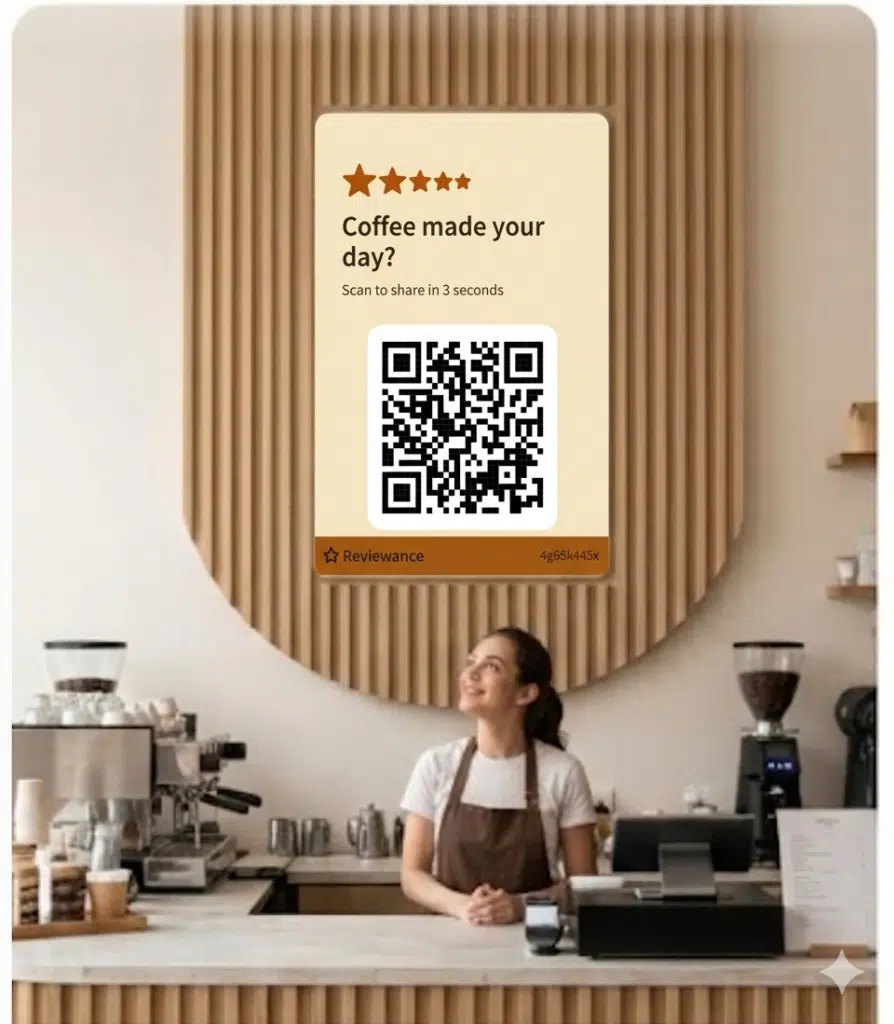
Your customers are already taking photos of your latte art and interior design; Reviewance ensures those photos actually end up on your Google profile. By placing smart, frictionless QR codes at peak satisfaction touchpoints—like table stands or takeaway sleeves—we prompt guests to share their visual experience exactly when they are most impressed. This constant stream of User-Generated Content tells Google’s AI that your café is the most relevant and "aesthetic" choice in the neighborhood.
Scaling Social Proof Without the Stress
For café owners and managers, the "human hurdle" of asking for reviews is often the biggest barrier to growth. Reviewance removes the awkwardness from the interaction. Instead of baristas having to "sell" the idea of a review during a busy rush, our automated system acts as a silent, friendly nudge. This ensures a consistent review velocity, keeping your rankings high and your "Local Pack" position secure, even during your busiest hours.
Turning "Near Me" Searches into Foot Traffic
Google Maps is a game of data. The more your reviews mention keywords like "best cappuccino," "fast Wi-Fi," or "quiet workspace," the more often Google will put your shop in front of high-intent customers. Reviewance helps you curate these reviews by guiding customers toward the specific details that matter most for your SEO. We help you turn digital visibility into physical foot traffic, ensuring that the person searching for coffee two blocks away chooses your door every single time.
Your Competitive Edge in the Coffee Economy
The difference between a struggling café and a local landmark is often just half a star. With Reviewance, you aren't just collecting feedback; you are building a data-driven marketing engine that works 24/7. Whether you are a single specialty shop or a growing multi-location chain, we provide the tools to dominate your local map, increase your revenue, and turn every first-time visitor into a lifelong regular.
Ready to see your café at the top of the map? Join hundreds of successful coffee shops and start building your 5-star reputation today. Let’s make your café the most talked-about spot in the city.
Related Review Collection Guides
- How Restaurants Get More Google Reviews
- How Dentists Generate More Google Reviews
- Hotel Review Collection Best Practices
- Review Strategies for Med Spas
- Review Collection for Hair Transplant Clinics
- Customer Review Strategies for Auto Repair Shops