
A hospital's reputation has always mattered. What has changed is where that reputation is built.
Years ago, reputation was shaped primarily through physician referrals, local word-of-mouth, and traditional marketing. Today, most patients begin their healthcare journey online. Before choosing a hospital, specialist, or treatment provider, they search, compare options, read patient reviews, and evaluate experiences shared by others.
For hospitals, reputation is no longer simply a branding issue. It directly influences patient acquisition, patient retention, physician recruitment, community trust, and long-term organizational growth.
Effective hospital reputation management is about actively shaping how patients perceive your organization before, during, and after every interaction.
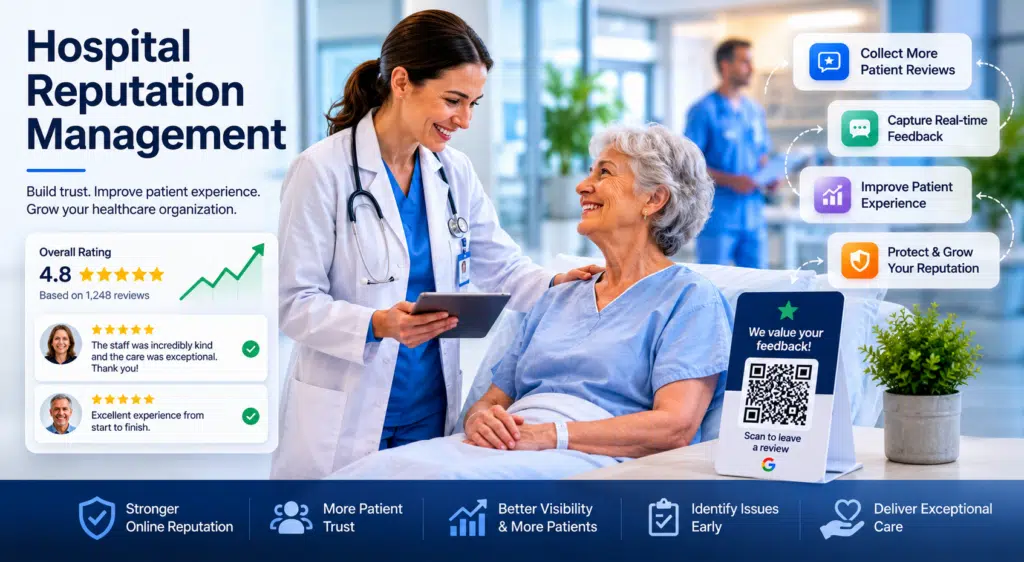
What Is Hospital Reputation Management?
Hospital reputation management is the process of monitoring, measuring, and improving how patients, families, healthcare professionals, and the broader community perceive a healthcare organization.
This perception is influenced by many factors, including:
- Online reviews
- Patient satisfaction
- Clinical outcomes
- Communication quality
- Response times
- Staff professionalism
- Digital presence
- Community engagement
While hospitals often focus heavily on operational excellence, many overlook how those experiences are reflected online. As a result, thousands of positive patient interactions never become public feedback that could influence future patients.
Why Hospital Reputation Matters More Than Ever
Modern patients behave like informed consumers.
Whether they need a specialist consultation, elective procedure, diagnostic service, or long-term treatment, they often begin by researching providers online.
A patient comparing two hospitals may notice that one organization has hundreds of recent reviews while the other has very few. Even if both provide excellent care, the hospital with stronger social proof often gains the advantage.
Reputation also impacts healthcare professionals. Physicians, nurses, and specialists increasingly evaluate an organization's reputation when considering employment opportunities. A hospital known for patient satisfaction and quality care becomes more attractive to top talent.
Additionally, healthcare organizations with strong reputations often experience higher patient trust, greater loyalty, and improved referral rates.
The Hidden Challenge: Most Happy Patients Never Leave Reviews
One of the biggest misconceptions in healthcare marketing is that satisfied patients naturally leave reviews.
In reality, most do not.
Patients may have an excellent experience, receive exceptional care, and recommend the hospital to friends and family. Yet they rarely take the extra step of sharing that experience publicly.
The reason is simple.
By the time patients return home, focus on recovery, or move on with daily life, leaving feedback is no longer a priority.
This creates a significant gap between actual patient satisfaction and publicly visible patient sentiment.
Many hospitals are unknowingly losing opportunities to strengthen their online reputation simply because they lack a systematic process for collecting patient feedback.
Reviews Are Only Part of the Reputation Equation
Online reviews are important, but they represent only one component of reputation management.
Leading healthcare organizations understand that reputation begins with listening.
Patient feedback can reveal operational issues that traditional reporting systems may miss. Long waiting times, communication breakdowns, scheduling frustrations, and service inconsistencies often appear in patient comments long before they become major organizational problems.
When hospitals consistently collect and analyze patient feedback, they gain valuable insights into both strengths and improvement opportunities.
This transforms reputation management from a marketing function into a strategic management tool.
Creating a Patient Feedback Culture
The most successful hospitals do not treat feedback as a one-time survey exercise.
Instead, they build a culture where patient voices are continuously heard and acted upon.
Patients should have simple opportunities to share their experiences throughout the care journey. The easier it is to provide feedback, the more representative the data becomes.
Hospitals that actively encourage patient input often identify emerging issues faster and improve patient satisfaction more effectively than organizations relying solely on periodic surveys.
Just as importantly, patients appreciate knowing that their opinions matter.
The Role of Technology in Modern Hospital Reputation Management
Managing reputation across multiple departments, specialties, facilities, and patient touchpoints can quickly become overwhelming.
This is where specialized reputation management platforms can help.
Solutions such as Reviewance enable hospitals to streamline review collection and feedback management through patient-friendly digital experiences. Instead of hoping patients eventually leave reviews, healthcare organizations can create structured opportunities for patients to share feedback immediately after positive interactions.
Reviewance also helps organizations centralize feedback data, monitor patient sentiment across locations, compare performance trends, and identify service improvement opportunities before they become larger reputation risks.
For multi-location healthcare networks, this visibility becomes particularly valuable because leadership teams can better understand which facilities are excelling and which areas require attention.
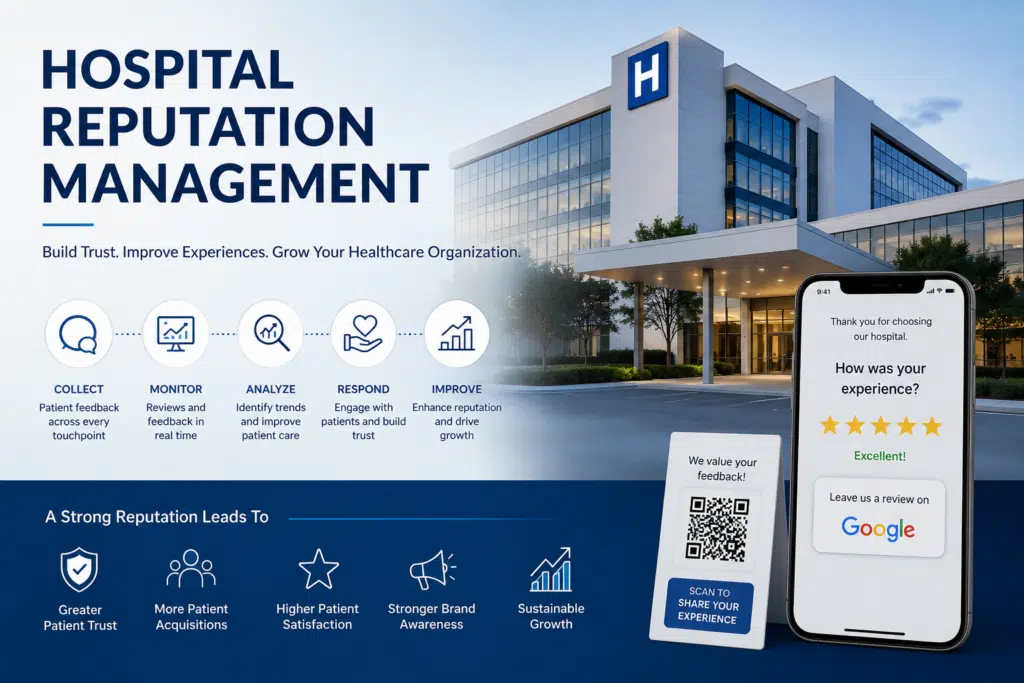
Responding to Reviews the Right Way
Many hospitals underestimate the impact of review responses.
When prospective patients read reviews, they often pay as much attention to the organization's response as the original feedback itself.
Professional, empathetic, and thoughtful responses demonstrate accountability and patient-centered values.
Even when responding to criticism, hospitals can reinforce trust by showing that they listen carefully and take patient concerns seriously.
While privacy regulations must always be respected, organizations can still acknowledge feedback and communicate a commitment to continuous improvement.
Measuring Reputation Beyond Star Ratings
A high star rating is valuable, but it should not be the sole success metric.
Healthcare leaders should also monitor:
- Review volume growth
- Feedback response rates
- Patient sentiment trends
- Service-specific satisfaction
- Department-level performance
- Location comparisons
- Resolution times for patient concerns
These metrics provide a more complete understanding of organizational reputation than ratings alone.
The goal is not simply to accumulate reviews. The goal is to build a trusted healthcare brand supported by authentic patient experiences.
Common Reputation Management Mistakes Hospitals Make
Many hospitals invest heavily in advertising while neglecting reputation management.
Others focus exclusively on negative reviews and fail to encourage satisfied patients to share positive experiences.
Some organizations collect feedback but never analyze it, while others gather data without acting on the insights.
The most successful hospitals recognize that reputation management is an ongoing process rather than a one-time initiative.
It requires consistent listening, measurement, response, and improvement.
The Future of Hospital Reputation Management
As healthcare becomes increasingly transparent and patient-driven, reputation will continue to play a larger role in organizational success.
Patients expect more information, more transparency, and more evidence of positive experiences before making healthcare decisions.
Hospitals that proactively manage reviews, collect meaningful feedback, and continuously improve patient experiences will be better positioned to earn trust in a competitive healthcare environment.
The organizations that succeed will not simply have the best marketing. They will have the strongest connection between patient experience, feedback, reputation, and operational performance.
The Bottom Line
Hospital reputation management is no longer optional.
Every patient interaction contributes to how a healthcare organization is perceived online and offline. Hospitals that actively collect feedback, encourage patient reviews, and use reputation data to drive improvement gain a significant competitive advantage.
When reputation management becomes part of a broader patient experience strategy, hospitals strengthen trust, improve service quality, and create sustainable growth built on authentic patient voices.