
Why Reputation Matters More Than Ever for Small Businesses
A few decades ago, a small business built its reputation through word of mouth. Customers shared their experiences with friends, family, and neighbors, and those recommendations often determined whether a business succeeded or struggled.
Today, reputation still drives business growth, but the conversation has moved online.
Before visiting a restaurant, scheduling a dental appointment, booking a hotel room, or hiring a local contractor, customers typically search online. They read reviews, compare ratings, browse photos, and evaluate what previous customers have said about the business. In many cases, they make a decision before ever speaking with an employee.
For small businesses, this means reputation management is no longer optional. It has become one of the most important aspects of marketing, customer experience, and long-term growth.
What Is Small Business Reputation Management?
Small business reputation management is the process of monitoring, influencing, and improving how customers perceive your business online and offline.
This includes managing online reviews, responding to customer feedback, encouraging satisfied customers to share their experiences, and addressing issues before they damage trust.
A strong reputation creates confidence. A weak reputation creates hesitation.
When potential customers compare two similar businesses, reputation often becomes the deciding factor.
Imagine two dental clinics in the same city. Both offer similar services and pricing. One has hundreds of recent reviews with detailed patient experiences, while the other has only a handful of reviews and little online presence. Most people will naturally choose the business that appears more trusted.
That is the power of reputation management.
The Growing Importance of Online Reviews
Online reviews have become the digital version of personal recommendations.
Customers trust reviews because they provide real-world experiences from people who have already used a product or service. Reviews help answer questions that businesses often cannot answer themselves.
Potential customers want to know:
- Is the service reliable?
- Is the staff professional?
- Was the experience worth the money?
- Would previous customers return?
Reviews provide those answers.
For small businesses, platforms such as Google Reviews often have the biggest impact because they appear directly in search results and Google Maps. Positive reviews can increase visibility, improve click-through rates, and influence purchasing decisions.
The challenge is that reviews do not manage themselves. Businesses must actively participate in the process.
Reputation Management Is About More Than Reviews
Many business owners assume reputation management simply means collecting more five-star reviews.
While reviews are extremely important, reputation management is much broader.
Customers evaluate businesses through every interaction they have. A delayed response, poor customer service experience, unanswered complaint, or outdated online profile can influence perception just as much as a review.
Effective reputation management involves creating a consistent experience across every customer touchpoint.
The goal is not to appear perfect.
The goal is to appear trustworthy, responsive, and customer-focused.
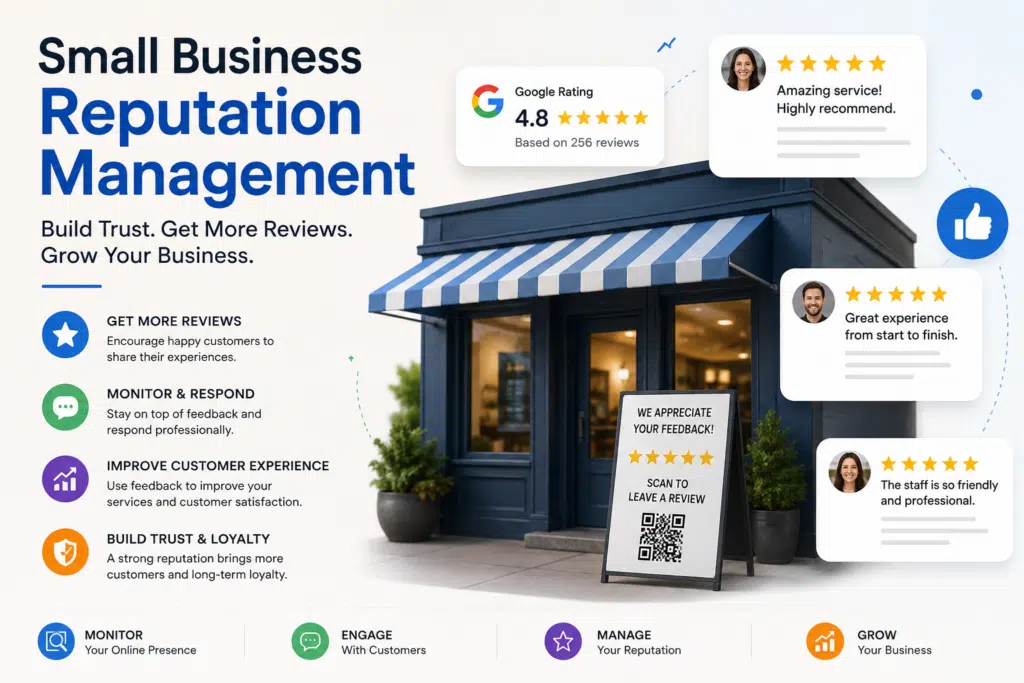
Why Small Businesses Often Struggle With Reputation Management
Large companies often have dedicated marketing teams, customer experience departments, and reputation specialists.
Small businesses usually do not.
Owners are often responsible for operations, staffing, sales, customer service, and marketing simultaneously. As a result, reputation management is frequently pushed aside until a problem occurs.
Unfortunately, by the time negative feedback becomes visible, the damage may already be affecting customer acquisition.
Many businesses also struggle because they rely on customers to leave reviews voluntarily. The reality is that even highly satisfied customers often forget to leave feedback unless the process is simple and convenient.
The Most Effective Reputation Management Strategies
Successful reputation management starts with creating experiences worth talking about.
No software can compensate for poor service. Businesses that consistently deliver value naturally generate more positive feedback.
However, great experiences alone are not enough.
Satisfied customers need gentle reminders and convenient opportunities to share their opinions. Many successful businesses now use QR codes, SMS review requests, email follow-ups, and customer feedback systems to make reviewing effortless.
Timing matters as well.
The best moment to request a review is often immediately after a positive customer interaction, when satisfaction is highest and the experience is still fresh.
Businesses that consistently collect reviews throughout the year tend to outperform businesses that only request reviews occasionally.
How to Respond to Negative Reviews
Every business receives criticism at some point.
Negative reviews are not necessarily harmful. In fact, a few critical reviews can make a review profile appear more authentic.
What matters most is how the business responds.
A professional response demonstrates accountability and shows future customers that the business takes concerns seriously.
Avoid arguing with reviewers, making excuses, or becoming defensive.
Instead, acknowledge the customer's experience, express empathy, and offer to continue the conversation privately when appropriate.
Prospective customers often pay more attention to the response than the original complaint.
A thoughtful response can actually strengthen trust.
Common Reputation Management Mistakes
One of the biggest mistakes small businesses make is ignoring reviews altogether.
Another common mistake is responding only to negative reviews while overlooking positive ones. Customers appreciate acknowledgment, and a simple thank-you can strengthen loyalty.
Some businesses also make the mistake of focusing solely on review quantity while neglecting customer experience. Reviews are a reflection of operational performance. If recurring issues appear in customer feedback, those issues deserve attention.
Perhaps the most damaging mistake is inconsistency.
A business that actively manages its reputation for one month and then neglects it for six months will struggle to build long-term trust.
Reputation management works best when it becomes part of daily operations.
How Technology Is Changing Reputation Management
Modern reputation management platforms have made it easier for small businesses to collect reviews, monitor feedback, and identify trends.
Solutions such as Reviewance help businesses generate reviews through QR codes, SMS requests, and instant feedback tools while providing valuable insights into customer experience.
Rather than waiting for reviews to appear organically, businesses can proactively encourage feedback and identify opportunities for improvement.
This shift from passive monitoring to active reputation growth is becoming increasingly important in competitive local markets.
The Relationship Between Reputation and Local SEO
Reputation management and local SEO are closely connected.
Google uses review-related signals when determining local search rankings. Factors such as review volume, review recency, review quality, and business responsiveness can all influence visibility.
Businesses with stronger review profiles often appear more prominently in local search results and Google Maps.
This creates a powerful cycle.
More reviews lead to better visibility.
Better visibility leads to more customers.
More customers create more opportunities for reviews.
Businesses that understand this relationship often gain a significant advantage over competitors.
The Future of Small Business Reputation Management
Customer expectations continue to evolve.
People want transparency, authenticity, and responsiveness from the businesses they support. They expect businesses to listen, respond, and continuously improve.
As artificial intelligence, automation, and customer experience technology continue to advance, reputation management will become even more integrated into everyday business operations.
The businesses that thrive will be those that view reputation management not as a marketing tactic, but as an ongoing commitment to customer satisfaction.
Small business reputation management is ultimately about trust.
Every review, customer interaction, response, and piece of feedback contributes to how people perceive your business.
A strong reputation attracts customers, improves local search visibility, increases conversions, and supports sustainable growth.
The most successful businesses understand that reputation is not built through advertising alone. It is earned through consistently positive experiences and strengthened through active engagement with customers.
In a world where potential customers can learn about your business with a single search, managing your reputation may be one of the most valuable investments you can make.