
By Daniel Harper, Licensed Massage Therapist and Owner of Harbor & Stone Massage Therapy
When I first opened Harbor & Stone Massage Therapy, I thought the hardest part of building a successful practice would be getting people through the door. I was wrong. Getting someone to book their first massage is important, but convincing them to come back, recommend you to a friend, and trust you with their body is where the real work begins. I have always believed that massage therapy is about much more than technique. People come to us because something hurts, because they are stressed, because they cannot switch off, or sometimes simply because they want an hour where nobody needs anything from them. When someone leaves a treatment room looking visibly more relaxed than when they entered, that is the part of the job I find most rewarding.

For a long time, I assumed that if I gave people a great massage, the business would naturally grow through word of mouth. And to some extent, it did. Clients recommended me to coworkers, spouses, friends, and family members. Some people would tell me during checkout that they had already started planning their next appointment. But there was another source of referrals that I initially underestimated: Google. I started noticing that new clients would mention our Google Business Profile during their first appointment. Some had found us through Google Maps, some had searched for a massage therapist near them, and others had compared several massage therapy practices before deciding where to book. That was when I started looking at our Google reviews differently.
I Realized People Were Reading Reviews Before They Booked
Once I became more aware of it, I started asking new clients how they had found Harbor & Stone. I wasn't trying to conduct some sophisticated marketing study. I was simply curious. I wanted to know whether our website, local referrals, Instagram account, or Google profile was actually bringing people through the door.
The answers were surprisingly consistent. Google came up again and again, and when I asked what made them choose us instead of another massage therapist, reviews were often part of the answer. People wanted to know what the experience was actually like before booking. They wanted to know whether the therapist was professional, whether the environment was comfortable, whether appointments started on time, and whether other people had felt that the treatment was worthwhile.
That made perfect sense to me. Massage therapy is an intimate service. Someone is trusting you with their physical comfort and personal space. A photograph of a beautiful treatment room can create a good first impression, but a detailed review from another client can provide something much more powerful: reassurance.
The Problem Wasn't Happy Clients. It Was Getting Them to Leave a Review.
This was the part I struggled with for quite a while. I had plenty of happy clients. People regularly told me how much better they felt after a session, and many of them genuinely wanted to support the business. But there is a huge difference between someone saying, "You did a great job," and that person actually opening Google, finding your business, clicking the review button, and writing something.
I used to say, "If you enjoyed the massage, we'd really appreciate a Google review." Most clients smiled and said they would do it. I knew they meant it. Then they walked out, got into their car, went back to work, picked up their children, answered their messages, or simply continued with their day. By the next morning, the intention had disappeared.
Create your review QR codes
Your business name
First month only $1, then just $9.99/month. Cancel anytime.
That taught me an important lesson about how to get more Google reviews for a massage therapy business. You don't necessarily need to convince more people to leave reviews. You need to make it much easier for the people who already want to leave one.
I Stopped Treating Google Reviews as Something That Happened by Chance
I eventually decided that review collection needed to become part of the way we operated the business. I already had systems for appointment scheduling, client intake, treatment notes, follow-up, cleaning, and payments. Why wouldn't I have a system for our online reputation?
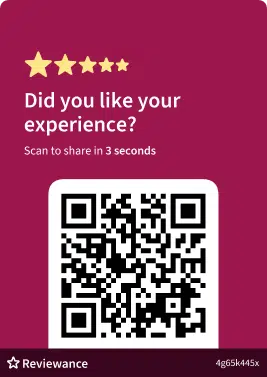
I started with a simple Google review QR code at the front desk. It wasn't complicated, but it removed one of the biggest problems: asking clients to remember our business name and search for us later. If someone was genuinely happy with their massage, they could scan the QR code before leaving and go directly to the review page.
I also experimented with where we placed the QR code. I didn't want the studio to feel like it was constantly asking for reviews, so I chose moments and locations where it made sense. The reception desk worked well, but I found that the most important factor wasn't actually where the QR code was placed. It was when we asked.
The Best Time to Ask Was Immediately After the Massage
Massage has a very particular emotional rhythm. A client arrives carrying the tension of their day, spends an hour in a quiet room, and then slowly gets back into the outside world. Sometimes they sit for a moment after the treatment before getting dressed. Sometimes they tell you immediately that they feel completely different. Those moments became incredibly important to me.
If a client finished a treatment and said something like, "That was exactly what I needed," I didn't want to wait until the next day to ask for a review. I would simply explain that if they had enjoyed the experience, a quick Google review would really help the practice. When the review process was immediately accessible through a QR code, there was much less friction.
That small change made me understand something I had previously overlooked. Timing is part of review management. Asking someone to review a massage therapy practice two days after their appointment is very different from giving them an easy way to share their experience while they are still feeling the benefit of the treatment.
I Also Started Using a Mobile QR Code
One of the things I particularly liked about Reviewance was the ability to use a Mobile QR Code directly from my phone. That may sound like a small feature, but it suited the way I actually work.
I'm not sitting behind a reception desk all day. Sometimes I'm finishing an appointment, sometimes I'm helping another therapist, and sometimes I'm working at an event or providing massage services outside the studio. Having the review QR code available on my phone meant I didn't have to rely on a physical sign being nearby.
If a client gave me genuine positive feedback after a session, I could simply show them the QR code. They could scan it immediately and leave their review while the experience was still fresh in their mind.
That became particularly useful for clients who weren't regular visitors. A person who comes once for a specific problem may not think about reviewing the business several days later. Giving them an easy opportunity at the right moment made much more sense.
Reviews Became Part of How I Understood the Business
Something else happened as our number of Google reviews grew: I started reading them much more carefully.
At first, I was mostly interested in the rating and the number of reviews. Eventually I became much more interested in what people were actually saying. Certain themes appeared repeatedly. Clients talked about feeling comfortable, appreciated how carefully I listened during consultations, mentioned the cleanliness of the studio, and frequently described how relaxed they felt afterward.
Those comments were useful because they showed me what clients valued most. I might think that a particular treatment technique was the most important part of the experience, while clients might actually care more about feeling listened to or having a calm environment.
That changed the way I thought about reputation management. Google reviews aren't simply a score attached to your business. They are a continuous stream of customer feedback that can tell you what you're doing well and where you can improve.
Reviewance Helped Me Create a More Complete Feedback Process
This is another reason I eventually incorporated Reviewance into the way we collect customer feedback. A public Google review is extremely valuable, but not every piece of feedback needs to be public.
Sometimes a client wants to tell you that the room was too warm, that they would prefer a different appointment time, or that something about their experience could have been better. Reviewance gives us a private feedback option, which means clients have another way to communicate with us directly.
I think that's particularly important for a massage therapy business because personal services depend so heavily on trust and communication. If someone has a concern, I'd much rather hear about it directly and have the opportunity to address it than never hear from them again. At the same time, genuinely happy clients have a simple path to share their experience publicly on Google.
For me, those two things belong together: listening privately and building public trust through authentic reviews.
I Don't Think Google Reviews Replace Great Massage Therapy
If there is one thing I would never want another massage therapist to misunderstand, it's this: a review strategy cannot compensate for poor service.
You can have the best QR code in the world, but if your clients don't feel cared for, they won't suddenly become enthusiastic reviewers. The foundation is still the treatment itself, the professionalism of the therapist, the cleanliness of the practice, the consultation, the communication, and the overall experience.
What a good review system does is capture the positive experiences that are already happening.
That distinction is important to me. I'm not trying to manufacture five-star reviews. I'm trying to make sure that when a client genuinely has a five-star experience, there is an easy and natural way for them to tell the next person who is searching for a massage therapist.
Looking Back, I Wish I Had Started Earlier
When I look at our Google Business Profile today, I sometimes think about how many happy clients came through our doors before I understood the importance of asking them to share their experience. We had years of good work that simply wasn't represented online.
I don't make that mistake anymore.
We now have a consistent process for collecting Google reviews, we use QR codes in appropriate places, and the Mobile QR Code gives us flexibility when we're working directly with clients. Most importantly, we ask at the right moment rather than hoping someone remembers us later.
The result hasn't just been more reviews. It has been a stronger online reputation, more confidence from first-time clients, and a much clearer understanding of what people value about our practice.
If you're a massage therapist trying to get more Google reviews, my advice is to stop thinking of review collection as an occasional request. Treat it as another part of your customer experience. Give genuinely satisfied clients an effortless way to share what they thought, ask at the moment when the experience is still fresh, and pay attention to what those reviews are telling you about your business.
A great massage can make someone feel better for an hour.
A great Google review can help the next person find you.