
Why Google Reviews Matter So Much for Tourist Businesses
Running a restaurant in a tourist destination is very different from running a restaurant that mainly serves local customers. Our guests come from all over the world, often for the first and only time, and most of them have no personal connection to our restaurant before they arrive. They don't know our staff, they don't know the neighborhood, and they certainly don't know whether the photos on our website or social media tell the whole story. Before deciding where to eat, many of them open Google Maps, compare restaurants, look at ratings, read customer reviews, check photos, and then decide where they feel comfortable spending their money.

I started noticing this pattern years ago. Guests would walk through the door and tell us that they had found us on Google. Some would mention a specific review they had read before coming. Others would say they had compared us with several nearby restaurants and chose us because our reviews made the experience sound more authentic, friendly, or reliable. At first, I thought our food and service were doing all the work. Eventually, I realized that our Google Reviews were often introducing us to customers before we ever had the opportunity to meet them.
For a tourist restaurant, that makes online reputation much more than a marketing tool. Google Reviews are part of the customer journey.
Tourists Often Choose a Restaurant Before They Arrive
A local customer may already know the area, recognize the restaurant, or have friends who have visited before. A tourist doesn't have that advantage. They are making decisions with limited information, sometimes in a completely unfamiliar city and occasionally in a language they don't speak.
That's why reviews become so important.
When someone is visiting a new destination, they may search for things like "best seafood restaurant near me," "traditional restaurant in Istanbul," "best breakfast near the old town," or "family-friendly restaurant near the beach." They then have dozens of options competing for their attention. Star ratings immediately provide a basic comparison, but written reviews provide something much more valuable: context.
A tourist wants to know what the experience will actually be like. Is the restaurant welcoming to international visitors? Is the food authentic? Is the location convenient? Is the service friendly? Are the portions generous? Is it suitable for families? Is the atmosphere worth the price? Are there vegetarian options? Is the restaurant really as good as the photos suggest?
Our website can answer some of these questions, but customers answering them for us feels completely different. That's why I take Google Reviews seriously.
International Customers Trust Other Travelers
One of the most interesting things about running a tourist restaurant is seeing how customers influence one another without ever meeting.
A guest from Germany might read a review written by another German traveler. Someone from the United States might look at reviews from previous American visitors. A family from the UK may specifically search for comments from other families. People naturally look for experiences that resemble their own situation. This is one reason I don't think about Google Reviews simply as a collection of star ratings anymore. Our reviews have become a library of experiences from people around the world.
A five-star rating tells someone that a customer was satisfied. A detailed review can tell them why they were satisfied. It can describe the food, the service, the atmosphere, the location, the staff, the value, and the overall experience in a way that a restaurant's own marketing never could.
For a tourist business, that kind of social proof is extremely valuable.
The Problem: Happy Tourists Don't Always Leave Reviews
The strange thing is that most of our happiest customers were not automatically leaving Google Reviews. They would finish their meal, thank us, take photographs, tell us how much they enjoyed everything, and leave with a smile. Some would say, "We'll definitely recommend you to our friends." Others would promise to leave a review when they returned to their hotel.
Then they would disappear into the rest of their vacation. They had another tour the next morning, a flight to catch, another city to visit, or hundreds of photos to organize. By the time they returned home, our restaurant was competing for their attention with everything else that happened during their trip.
I eventually understood that the problem wasn't a lack of happy customers. The problem was asking for the review at the wrong time.
The Best Time to Ask for a Google Review
For us, the best moment is when the customer has just finished a positive experience. If someone tells us they loved the food, compliments a member of staff, asks for a photograph, or says they are going to recommend us, that is a natural moment to invite them to leave a review.
The important thing is not to make the request feel like another sales pitch. Instead of saying, "Please go to Google and leave us a five-star review," we can simply say something like, "We're really glad you enjoyed your experience. If you have a minute, we'd really appreciate your feedback on Google."
Then we make the process extremely easy. This is where Reviewance changed the way we collect reviews.
Create your review QR codes
Your business name
First month only $1, then just $9.99/month. Cancel anytime.
How We Use Reviewance Mobile QR to Get More Reviews
Before using Reviewance, we experimented with printed QR codes and signs around the restaurant. The problem was that customers didn't always notice them, and I didn't want the restaurant to look like it was covered in advertising. Reviewance Mobile QR gave us a much simpler option.
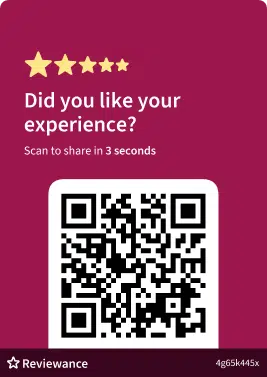
Instead of putting a QR code permanently on every table or wall, we can show the QR code directly from a phone when a customer is genuinely happy with their experience. A member of our team can simply open the Reviewance Mobile QR, show it to the customer, and let them scan it with their own phone. The customer doesn't need to search for our restaurant on Google, remember the name of our business, or find the correct Google Business Profile manually. They scan, tap, and can leave their feedback while the experience is still fresh.That small change made the process feel much more natural.
It also solved another problem that is particularly important in tourism: language and convenience. When you're serving people from many different countries every day, you don't want your staff explaining a complicated review process to every customer. The simpler the customer journey, the more likely people are to complete it.
Why QR Codes Work Well for Restaurants in Tourist Destinations
Restaurants are particularly well suited to QR code review collection because there is a natural physical moment when the customer is already holding a phone.They may already be taking photos of their food, checking directions, messaging friends, or paying digitally. Asking them to scan a QR code takes only a few seconds and doesn't require them to remember anything later.
We can use review QR codes at different customer touchpoints, including the checkout counter, table, receipt, takeaway packaging, payment area, or through a mobile device used by staff.But I've learned that placement isn't everything. Timing matters just as much.A QR code sitting on a table for six hours may become invisible. A QR code shown personally to a customer immediately after they say, "Everything was fantastic," is much more powerful.
The technology is simple. The customer psychology behind when you use it is what matters.
More Reviews Create a Stronger First Impression
One of the biggest benefits we've seen from consistently collecting reviews is that new customers arrive with more confidence. When a tourist sees a restaurant with hundreds of recent reviews, a strong rating, detailed customer experiences, and photos from real visitors, the business immediately feels less risky.
That matters because tourists have limited time.If someone has only three nights in a city, they don't want to waste one of those evenings on a disappointing restaurant. They are looking for evidence that their decision is likely to be a good one.Reviews provide that evidence.
A restaurant with ten reviews and a 4.9 rating may look less established than a restaurant with 1,500 reviews and a 4.8 rating. The second restaurant has demonstrated that hundreds or thousands of people have actually experienced it.That's why I focus not only on our average rating, but also on review volume, review recency, and the quality of the feedback customers leave.
Recent Reviews Are Especially Important for Tourist Restaurants
Tourist businesses change constantly.Menus change. Staff changes. seasons change. Prices change. New competitors open. Restaurants renovate. Experiences improve or sometimes decline. A review from five years ago can still be useful, but a traveler planning a trip today naturally wants to know what the restaurant is like now.
That's why maintaining a consistent flow of authentic customer reviews is important to us. Instead of thinking, "We already have enough reviews," I think about whether our current reputation accurately represents the experience we're providing today. If we have hundreds of happy customers every month, there is no reason our online reputation should remain frozen in the past.
Reviews Also Help Us Understand Our International Customers
There is another benefit I didn't expect when we started taking reviews more seriously. Our reviews became a source of customer intelligence.We started seeing patterns in what different types of visitors appreciated. Some customers repeatedly mentioned the atmosphere. Others talked about authentic local food. Families mentioned staff friendliness and menu flexibility. International visitors sometimes highlighted things we considered normal but that were particularly important to someone visiting from another country.
This information is extremely useful. Instead of guessing what tourists value, we can look at what they actually talk about after experiencing our restaurant. That helps us improve the customer experience, not just our online reputation.
What If a Customer Has a Negative Experience?
Not every customer will be happy, and no restaurant should expect that. One of the most valuable parts of a good customer feedback system is creating a way for customers to tell you when something went wrong. If someone had a problem with their meal, service, waiting time, or experience, we want to know about it. A private feedback channel can give management an opportunity to understand the problem and respond appropriately instead of discovering the issue later through a public review.
This is another area where Reviewance became useful for us. The goal isn't to hide negative experiences or manipulate reviews. The goal is to listen to customers and resolve problems quickly while making it easy for genuinely satisfied customers to share their experiences publicly. That distinction is important. A good review strategy should begin with a good customer experience.
How to Get More Google Reviews from Tourists
If I had to start again, I would focus on a few simple principles.
First, I would make the request immediately after a positive customer interaction rather than waiting until the customer has left. Second, I would make the process as simple as possible because every additional step reduces the chance that someone will complete it. Third, I would train staff to recognize natural moments to ask rather than forcing every employee to use exactly the same script with every customer.
I would also make review collection part of the normal customer journey rather than treating it as a separate marketing campaign. A restaurant that serves hundreds of tourists every week has hundreds of opportunities to collect genuine feedback. The important thing is creating a system that captures those experiences consistently. And finally, I would track the results.
If you're asking customers for reviews but don't know how many people are scanning, how many are completing the process, or how review volume changes over time, you're essentially guessing.
Why I Take Google Reviews Seriously Today
I used to think Google Reviews were something that happened after the real business was done. Now I see them differently. For a tourist restaurant, the review is often part of the beginning of the next customer's experience. Someone may discover us on Google, read a review written by a traveler from another country, look at the photos, compare us with nearby restaurants, and decide to visit because that previous customer gave them confidence.
That means the experience we provide today can influence the customer who walks through our door next week.Reviewance helped us turn that process from something passive into something we actively manage. With Reviewance Mobile QR, we can ask happy customers for feedback at the right moment, without filling the restaurant with permanent signs or making the process complicated for staff.
We still focus on the things that matter most: good food, great service, cleanliness, atmosphere, and making visitors feel welcome. But now, when a customer tells us they had a wonderful experience, we don't simply say goodbye. We give them an easy way to tell the next traveler.
Final Thoughts: Your Next Customer May Already Be Reading Your Reviews
If you run a restaurant, hotel, tour company, attraction, or another tourist-focused business, your next customer may already be researching you before they arrive. They may be sitting in another country, looking at your Google Business Profile and comparing you with five other businesses. They don't know your staff. They haven't tasted your food. They haven't experienced your service.
But they can read what your previous customers experienced.That's why I believe Google Reviews have become one of the most important assets for a tourist business. And if you already have happy customers, the opportunity isn't necessarily to find more people who love your business. It's to give the people who already love it an easy way to tell the world. That is what we use Reviewance for.